UN Breaks Silence: General Assembly Recognizes Iran’s 1988 Massacre of Political Prisoners in Landmark Resolution
Iran Freedom
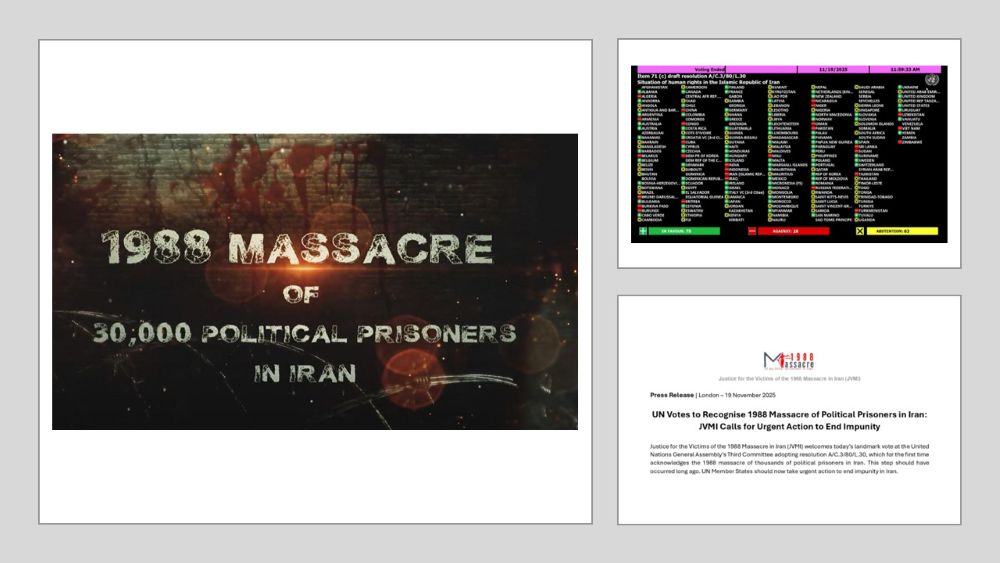
On 19 Nov 2025, the UN Third Committee adopted its first resolution recognizing the 1988 massacre of political prisoners in Iran.
Historic UN Vote Marks First Official Recognition of 1988 Massacre
In a groundbreaking development, the United Nations General Assembly’s Third Committee adopted resolution A/C.3/80/L.30 on November 19, 2025, explicitly recognizing the 1988 massacre of thousands of political prisoners in Iran for the first time. The vote passed with 79 countries in favor, 28 against, and 63 abstentions, signaling a shift toward addressing decades of impunity for human rights violations in the Islamic Republic.
This resolution on the human rights situation in Iran references the atrocity in paragraph 29, expressing “serious concern at the lack of accountability” for enforced disappearances, extrajudicial executions, and the destruction of evidence and grave sites—echoing the 1988 summary and arbitrary executions. It highlights how such impunity enables ongoing violations and incitement to violence in state-linked media.
The UN General Assembly's Third Committee adopted resolution A/C.3/80/L.30 (https://t.co/HxC5OQyfBf) on the human rights situation in the Islamic Republic of Iran by 79 votes in favour, 28 against, and 63 abstentions. 📺Voting details: https://t.co/qNkJmoJe0X (from 1hr 25min).…
JVMI Hails Resolution as Critical Step, Demands Immediate Investigations
Justice for the Victims of the 1988 Massacre in Iran (JVMI) welcomed the adoption as a long-overdue acknowledgment of crimes against humanity. “This step should have occurred long ago,” stated JVMI in a press release from London. The organization, which has campaigned since July 2016 for international recognition, noted that the UN Special Rapporteur on Iran concluded in 2024—after a six-year investigation—that the 1988 executions and disappearances constitute ongoing crimes against humanity and genocide.
Yesterday the UNGA Third Committee adopted a resolution on the human rights situation in Iran which, for the first time, references the #1988Massacre, the first official acknowledgement by the global community of those crimes against humanity.
— Justice for the Victims of 1988 Massacre in Iran (@jvmifoundation) November 20, 2025
JVMI President Tahar Boumedra emphasized the urgency: “Today’s vote must be more than symbolic. With Iran’s authorities threatening to repeat the 1988 massacre, the international community has a duty to prevent the execution of political prisoners. Governments must move beyond words to ensure accountability for Iranian officials, end systemic impunity, and prevent further executions of dissidents.” The group urges all UN member states to support the resolution in the General Assembly plenary in December and to launch criminal investigations against officials implicated in the 1988 crimes and recent executions targeting dissidents, particularly those affiliated with the People’s Mojahedin Organization of Iran (PMOI or MEK).
Maryam Rajavi Calls for UN Access to Prisons and Referral to Security Council
In a message to the Human Rights Conference in Geneva, Mrs. Maryam Rajavi, President-elect of the National Council of Resistance of Iran (NCRI), praised the resolution as an “important step” following the UN Special Rapporteur’s July 2024 report. She linked it to the broader fight against the regime’s “ongoing killings and bloodbath” in prisons, describing the slaughter as Supreme Leader Ali Khamenei’s war on the Iranian people.
Mrs. Rajavi recalled the assassination of Prof. Kazem Rajavi in Geneva in 1990, an advocate for the 1988 victims, and criticized decades of international silence that followed Massoud Rajavi‘s 1988 revelation of Ayatollah Khomeini’s edict ordering the massacre. She highlighted escalating executions: 865 in 2023, 1,000 in 2024, and 1,650 in 2025 so far, including political prisoners like Zahra Tabari and Javad Vafaei Sani.
Mrs. Rajavi demanded the UN refer Iran’s human rights violations to the Security Council, invoke universal jurisdiction to prosecute regime leaders for genocide and crimes against humanity, and pressure for access to prisons—especially for long-term inmates like Maryam Akbari Monfared and Gholam-Hossein Kalbi. “The notorious Saydnaya prison of the Syrian dictatorship collapsed last December; Evin and other prisons of Khamenei will also collapse,” she declared, vowing an Iran free of executions through organized resistance and uprisings.
It is encouraging that the 3rd Committee of the UN General Assembly, in its resolution, referred to the massacre of political prisoners in Iran in 1988.pic.twitter.com/t6JH5EndC6
Alarming Recent Threats and Executions Heighten Urgency
The resolution’s timing is stark amid rising threats. On July 7, 2025, Fars News—affiliated with the Islamic Revolutionary Guard Corps (IRGC)—openly called for repeating the 1988 executions. Just weeks later, on July 27, political prisoners Mehdi Hassani and Behrouz Ehsani were executed for PMOI affiliation, with at least 17 others sentenced to death in recent months on similar charges.
These events underscore JVMI’s and Rajavi’s warnings: the regime’s execution spree is part of a strategy including regional destabilization and nuclear expansion. As JVMI tweeted post-vote, “It’s time for governments around the world to hold the perpetrators of those crimes against humanity accountable” and “end impunity in Iran.”
Background: The 1988 Massacre and Legacy of Impunity
The 1988 massacre saw Iran’s government execute an estimated 30,000 political and ideological prisoners in a matter of months, based on a fatwa by then-Supreme Leader Ayatollah Ruhollah Khomeini targeting the PMOI. “Death Commissions”—three-member panels—interrogated inmates, executing those who refused to renounce their beliefs. A second wave targeted leftist groups. Victims were buried in secret mass graves, their names and locations withheld.
Despite global revelations in 1988, the international community remained silent, allowing perpetrators to evade justice. Today, this impunity persists, fueling calls for action to honor the victims and prevent recurrence.