



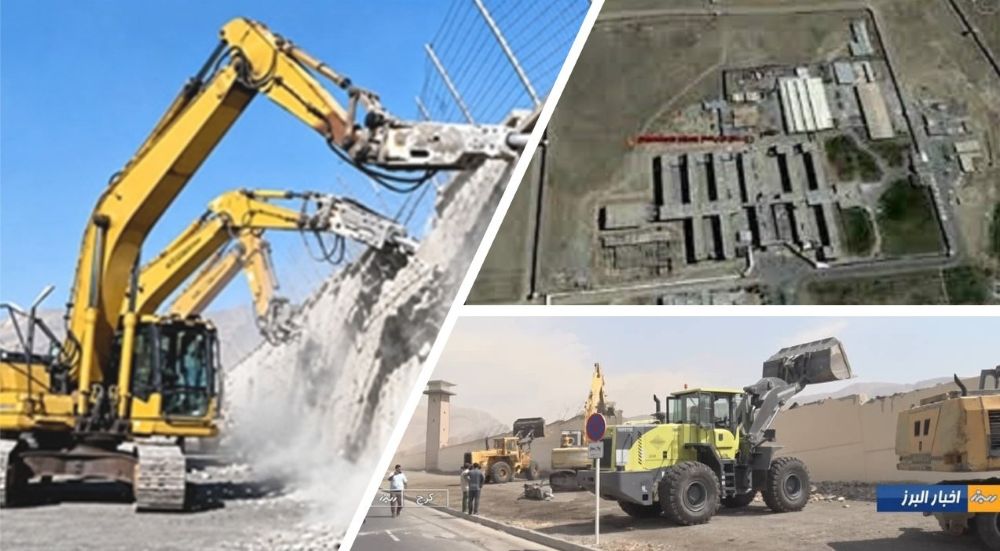
The demolition of a key site linked to the 1988 massacre has prompted calls for urgent international action to preserve evidence.
Iranian authorities have begun demolishing Gohardasht Prison in Karaj, one of the principal sites associated with the detention and execution of political prisoners during the 1988 massacre. According to the National Council of Resistance of Iran (NCRI), demolition began on September 13, with officials planning to remove the surrounding walls within a month and clear the site for residential and commercial development.
Gohardasht holds significant historical and evidentiary importance. Survivors have described its isolation cells, torture chambers, corridors, and notorious “Death Hall,” where political prisoners were taken during the mass executions. Testimonies, sketches, and three-dimensional reconstructions of the prison later became important evidence in the Swedish prosecution of former Iranian prison official Hamid Noury.
The demolition has raised concerns that physical evidence could be permanently lost before independent investigators have an opportunity to examine and document the site. Architectural features and prison records could help corroborate survivor accounts and establish how prisoners were taken to execution locations.
🚨 Iran's state TV airs footage of the destruction of Gohardasht Prison, where thousands of political prisoners were extrajudicially executed during the #1988Massacre.
A blatant attempt to destroy evidence of crimes against humanity.
CC: @drmaisato @volker_turk @AgnesCallamard pic.twitter.com/toB921hzZC
— M. Hanif Jazayeri (@HanifJazayeri) September 15, 2026
The report also highlights previous allegations of interference with mass graves and burial sites associated with political executions across Iran. In a July 2024 report, then-UN Special Rapporteur on Iran Javaid Rehman warned of a systematic campaign to destroy mass graves linked to thousands of political prisoners executed in 1988.
J. Kenneth Blackwell, a former U.S. ambassador to the UN Commission on Human Rights, calls on the United Nations to urge Tehran to halt further demolition until independent experts can document the site. He also urges governments to demand the preservation of prison registers, architectural plans, execution records, photographs, personnel files, and other relevant archives.
Excellent commentary by Amb. @kenblackwell: "Iran is bulldozing a crime scene — and the UN is standing by"https://t.co/n5BfaPtNRW @realDonaldTrump @SecRubio @amnesty @AmnestyIran @drmaisato @volker_turk
— Ali Safavi (@amsafavi) September 17, 2026
The article emphasizes that preserving Gohardasht is not simply about protecting a historical building, but about safeguarding potential evidence for future investigations and prosecutions. Families of the victims, many of whom were denied the bodies or burial locations of their loved ones, continue to seek truth and accountability nearly four decades after the massacre.