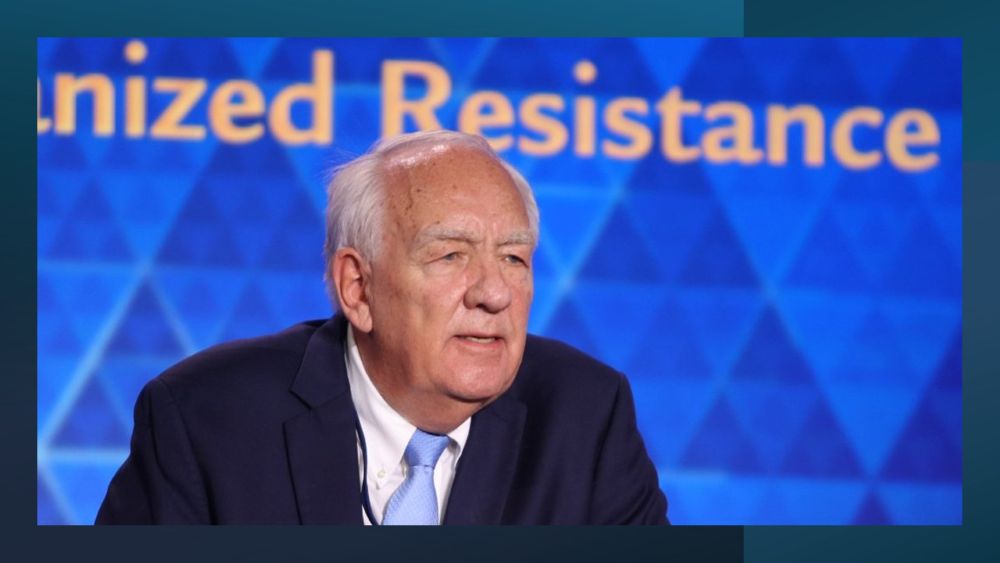
At the Free Iran World Summit 2025 in Rome on July 31, Ambassador Stephen Rapp, former U.S. Ambassador-at-Large for Global Criminal Justice and former Chief Prosecutor at the Rwanda Tribunal and the Special Court for Sierra Leone, delivered a compelling speech urging the international community to hold Iran’s regime accountable for its longstanding crimes against humanity.
Rapp condemned the alarming rise in executions under the Iranian judiciary, noting nearly 1,000 hangings in 2024 and 700 more already in 2025. He warned of the risk of repeating the 1988 massacre, in which 30,000 political prisoners were killed. He described how the regime continues to use torture, sham trials, and baseless charges to crush dissent, often targeting individuals whose only “offense” is advocating for a free and democratic Iran.
Drawing from his experience in prosecuting mass atrocities in Rwanda, Sierra Leone, and Bosnia, Rapp asserted that justice for Iran’s victims is achievable—but only if the global community treats it as a priority. He stressed the importance of building credible legal cases, identifying perpetrators, and denying them any safe haven.
Rapp firmly warned that compromising justice in exchange for political agreements with Tehran would only fuel further impunity. He called for a coordinated international effort to uncover the truth and hold those responsible accountable. In closing, Rapp emphasized that real change in Iran must include justice for victims and survivors—a message that resonates far beyond Iran’s borders: crimes against humanity will not be tolerated.
The full text of Ambassador Rapp’s speech follows.
Ambassador Stephen Rapp: Justice Must Prevail for Iran’s Victims
A Future for a Free and Just Iran
Thank you.
It is a great honor to be with you, because in this room and on the screen from Ashraf 3, on the screen from the streets of Tehran, and in the presence of your great elected leader, Maryam Rajavi, I see the future of a free Iran.
But it will require a great deal of work. And I’m here because I’m ready to work with you to achieve that end, to achieve change in Iran, a democratic future for that country, but a country in which there is justice, in which those who have committed these crimes will face the victims and survivors and be held to account.
A Wave of Executions: Silencing Dissent through Fear
We meet today at a time when the Iranian judiciary, this regime’s judiciary, is committing a torrent of executions. In 2023, 850 people were hanged. In 2024, it was almost 1,000. In this seventh month of 2025, the number has reached 700. And if that rate continues, it’ll be a new record in this decade. But of course, we all fear that that number could accelerate. We’re not talking here about numbers; we’re speaking of individuals. I saw earlier today here in pictures that people held in their hands, and outside the hall, the photos of Behrouz Ehsani and Mehdi Hassani who were executed, hanged, just this Sunday morning. All of these hundreds that have been hanged and executed during these last two years were fathers and mothers, sisters and brothers, sons and daughters. I’m here today, and I think all of us are here today, to say that those victims are not forgotten. And to say to the survivors, so many in this room, that you’re not alone, that we’re with you, and that the day of justice will arrive.
Now, we see what this regime is doing. It’s not charging anyone for any conduct, any acts of terror. It’s charging people for phony crimes like “enmity against God” or “corruption on earth,” based upon confessions elicited under brutal torture that are ridiculous in their facts and found by judges after trials of only minutes. What the regime is doing is trying to suppress dissent, trying to suppress the pent-up desire for change in Iran, trying to put people in fear, trying to terrorize its own population.
1988 Massacre: A Crime Against Humanity
And now we fear that it could accelerate, that we could be headed for another time like that awful period in 1988—the victims of which we see commemorated outside this hall—when 30,000 men and women, girls and boys, were brutally, judicially murdered by this regime, charging them with holding on to beliefs when the only belief that they held on to was the idea that Iran could be a normal country, a country in which its people could decide how they would be ruled.
Now we’re hearing from the Fars News Agency, the news arm of the Islamic Revolutionary Guard Corps, in an editorial two weeks ago, that those death sentences, those Death Commissions, were a “successful historical experience.” Well, that experience, those crimes, then and now, are crimes against humanity. They’re crimes against not only the people of Iran but against all of humankind that can be prosecuted in the dozens of countries that have put crimes against humanity in their statutes, and in any international court or tribunal that might be established in the future.
Amb. Stephen Rapp seeks justice for Iran's ongoing crimes against humanity:
Fars News calls the #1988Massacre a ‘successful historical experience.’ Those crimes, then and now, are crimes against humanity, prosecutable in dozens of countries and in any future international court. pic.twitter.com/WYxVIuwnbv
— M. Hanif Jazayeri (@HanifJazayeri) August 4, 2025
I come here because I’m an individual that’s been involved in prosecuting those cases. I came from the United States, a prosecutor, a US Attorney, like Mayor Giuliani. And we put bad guys away in Iowa too. You may have had more of them in New York. I do remember your visit to my office in ’97 when I was US Attorney. But I left there in 2000, went to the Rwanda Tribunal to prosecute those responsible for the murder of 800,000 men, women, and children in a period of only 100 days…
Justice as a Human Right, Not a Bargaining Chip
Why is it so important? Obviously, we all and Syrians certainly dreamed of political change, of a day that they never thought would arrive when they’d be in control of their own fate. Isn’t that enough? No, it’s not enough. Those victims and their survivors are entitled as a matter of international human rights to know the truth of what happened, to have their case investigated, and to have their perpetrators held to account. And it’s also important for people elsewhere, in other parts of the world, where similar dictatorial regimes may try to do the same thing to hold on to power, to hold on to the wealth and control that it provides them. It sends a message to each of them that you will never have a day’s rest in this life. But there will come a day, when you will be arrested, when the jail door will close behind you, and you will have to face the victims and survivors of the crimes that were committed.
What’s needed? It clearly takes more than words. First of all, it takes a commitment not to trade away justice. One could sadly imagine that if the regime today said, “Oh, we’ll forget enrichment,” people would forget about justice. That can’t be the result. We’ve had in the past moderate-sounding leaders in Iran, and they said, “We’ll make changes, you just have to help us stay in power.” That’s not an offer. That’s not an offer that can’t be accepted. There has to be justice.
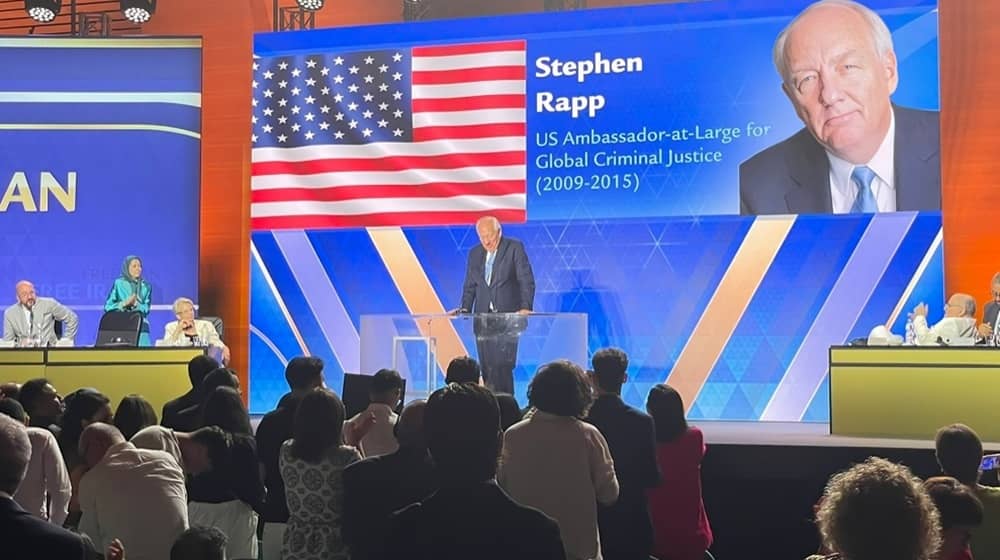
It also takes the kind of thing that we’ve had in Syria. More than UN commissions, more than the great special rapporteur that wrote the report and found that these were international crimes that were committed in 1988—and that was an extremely important declaration to come from the international community. More than the fact-finding mission established by the Human Rights Council. They will write reports. But as I know as a prosecutor, when it comes to actually holding people to account, you can’t just put in a report and say, “He’s guilty.” You need evidence that meets judicial standards. You need to be able to identify the perpetrators that are available. You need to find the people that are traveling internationally. You need to find those actors that are non-Iranian that are assisting this regime, whether they’re persons or companies that are making these crimes happen. And you need to have evidence to hold them to account.
So let me say here that what we need is a campaign. The campaign that you’ve waged for political change, but a campaign for justice, to bring this to the highest level on the agenda of the international community. To insist on the effort for justice, for the development of evidence, for the pursuit of the perpetrators, for cooperation between countries so that when one is found in a country that doesn’t have jurisdiction or capacity, they will be extradited to another. That kind of commitment is essential. And the signaling of that commitment is essential to preventing the crimes of 1988 from being committed again in this decade.
The world’s resolve will not be measured by words. It requires action. And let us begin here this action for justice. Then we can see a future in which the victims and survivors of the crimes that affected everyone in this room and people across Iran—and that are a threat to all of humankind—will see the perpetrators of those crimes brought to justice and a free Iran begin tomorrow.
Thank you.