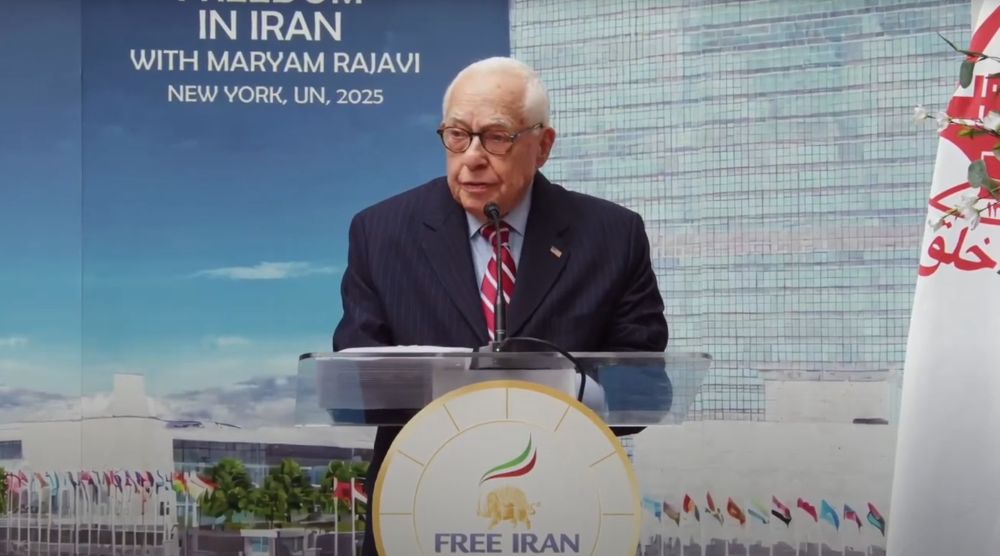
On September 24, 2025, the second day of a large demonstration by Iranian Americans and supporters of the Iranian Resistance in New York, thousands gathered outside the United Nations headquarters to protest the presence of regime president Masoud Pezeshkian at the UN General Assembly.
Former U.S. Attorney General Judge Michael Mukasey, a keynote speaker at the event, declared that the Iranian regime is weaker than it has been in decades. The crowd also voiced strong support for the National Council of Resistance of Iran (NCRI) and its president-elect, Maryam Rajavi, chanting: “No to the Shah, no to the mullahs—yes to a democratic republic.”
Mukasey emphasized, “Conditions are now more favorable for the regime’s collapse than at any time in recent history.” He dismissed the idea that Pezeshkian could bring change, calling him “merely a mouthpiece for the mullahs,” and rejected monarchist claims by stating, “the Shah’s son and his supporters have no legitimacy to lead.”
He strongly endorsed Maryam Rajavi’s Ten-Point Plan as the only viable path forward for Iran, highlighting the need for democracy, gender equality, rule of law, and a non-nuclear government.
Mukasey urged for meticulous documentation of the regime’s atrocities, including massacres, sham trials, and executions, to hold perpetrators accountable once change occurs. He concluded, “Now is the time to increase our efforts against the regime and prepare for the moment when those efforts succeed.”
The full text of Judge Michael Mukasey’s speech follows:
Thank you very much for that kind introduction and thank you all for being here. Particularly warm greetings to the residents of Ashraf, who I understand are watching this today. This is the 60th year since the founding of the MEK. Of course, a lot has changed in that time, although in a sense, a lot has not changed. The MEK was founded to oppose the tyranny of the Shah. It continues to oppose tyranny: since 1979, the tyranny of the Mullahs.
The late Senator Joseph Lieberman, a great friend of the MEK, a personal friend of mine, and a law school classmate, referred to Iran as the unfinished business of the 20th century. It still is the unfinished business of the 20th century.
We’re meeting today across the street from the headquarters of the United Nations—an institution that should have been of help. A man named Masoud Pezeshkian has come to the United Nations to attend the UN General Assembly, claiming to represent Iran. But of course, all he represents is the tyrannical regime of the Mullahs that for the moment controls the country.
When Pezeshkian took office, another law school classmate of mine circulated an email to the class, saying that we should all be encouraged because it’s likely he will be more liberal than Ebrahim Raisi, the mass murderer who was his immediate predecessor. The reason why my classmate thought Pezeshkian was likely to be liberal is that he is a physician, a cardiologist who practices the healing arts, and so, surely, he must be humane.
As I pointed out to my classmate and to the others at the time, Bashar al-Assad of Syria, who killed hundreds of thousands of his own citizens, is a physician. The late Ayman al-Zawahiri, who succeeded Osama bin Laden as head of Al-Qaeda, was a physician. And Josef Mengele, who conducted experiments on concentration camp inmates during World War II, was a physician. So, we should not take a lot of encouragement from Dr. Pezeshkian’s medical credentials. Sure enough, he is simply a mouthpiece for the Mullahs, as he himself has conceded.
But even if Pezeshkian is not much of an improvement, as to matters not within the control of the regime, things do seem much improved. For the first time since I started addressing gatherings like this in 2009, we can be less concerned with the possibility that the regime may get an atomic bomb. Those ambitions were dashed in the past several weeks. We can also take encouragement from the fact that the Europeans have started the process of putting in place the snapback sanctions that the regime has been dreading, which will likely make its precarious economic situation even shakier. Even before those sanctions go into effect, the regime cannot even provide its citizens with reliable supplies of electricity and water.
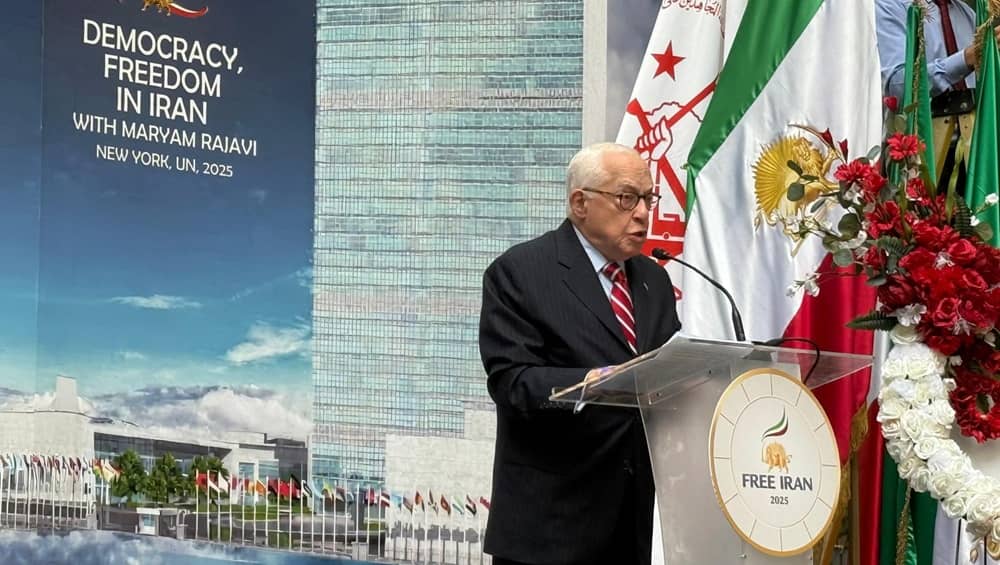
I don’t think it’s an overstatement to say that conditions are more favorable now for the collapse of the regime than they have been in decades. Unfortunately, one symptom of this good news is the bad news that the regime has reverted to an accelerated campaign of executions and repression as the only way of trying to stay in control. However, even in the face of this brutality, the Iranian people demonstrate against the regime and make it clear that they blame the regime, and not the nations opposing the regime, for the harsh conditions in the country.
There are several things that we can do from outside the country to help bring about better days for the Iranian people. First, we should make it clear to our own governments that the only viable alternative for the Iranian people and the rest of the world is regime change.
Second, we must make it clear that that change must be complete and reject the suggestion of self-serving fools like the son of the shah and members of his clique, that the people of IRGC and MOIS can help us establish a new order in Iran or that his connection to the corrupt regime of the shah somehow gives him credentials for leadership in a new government. We must make it clear to the media that he has no standing whatsoever to claim leadership authority.
Third, we should prepare for the day when the Mullahs and those who support them can be made to face justice by compiling a record—through testimony and documentation—of what they did: the massacres, the phony trials, the executions, so that the evidence is at hand. And finally, we should make it clear that any new order must be based on principles of democracy, equality of all men and women before the law, and a non-nuclear government—principles that are outlined by Mrs. Rajavi in her Ten-Point Plan.
In short, this is the time to redouble our efforts against the regime and to prepare for the day when those efforts succeed. The people in Ashraf who are watching this rally already know this. We have to get the message to those outside the country and to the world at large.
Thank you very much for being here.