A New Generation at the Center of Iran’s Democratic Struggle
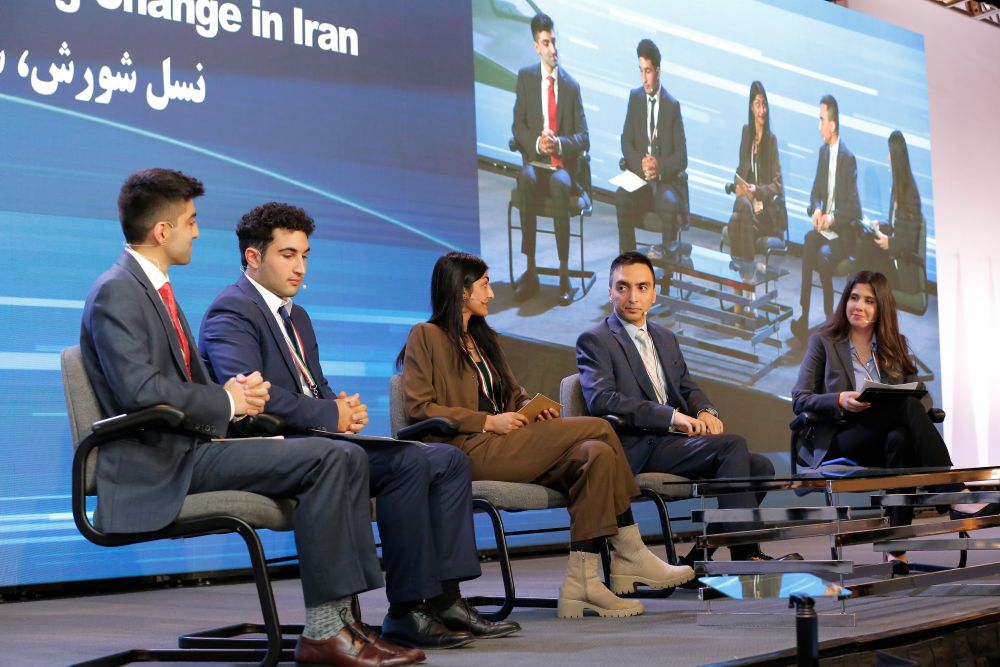
The fourth session of the Free Iran Convention 2025, titled “The Power of Youth in Driving Change in Iran,” spotlighted Iran’s new generation as the decisive engine of the country’s freedom movement. From high-risk activism inside Iran to professional leadership abroad, speakers underscored how Gen-Z’s courage, digital fluency, and global advocacy are reshaping the future of Iran’s democratic transition.
Nicole Shariati: “This Generation Turns Fear Into Fire”
Panel moderator Nicole Shariati, cybersecurity consultant and daughter of a former political prisoner, opened the session by grounding the discussion in personal history and national sacrifice.
She described the regime’s decades-long attempt to break young Iranians through fear, humiliation, and bloodshed—an effort she declared has ultimately failed.
-
Iran’s youth “refuse to surrender their future.”
-
Despite university closures, censorship, and violent crackdowns, they continue to organize at personal risk.
-
MEK-affiliated Resistance Units represent “the beating heart of this movement.”
Shariati emphasized that the youth have transformed “pain into power, oppression into organization, and fear into fire,” forming the backbone of Iran’s democratic future.
Nicole Shariati: As the daughter of a political prisoner, I stand with Iran’s youth resisting fear and repression. Despite arrests and media bans, they connect, organize, and refuse to surrender their future. #FreeIranConvention2025 #NCRIAlternative https://t.co/Gz3MzicTKf
— Iran Freedom (@4FreedominIran) November 15, 2025
Mohammadreza Hesami: Growing Up Under a System That Suffocates Ambition
Mohammadreza Hesami, senior medical dosimetrist, delivered a powerful personal account of adolescence under the Islamic Republic:
-
Young people naturally hope to “be the best version of themselves,” but the regime polices appearance, ideology, and behavior.
-
Life feels like being in a “prison,” with limited options: accept oppression, flee, or resist.
-
The regime fears confident youth because “the moment people stop feeling afraid is the moment the regime collapses.”
He cited imprisoned students Ali Younesi, Amir Hossein Moradi, and death-row youth activist Ehsan Faridi as evidence of a dictatorship terrified of independent thinkers.
“The regime hasn’t failed at suppressing,” he said. “They fear a generation that no longer believes in them.”
Mohammadreza Hesami: Youth want to grow, dream & have a future. But the regime suppresses hopes, controls ideology, and punishes dissent. This broken system forces youth to choose humiliation, exile, or resistance. #FreeIranConvention2025 #NCRIAlternative https://t.co/JFM9HxebGG
— Iran Freedom (@4FreedominIran) November 15, 2025
Mahrana “Mickey” Mohammadi: A Youth-Centered Roadmap for Iran’s Future
Mahrana “Mickey” Mohammadi, J.D. candidate at Penn State Dickinson Law, outlined how the MEK’s youth-focused roadmap could transform Iran:
-
Dismantling IRGC monopolies to free Iran’s economy and launch a national youth entrepreneurship fund.
-
Restoring free and open universities, turning campuses into centers of thought—not ideological control.
-
Guaranteeing women’s leadership, including repeal of compulsory hijab laws and discriminatory regulations.
-
Independent judiciary as the core of democracy and rule of law.
She credited Maryam Rajavi’s Ten-Point Plan for providing youth with clarity, structure, and a democratic vision grounded in equality and justice.
Mahrana Mohammadi: Maryam Rajavi’s plan tackles IRGC monopolies strangling Iran’s youth economic future. Stolen assets must fund youth entrepreneurship to empower young Iranians to create, build, and think freely. #OurChoiceMaryamRajavi #NCRIAlternative https://t.co/aV6t9IH1IA
— Iran Freedom (@4FreedominIran) November 15, 2025
Ryan Nasir: Resistance Units as the Front Line of Youth Activism
Ryan Nasir, computer science student and R&D intern, described the Resistance Units as:
-
“The tip of the spear” of Iranian society.
-
Comprised of nurses, students, workers, and young professionals across all 31 provinces.
-
The force keeping hope alive “in a land full of darkness.”
He explained that simple acts like writing slogans or filming public defiance signal one truth:
“The regime is not ten feet tall.”
Nasir emphasized the synergy between Resistance Units inside Iran and the NCRI abroad—a relationship built on decades of sacrifice from the MEK, from the 1988 massacre to the struggles of Camp Ashraf.
Ryan Nasir: The #ResistanceUnits are the spearhead of Iran’s fight, embedded in every province and part of society—students, workers, youth. Despite arrests and repression, they grow stronger and fearless, lighting hope in a dark, oppressive land.https://t.co/CnKfOp9DOt
— Iran Freedom (@4FreedominIran) November 15, 2025
Seena Saiedian: Why Iran’s Youth Choose Regime Change, Not Reform
Seena Saiedian, J.D. candidate at the University of Virginia School of Law and Karsh-Dillard Scholar, delivered a deep analysis of why Iran’s youth overwhelmingly demand regime change:
-
This generation has known only repression: high inflation, unemployment, surveillance, and imprisonment of students for mere association with the MEK.
-
Decades of “reformist” presidencies produced only more brutality and censorship.
-
Every uprising—from 2009 to 2022—has rapidly evolved into demands targeting the regime itself.
Saiedian said young Iranians are emboldened because they see a viable democratic alternative: the NCRI and the MEK.
He highlighted why the MEK resonates:
-
A principled commitment to democracy
-
Organizational capacity
-
Institutional safeguards for free elections
He emphasized that the MEK’s credibility is grounded in sacrifice—from rejecting theocracy in 1979, to enduring the 1988 massacre, to surviving the 2018 terror plot in Paris.
Fake opposition figures, he argued, offer no structure or principles and appear only during uprisings.
“Iranians don’t want to go back—they want to go forward.”
In closing, Saiedian stressed that each uprising becomes “more radical and more widespread” because the youth now believe a democratic future is not only necessary—but achievable.
Seena Saiedian: Young Iranians see no hope under a regime of repression, inflation, and halted progress. Yet each uprising unites the people in a call for regime change—not reform—as corruption and terrorism rule every level. #FreeIranConvention2025 https://t.co/PpCnEx5zKk
— Iran Freedom (@4FreedominIran) November 15, 2025