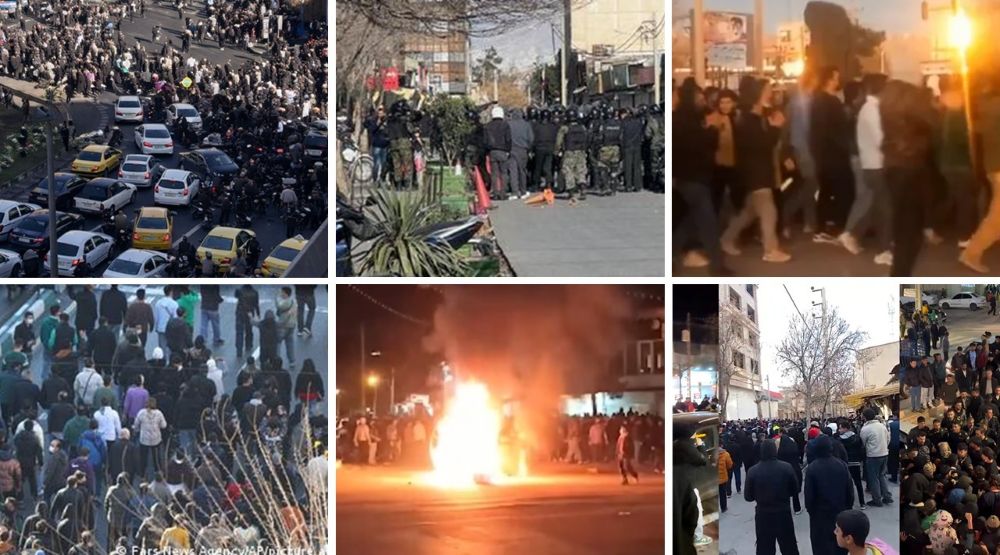
Iran Protests entered their fifth consecutive day on Thursday, January 1, 2026, marking a decisive shift from economic demonstrations to an open nationwide challenge against the clerical regime. What began on December 28, 2025, as protests by merchants against the collapse of the national currency has evolved into widespread urban resistance across dozens of cities, with protesters directly confronting security forces and attacking regime institutions.
Escalation to Urban Resistance in Western Iran
One of the most intense flashpoints on day five was Lordegan in Chaharmahal and Bakhtiari province. Security forces opened fire on unarmed protesters, resulting in at least two deaths and multiple injuries. Despite the use of live ammunition, demonstrators advanced on regime centers, occupying and heavily damaging the governorate building, the judiciary, and the local office of the Foundation of Martyrs.
More footage of intense situation in Lordegan as security forces try to stop anti-regime protests through force and bullets and demonstrators continue to resist. Locals report that there are casualties as security forces directly opened fire on civilians.#IranProtests pic.twitter.com/V5ITSfrThY
— People's Mojahedin Organization of Iran (PMOI/MEK) (@Mojahedineng) January 1, 2026
Similar confrontations spread across western provinces. In Azna, rebellious youth attacked the main police station, setting the building and several State Security Force vehicles on fire. In Nurabad, protesters overturned a security vehicle, while in Delfan, an IRGC intelligence vehicle was torched. In Farsan, demonstrators surrounded a Basij base, signaling a shift from protest to active siege of regime installations.
January 1—Azna, western Iran
Protesters occupied a base of security forces and set fire to a vehicle of the regime's repressive forces.#IranProtests pic.twitter.com/dtN2RkI6JD— People's Mojahedin Organization of Iran (PMOI/MEK) (@Mojahedineng) January 1, 2026
Nationwide Spread of Protests and Street Battles
Iran Protests expanded rapidly to central and southern regions. In Shiraz, Kavar, Marvdasht, and Firuzabad, large crowds chanted “Death to the dictator” while blocking roads with fire. In Marvdasht, security forces fired on people’s cars, but protesters fought back, forcing agents to retreat and torching a police vehicle.
In Isfahan province, demonstrations continued in multiple cities, including Shahin Shahr and Semirom, where an SSF vehicle was set ablaze. In Junaqan, protesters set fire to the office of the Supreme Leader’s Friday prayer representative. In Arak and Khomein, clashes that began earlier continued, with crowds chanting, “This is the year of blood, Seyyed Ali will be overthrown.”
Qom Joins the Iran Protests
A major symbolic blow to the regime occurred as protests erupted in Qom, the ideological heart of the clerical establishment. Demonstrators clashed with security forces and forced them to retreat while chanting slogans such as “Mullahs must get lost” and “Don’t be afraid, don’t be afraid, we are all together.” The protests in Qom signaled a direct rejection of the ruling clergy from within its traditional power base.
Protesters in Qom chanting, "Cannons, tanks, firecrackers, mullahs must get lost!"#IranProtests pic.twitter.com/48rHw8PV7O
— People's Mojahedin Organization of Iran (PMOI/MEK) (@Mojahedineng) January 1, 2026
Strikes and Economic Paralysis Across Key Cities
Parallel to the street protests, Iran Protests continued to paralyze major economic hubs. In Tehran, the central Fruit and Vegetable Market remained on strike for a second consecutive day despite repeated attempts by security forces to disperse protesters with tear gas. Demonstrators chanted “Death to Khamenei,” underscoring the political nature of the uprising.
In Kermanshah, a 100 percent strike shut down the city’s commercial center, prompting authorities to impose a temporary internet blackout. Markets in Isfahan, Hamedan, and the southern port of Bandar Ganaveh also remained closed, with merchants vowing to keep shutters down indefinitely.
Crackdown on Students and Youth Resistance
The regime intensified pressure on universities, raiding dormitories at Beheshti University in Tehran during the night and arresting several female students. Despite this crackdown, student protests continued. In Mashhad, students at Khayyam University demonstrated and chanted, “Students would rather die than live in humiliation.”
January 1—Tehran, Iran
Melli (Beheshti) University
Security forces attacked students’ dormitory after midnight.
Students resisted to prevent their classmates from being arrested.
Security forces reportedly abducted students in their raid.
At least one student hospitalized after… pic.twitter.com/MZWs8mnpMr— People's Mojahedin Organization of Iran (PMOI/MEK) (@Mojahedineng) January 1, 2026
Youth resistance remained a defining feature of day five. In Hamedan, Asadabad, and Islamabad-e Gharb, protesters stood their ground despite live fire and tear gas, forcing security forces to withdraw in several instances.
Nightly Protests and Nationwide Slogans
As night fell, Iran Protests expanded into widespread nightly rallies. Demonstrations were reported in Ilam, Dehloran, Abdanan, Rasht, Qazvin, Bandar Abbas, Khorramabad, Shahin Shahr, and Harsin. In Bandar Abbas, women-led protests filled the streets with anti-government slogans. In Lali, protesters set fire to a statue of Qassem Soleimani.
January 1—Dehloran, western Iran
Locals hold anti-regime protest rallies and chant, "Down with Khamenei!"#IranProtests pic.twitter.com/SPQca3l8h3— People's Mojahedin Organization of Iran (PMOI/MEK) (@Mojahedineng) January 1, 2026
Across cities and provinces, chants of “Death to Khamenei” and “This is the year of blood” echoed through the streets, reflecting the protesters’ belief that the uprising has moved beyond reformist demands.
Economic Crisis Driving the Uprising
The Iran Protests remain rooted in a severe economic collapse. The national currency has fallen to around 1.45 million rials per US dollar, while food prices have surged by more than 70 percent. Protesters have increasingly linked economic hardship to political change, chanting slogans such as “Poverty, corruption, high prices, we’re going for regime change.”
By the end of the fifth day, the breadth and intensity of the Iran Protests—spanning strikes, urban resistance, and nightly demonstrations—highlighted a nationwide challenge that the regime has so far failed to contain through repression alone.