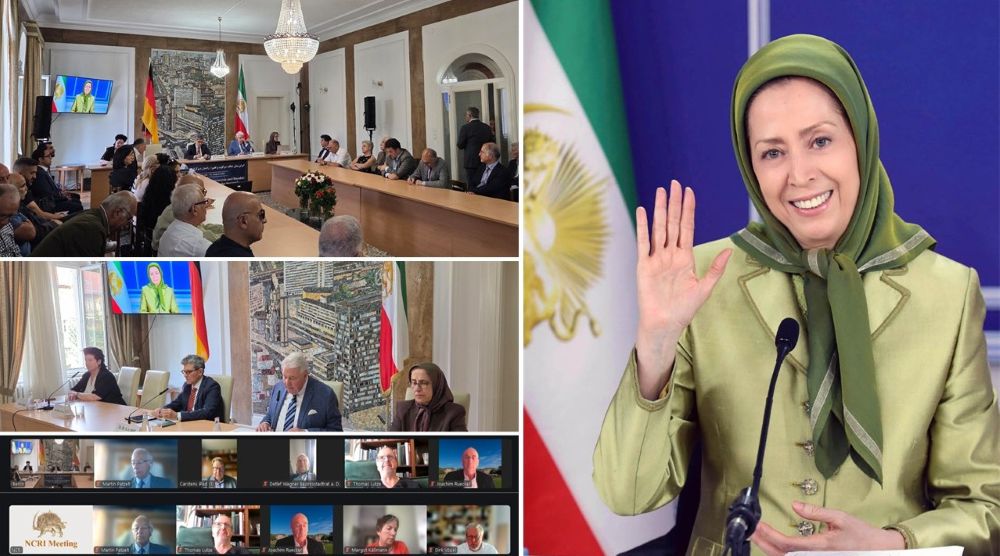
Message to Germany Conference Presents the Situation in Iran, Resistance Activities and a Plan for the Transfer of Power
The Main Conflict in Iran
In a message to a conference in Germany, Mrs. Maryam Rajavi, President-elect of the National Council of Resistance of Iran (NCRI), said that although the fires of external war had for now quieted, the main conflict between the people of Iran and religious fascism continued unabated.
The message described the situation as a confrontation between the Iranian people and the ruling system, with members of the PMOI and young people who had taken part in uprisings facing executions, while Resistance Units continued their operations and protests continued across the country.
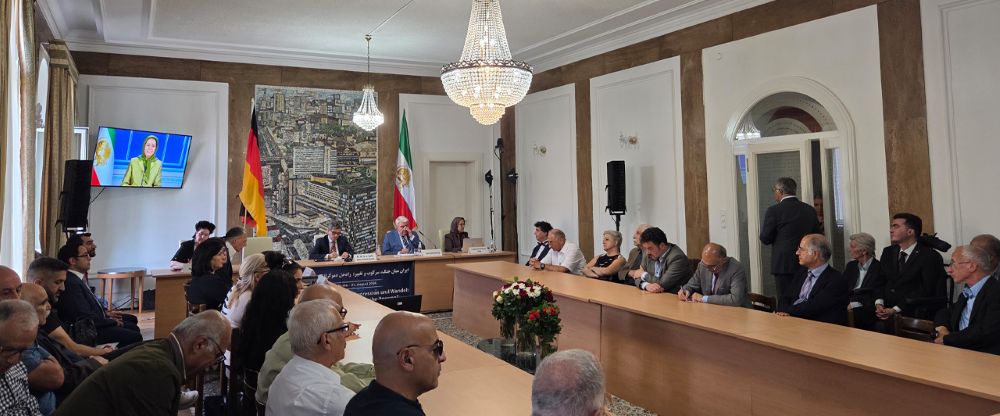
A conference was held in Germany in support of a democratic solution in Iran, featuring members of parliament, German dignitaries, and human rights advocates.
In a message to this conference about the major events of the past year, I answered questions about the path the Iranian… pic.twitter.com/4zKPOnjDWD
— Maryam Rajavi (@Maryam_Rajavi) August 31, 2026
Escalation of Suppression Under the Cover of War
The message referred to more than four decades of massacres and killings and noted that the period coincided with the 38th anniversary of the 1988 massacre of 30,000 political prisoners, more than 90 percent of whom were members of the PMOI.
It stated that the conflict had begun on June 20, 1981, and had continued for more than 45 years. The foreign war that began on February 28 was presented as a parenthesis within the primary conflict between the Iranian people and the regime.
The December 2025–January 2026 uprising and the killing of thousands of protesters were also addressed. The message stated that tens of thousands of people were arrested during the uprising and the days that followed, including 2,000 PMOI members and supporters who went missing.
The message said that the regime intensified its measures of control and suppression in the context of the war. It referred to the head of the judiciary declaring that the judicial branch had assumed a “full wartime posture” and to IRGC commanders announcing that “shoot-to-kill” orders had been issued against protesters.
Since the war began on February 28, 2026, the message said, the regime had mobilized its forces and kept them on the streets for six months to counter popular uprisings.
It also referred to a statement by Foreign Minister Abbas Araghchi that the streets had been essential to keeping the regime going alongside its missiles.
The Regime’s Strategy
The message set out three elements of the regime’s strategy to prevent its overthrow: executing members of the PMOI and arrested protesters, maintaining an atmosphere of war, and deploying its forces on the streets.
At the same time, resistance and protests were described as expanding. Resistance Units continued their operations against repression, while protesting prisoners in more than 60 prisons carried out hunger strikes every Tuesday under the “No to Executions Tuesdays” campaign.
Workers, retirees, nurses and citizens who had lost their assets also took part in street protests. The message cited slogans calling for an end to warmongering and for rights to be secured through street protests.
The Regime’s Internal Situation
The message addressed the regime’s struggle for survival and its efforts to conceal its situation. It referred to the memorandum of understanding signed with the United States on June 17.
The memorandum was described as providing political and economic benefits to the regime. At the same time, the message said that the ruling system viewed moving forward with the agreement as a threat to its authority.
It also referred to disputes at the highest levels of power. The new Supreme Leader viewed ending the war and proceeding with the agreement as a threat to the regime’s authority, while senior officials argued that the regime could not govern without an agreement.
The message stated that whichever path the regime chose, popular uprising and overthrow remained ahead.
Two Factors Deterring Overthrow
The message identified two factors as obstacles to the Iranian people’s movement to overthrow the regime.
The first was international policy, particularly in Europe. The message said that foreign powers had not recognized the principal force for change in Iran and had continued efforts to reach an accommodation with the regime.
The second was the role of remnants of the Shah’s dictatorship. The message said that they disrupted uprisings, created divisions among opposition groups, promoted fascist slogans and called for attacks on Iranian cities.
The message also addressed the son of the former Shah, his political activities and his followers’ campaigns against Iranian dissidents and foreign journalists. It referred to the reconstruction of the SAVAK secret police.
Massoud Rajavi, the Leader of the Iranian Resistance, was cited in the message as saying that the lesson of the two wars and the 2025–2026 uprising was that a return to monarchical fascism was a mirage.
The Slogan of Peace and Freedom
The message stated that, amid the conditions of the previous year, the National Council of Resistance of Iran adopted a policy centered on the slogan of “peace and freedom” and announced a provisional government.
It said that the policy received social backing and support from Iranians inside and outside Iran.
The message also addressed the activities of the PMOI inside Iran and the establishment of a social and military framework for resistance across Iranian cities, alongside arrests and executions of its members.
During the December 2025–January 2026 uprising, Resistance Units launched 630 military operations against the IRGC, particularly in defending protesters against repression.
The message referred to an IRGC statement dated July 26, which said that the PMOI had been an enemy of the system and had played a prominent role in recent uprisings, including the January uprising.
It also stated that five days before the outbreak of the war, the PMOI targeted Khamenei’s residence and headquarters in a major operation.
A Plan for the Future of Iran
The National Council of Resistance of Iran’s plan for the immediate aftermath of the regime’s overthrow was also presented in the message.
The transition process would entail the formation of a provisional government for a maximum period of six months. Its primary task would be to hold elections for a Constituent and Legislative Assembly.
Following those elections, sovereignty would be transferred directly to the elected representatives of the people in the assembly.
The message stated that an organized resistance, a plan for the transfer of power, a provisional government with a time-limited mandate, free elections for a democratic republic and the Ten-Point Plan addressed concerns regarding a power vacuum following regime change.
Closing of the Message
At the conclusion of the message, Mrs. Rajavi expressed gratitude to the Union of Iranian Communities in Germany for organizing the conference.
She also expressed appreciation to the representatives and members of the German Committee of Solidarity for a Free Iran for their efforts in support of the Iranian people’s struggle for freedom and democracy.