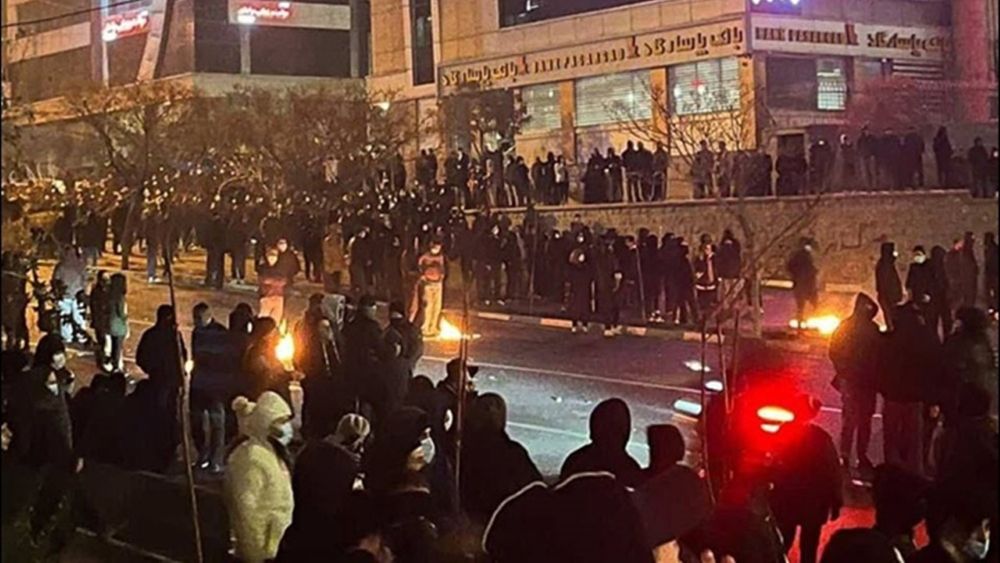
There has been a systematic and highly orchestrated campaign during and after the January uprising in Iran aimed at presenting a false and biased portrayal of the Iranian people’s uprising and its political objectives through a new tactic: dubbing audio over clips of the uprising, specifically to present them as demonstrations in favor of the restoration of the monarchy.
In recent weeks, the practice of overlaying audio onto protest clips from Iran, distributing them on social media or sending them to the press has become a systematic routine. The objective is to create the false impression that there is a trend toward the monarchy in Iran.
Forensic and technical analysis by third parties has verified hundreds of clips, revealing that the voices added to these videos, purporting to be slogans supporting the return of the monarchy, are completely engineered and bear no relation to reality.
In many instances, a single dubbed clip was distributed as footage of protests in three different cities on the same day. In some cases, the audio used for demonstrations in provincial Iranian towns, where residents have distinct local accents, featured a Tehrani accent that is entirely different (for example, during protests in Mamasani in Fars Province, marking the 40th day of the martyrdom of protesters). In other instances, the audio plays while the crowd is engaged in clapping or other activities that do not match the sound, or the overlaid audio is inconsistent with the background ambient noise.
In many of these cases, eyewitnesses have explicitly stated that such slogans were never chanted by the demonstrators. Furthermore, in some instances, it has been regime agents who attempted to divert the protests by chanting fascist slogans like “Javid Shah” (Long Live the Shah), only to be isolated by the crowd or met with a backlash from the protesters. The latest such incident occurred on February 21 at Sharif University of Technology in Tehran; when the student protests began, Basij agents tried to derail the demonstration by chanting “Javid Shah,” but were confronted by the protesters.
The following clip is very illuminating in revealing the extent of this outright fabrication:
Various aspects of this campaign have been exposed in investigations by other authorities, including Citizen Lab at the University of Toronto and the French newspaper Le Figaro.