


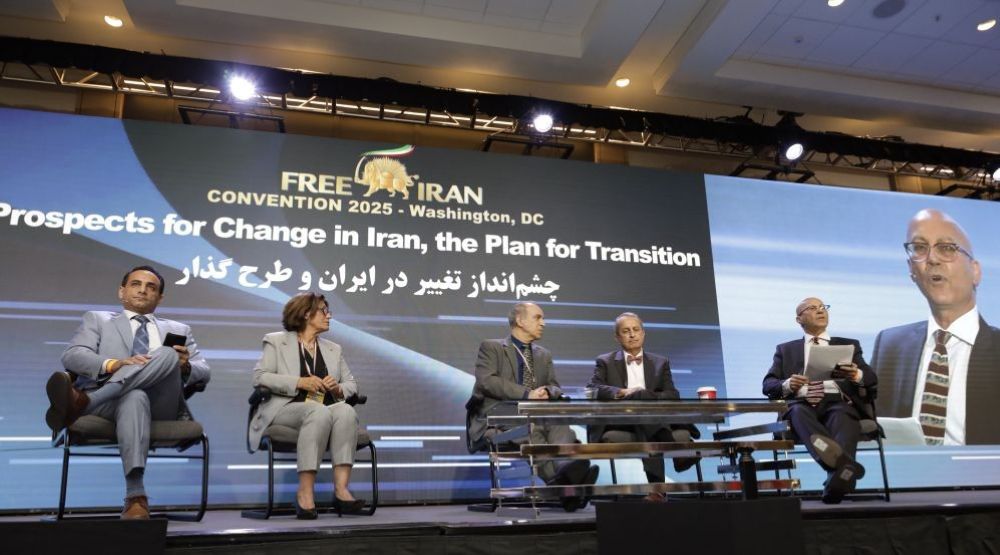
Experts Chart Iran’s Transition Strategy at Free Iran Convention 2025
WASHINGTON, DC — The fifth expert session of the Free Iran Convention 2025 tackled the defining question of Iran’s future: How can a collapsing dictatorship be replaced with a stable, democratic republic? The panel, titled “Prospects for Change in Iran: The Plan for Transition,” brought together accomplished specialists in medicine, aerospace engineering, political research, software development, and advanced robotics to examine both the strategy for ending the clerical regime and the roadmap for the day after.

Panel moderator Dr. Saeid Sajadi, Harvard-trained internal medicine specialist and researcher, opened by connecting the analysis to historical context. He recalled June 20, 1981, when the IRGC opened fire on a peaceful rally of half a million MEK supporters—an event he said “eradicated the regime’s remaining political legitimacy.” Sajadi argued that the constitution’s theocratic structure makes genuine reform impossible, and decades of uprisings now show a society unwilling to tolerate dictatorship. Iran, he said, is “in a terminal crisis—unable to retreat, unable to move forward.” The task ahead: determine how the regime will fall and how Iran’s democratic transition will be secured.
Dr. Saeid Sajadi: The fall of the mullahs' regime began on June 20, 1981, when Khomeini ordered IRGC to fire on 500,000 MEK supporters in Tehran. That day ended the regime’s political legitimacy & started the fight for a free Iran. #FreeIranConvention2025https://t.co/3W9JDFosG4
— Iran Freedom (@4FreedominIran) November 15, 2025
Regime Change Is Now “Inevitable,” Experts Say
Software engineer Farideh Sedighi said three forces are converging:
-
The regime’s internal collapse, fueled by corruption, economic freefall, and political fragmentation.
-
A society at breaking point, with nationwide protests across 16 sectors in the past year alone.
-
An organized alternative, through the NCRI and MEK, with expanding Resistance Units conducting over 3,000 operations in the last year.
Ms. Sedighi argued that uprisings without organization cannot topple the clerical establishment. “Leadership and structure exist,” she said—pointing to Maryam Rajavi’s platform and the disciplined growth of Resistance Units nationwide.
Farideh Sedighi: Iran faces 40+ years of repression, corruption, and economic collapse. Uprisings grow yearly, led by women and youth rejecting all regime factions. Leadership exists with MEK and NCRI for real change. #NCRIAlternativehttps://t.co/ayQkmDwXXR
— Iran Freedom (@4FreedominIran) November 15, 2025
The Youth Will Finish What Decades of Resistance Began
Caltech aerospace and robotics engineer Reza M. Nemovi responded to what Iran’s new generation wants by sharing his own story of perseverance. After surviving a catastrophic accident, he relearned to walk and went on to design AI-based aerospace systems. Iran’s youth, he said, share this same resilience: unified, strategic, and unwilling to trade one form of tyranny for another.
“They already have every condition required to bring the wall down,” he said. “The regime is merely the last obstacle still standing.”
Reza M. Nemovi: After a serious skydiving accident, I learned to walk and returned to study aerospace engineering. My journey reflects the resilience needed by Iran’s youth today. #FreeIranConvention2025 #OurChoiceMaryamRajavihttps://t.co/f16wP8mEXk
— Iran Freedom (@4FreedominIran) November 15, 2025
A Clear Strategy: A Nationwide Fight Led by Organized Resistance
NASA scientist Dr. Behzad Raofi addressed the core question directly: What is the realistic strategy to end the regime?
His answer: “To fight it and overthrow it.”
Dr. Raofi argued that the regime abolished peaceful political change on day one. By mid-1981, thousands had been killed or arrested simply for peaceful assembly. Today, he said, the landscape has changed: Resistance Units have grown into a sophisticated, nationwide network aligned with society’s demand for change. The combination of mass defiance and organized resistance, he said, is the path to victory.
Dr. Behzad Raofi: Since 1979, the regime brutally oppressed dissenters. On June 20, 1981, IRGC fired on 500,000 MEK supporters in Tehran, marking the regime’s loss of legitimacy & the start of the fight for freedom. #FreeIranConvention2025 #NCRIAlternativehttps://t.co/ZPC87qhuU0
— Iran Freedom (@4FreedominIran) November 15, 2025
Evidence Shows the Resistance Can Lead the Transition
Executive surgeon-scientist Dr. Firouz Daneshgari addressed a central concern: Can the MEK/NCRI lead the downfall of the regime?
His answer: “The evidence shows they already are.”
He recalled the early 1980s, when fewer than 200 surviving MEK members emerged from Shah’s prisons yet mobilized half a million people, producing the largest underground press network in Iran’s history. He pointed to later achievements: exposing the regime’s nuclear program, forming the National Liberation Army, and building today’s regenerative Resistance Units.
“Capability,” he said, “is not a slogan. It is performance. And performance is documented.”
Dr. Firouz Daneshgari: From 1979, the MEK resistance grew from less than 200 to mobilizing over half a million people in massive demonstrations. Their underground newspaper reached half a million readers daily—a true power of social mobilization. https://t.co/PlwtDZZ5ce
— Iran Freedom (@4FreedominIran) November 15, 2025
Q&A: Ensuring Stability the Day After the Regime Falls
Iran Will Not Fragment — It Will Stabilize
Ms. Sedighi dismissed the narrative of post-regime chaos as a myth promoted by both the ruling clerics and the Shah. Iran’s identity as a cohesive nation-state, she said, is thousands of years old. The real destabilizing force has always been the regime itself. With the NCRI’s organized network and unified national demand for democracy, she argued, Iran is positioned for restoration, not collapse.
NCRI Prepared for Governance — “44 Years of Testing and Planning”
Dr. Raofi compared the NCRI’s structure to a NASA system: complex, rigorously tested, and built for resilience.
He emphasized:
-
A 450-member coalition representing diverse political, ethnic, and religious backgrounds
-
52% female membership
-
25 expert committees operating as ministries-in-waiting
Surviving exile, massacres, assassination attempts, and global disinformation campaigns while maintaining operational coherence, he said, is the clearest proof the NCRI can govern the six-month transition period.
Why Maryam Rajavi’s Ten-Point Plan Resonates
Mr. Nemovi explained that the Ten-Point Plan’s structure mirrors the clarity and system architecture valued in engineering. Its commitments to secular governance, merit-based economics, innovation, and separation of religion and state match the aspirations of Iran’s youth and professionals seeking dignity and opportunity.
Trust Built on Evidence, Not Promises
Dr. Daneshgari closed the discussion by addressing credibility. He argued that trust must be based on observable consistency:
-
40+ years of adherence to democratic principles
-
Transparency in political positions
-
Accurate analyses on nuclear and regional issues
-
Organizational endurance under extreme pressure
“Promises made, promises kept,” he said—summarizing the NCRI’s track record.