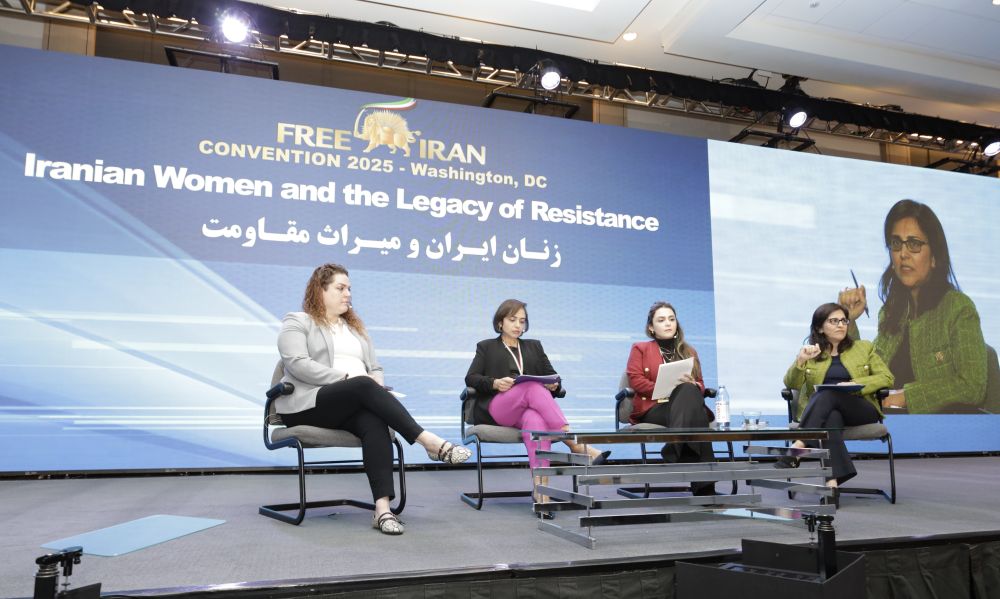
Empowering Iran’s Future: Women at the Core of Democratic Resistance
The second major session of the Free Iran Convention 2025 , titled “Iranian Women and the Legacy of Resistance,” spotlighted how Iranian women—physicians, legal experts, activists, and community leaders—have become the decisive force shaping Iran’s democratic movement. The panel emphasized more than a century of female resistance culminating in today’s organized, women-led struggle within the NCRI and MEK.
Dr. Ramesh Sepehrrad: A Century-Long Path to Leadership
-
Women’s leadership is the product of 100+ years of struggle, not a sudden development.
-
Repression shifted shape from the Constitutional Revolution to the Pahlavi era to the current theocracy.
-
The 2022 uprising was built on decades of underground organization led by women and youth.
-
Women of all ethnic groups—Azeri, Kurd, Baluchi, Lur, Turk—are active in the resistance.
-
The MEK and NCRI cultivated systematic women’s leadership through discipline and strategy.
“No other government has executed more women than Iran’s regime—yet women remain resilient, organized, and determined.”
At #FreeIranConvention2025, Dr. Ramesh Sepehrrad opens panel: "Women's Rise from Resistance to Leadership." NCRI thanks! Iranian women's 100+ yr fight—from 1906 Constitution to Pahlavi & theocracy tyranny. Despite violence, they empower & lead. https://t.co/Y0e4mV0SWq
— Iran Freedom (@4FreedominIran) November 15, 2025
Dr. Azadeh Sami: How Systemic Oppression Created Organized Resistance
-
Under the monarchy, elite women were selectively showcased but political women were persecuted.
-
The Islamic Republic institutionalized misogyny through compulsory hijab, discriminatory laws, and gender apartheid.
-
Women joined the MEK in large numbers in the 1980s despite backlash.
-
The MEK created an emancipatory leadership structure that placed women in strategic and operational positions.
-
Today, women form the core of Resistance Units and a multigenerational diaspora force.
“Systemic oppression created the urgency; the MEK created a real model for empowerment.”
Dr. Azadeh Sami highlights how Iranian women's leadership in the resistance grew from decades of oppression under monarchy and theocratic rule. Their strength turned systemic repression into a powerful emancipatory movement. #FreeIranConvention2025https://t.co/MjZvAA505V
— Iran Freedom (@4FreedominIran) November 15, 2025
Attorney Hannane Amanpour: Gender Apartheid by Constitutional Design
-
Inequality in Iran is rooted directly in the constitution under Velayat-e Faqih.
-
Women lack equal rights in marriage, divorce, custody, inheritance, and public office.
-
They are banned from the presidency, judiciary, and positions of power by design.
-
Since 1985, MEK women have risen to senior roles, culminating in Maryam Rajavi’s presidency-elect in 1993.
-
The regime demonizes politically active women—especially mothers—using tactics not seen in other global liberation movements.
Hannane Amanpour: The Islamic Republic’s constitution enshrines gender-segregated laws denying women equal rights in personal & public life. Yet Iranian women lead the resistance, a powerful sign of hope for Iran’s future. #FreeIranConvention2025 https://t.co/t7le9Jzmbr
— Iran Freedom (@4FreedominIran) November 15, 2025
Dr. Azadeh Zangeneh: A Life Split Between Freedom and Repression
-
Raised in the U.S., she was abruptly placed in an Iranian all-girls school and confronted with daily repression.
-
Many Iranian girls “cannot even conceptualize freedom” due to lifelong control.
-
Women have led every major movement—from 1906 to today’s uprisings.
-
MEK women hold strategic, operational roles built through discipline and sacrifice.
“What fuels Iranian women? Their lived truth—and the lived example they see before them.”
Dr. Azadeh Zanganeh: Growing up in Iran, I witnessed daily repression limiting girls’ freedom and voices. Women’s leadership in resistance builds on a century of struggle for equality and democracy. #FreeIranConvention2025 #OurChoiceMaryamRajavihttps://t.co/XDedsA11FG
— Iran Freedom (@4FreedominIran) November 15, 2025
Q&A: The Hijab Debate — A Struggle for Choice, Not Clothing
Hijab as Political Agency
-
Dr. Sami: the hijab debate is never about the fabric, but about choice.
-
Shah’s forced unveiling (1936) and the regime’s forced veiling share the same authoritarian logic.
-
She cited Maryam Rajavi:
“No to compulsory hijab, no to compulsory religion, no to compulsory government.”
-
No Contradiction Between Hijab and Freedom
-
Attorney Amanpour: hijab can be a tool of empowerment only if freely chosen.
-
There is no conflict between women who wear hijab and women who do not.
One-Word Legacy of Iranian Women
-
Amanpour: Unwavering
-
Dr. Sami: Fearless