


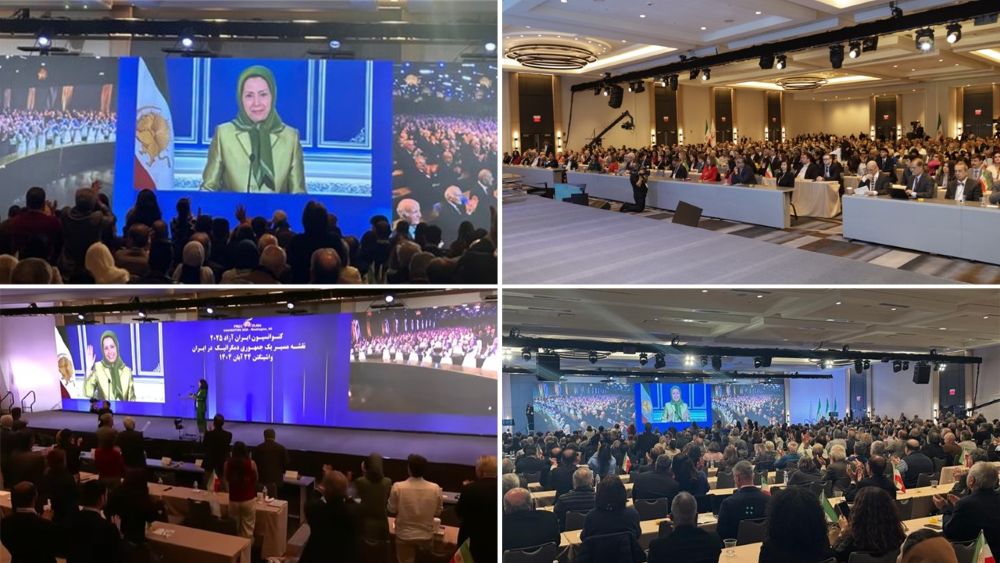
A Nation on the Brink of Change
the Free Iran Convention 2025 brought together hundreds of Iranian American scholars, professionals, human rights advocates, youth leaders, and community organizers from across the United States, joined virtually by supporters and dignitaries worldwide. Centered on the theme “The Path to a Democratic, Prosperous Republic in Iran,” the all-day gathering examined the country’s rapidly evolving internal dynamics and the growing momentum toward democratic transition.
Morning panels highlighted the regime’s deepening crisis, the expanding leadership roles of women and youth within the Resistance, and the strategic roadmap for transferring sovereignty to the Iranian people. Participants underscored that change is not hypothetical: it is imminent, driven by a well-organized, determined population prepared to reclaim Iran’s future.

Key Speeches and Highlights
Dr. Sofey Saidi, Scholar-Practitioner in International Relations and Member of the NCRI
Dr. Sofey Saidi opened the main session, welcoming attendees and highlighting the significance of the day’s discussions. She emphasized that the panels—spanning political analysis, human rights testimony, and strategic planning—demonstrated a common truth: Iran’s transformation is no longer theoretical but underway.
Dr. Saidi noted that hundreds of Iranian American scholars, professionals, youth, and human rights advocates, together with international supporters, had convened to examine Iran’s rapidly changing internal landscape and the growing momentum for democratic transition. She stressed the importance of structure and discipline in revolutionary movements, warning that revolutions without organized frameworks risk collapse, whereas disciplined movements with clear governance succeed.
Dr. Sofey Saidi highlights the growing momentum for a democratic, secular, non-nuclear Iran—powered by youth, women, and organized resistance. The NCRI stands ready to guide a peaceful transition. #FreeIranConvention2025https://t.co/NIlFCaJH0a
— Iran Freedom (@4FreedominIran) November 15, 2025
Mrs. Maryam Rajavi, President-elect of the NCRI
In her keynote remarks, Mrs. Maryam Rajavi framed the central challenge facing Iran and the world: “How can meaningful change be realized in Iran? This is the fundamental question of our time.” She declared that the regime has entered its terminal phase— “the final phase of its winter”—marked by economic collapse, eroding social control, and a society “ready to bring this regime down.”
Mrs. Rajavi emphasized that the roots of Iran’s crisis cannot be reformed or moderated. “Is it conceivable to reform this regime? Should one wait for it to become more rational?” she asked, noting that both hardliners and so-called reformists have overseen mass executions, repression, and regional warmongering. She reiterated her long-standing Third Option: “neither appeasement nor war, but the overthrow of the regime by the Iranian people and their organized Resistance.”
She honored the rise of Resistance Units and the new generation leading Iran’s uprisings, describing them as “the Iranian people’s great Army of Freedom.” Their courage, she argued, proves how regime change will be achieved—from inside the country through organized struggle. She concluded by reaffirming the NCRI’s democratic program: “We seek a democratic republic, free elections, the separation of religion and state, gender equality, and autonomy for Iran’s nationalities. We are not fighting to seize power. Our goal is to return sovereignty to the people of Iran.”
#FreeIran2025Convention in Washington, D.C.
Convening this assembly to examine the current grave and sensitive circumstances is both timely and indispensable.
The war that erupted a few months ago demonstrated unequivocally that the policy of appeasement has failed, and it has… pic.twitter.com/qTcdWKsZQo— Maryam Rajavi (@Maryam_Rajavi) November 16, 2025
Mike Pompeo, Former U.S. Secretary of State
Former U.S. Secretary of State Mike Pompeo described the regime in Tehran as increasingly fragile, stating, “This regime is weak… more internationally isolated than ever,” and noted that it survives only by “fear as its only tool,” pointing to the violent crackdown of 2022.
Pompeo highlighted regional failures, including Hezbollah’s decline and Assad’s loss of control, and stressed that Iran’s influence is collapsing. Yet the decisive force for change lies inside Iran: “A nation that has arisen from inside to oust a regime that is illegitimate.” He urged Western governments to abandon appeasement, warning that cash or concessions only enable repression, and emphasized that the NCRI has never sought foreign boots on the ground—only support for the Iranian opposition.
.@mikepompeo, Former US Secretary of State: The Iranian regime is weak, isolated, & devoid of legitimacy. Internal resistance—led by the NCRI and inspired by Maryam Rajavi—is the force that will bring real change. #FreeIranConvention2025 #NCRIAlternativehttps://t.co/hAVbl9x2B1
— Iran Freedom (@4FreedominIran) November 15, 2025
John Bercow, Former Speaker of the U.K. House of Commons
John Bercow praised the convention’s energy, calling it unlike any other he had attended in his political career. He honored the NCRI for organizing the event and highlighted the women’s and youth panels as especially moving. Condemning the clerical regime as a “failed state,” he dismissed claims that Iran lacks a viable democratic alternative and denounced self-appointed opposition figures as illegitimate.
Bercow emphasized that true legitimacy belongs to those who have remained on the ground, organized, and sacrificed: “The MEK has been doing precisely that for almost four and a half decades.”
John Bercow, Former Speaker of the UK Parliament: The sheer energy, precision, and passion of this NCRI gathering is unlike any convention I’ve seen in 46 years of public life. A powerful force united for Iran’s freedom and dignity. #FreeIranConvention2025https://t.co/B2wQwE1xEs
— Iran Freedom (@4FreedominIran) November 15, 2025
Carla Sands, Former U.S. Ambassador to Denmark
Former U.S. Ambassador Carla Sands praised Mrs. Maryam Rajavi’s leadership and noted that the convention reflected a political reality the world can no longer ignore. She highlighted that the regime’s fear is focused on the MEK and its organized Resistance Units, not exiled monarchs or lobbyists. Sands underscored the central role of women in the Iranian Resistance, calling it “the only revolution in the Middle East led by women,” historic and emblematic of the democratic future envisioned in Rajavi’s Ten-Point Plan.
Ambassador @CarlaHSands: “This convention is not symbolic—it’s proof that the Iranian people reject dictatorship and already have a democratic alternative. The NCRI is not theory. It is a government-in-waiting that survived prison, executions, and exile.”https://t.co/IJfbv5PW2s
— Iran Freedom (@4FreedominIran) November 15, 2025
Patrick Kennedy, Former U.S. Congressman
Patrick Kennedy emphasized the movement’s depth, discipline, and readiness to lead Iran’s democratic transition. Citing his visit to Ashraf-3, he described how residents maintained culture and community under siege. Kennedy framed Iran’s struggle in universal moral terms, paralleling global movements against apartheid and totalitarianism. He highlighted the courage of Iranian youth and reaffirmed that the only viable path is through the democratic principles of the NCRI and Mrs. Maryam Rajavi’s Ten-Point Plan.
Rep. Patrick Kennedy: “This is not an Iranian fight alone. It is a universal fight for human dignity. The world must stand with the Iranian people against a regime that leads the world in executing its own citizens.”#NCRIAlternative #OurChoiceMaryamRajavihttps://t.co/uI4dGB3C52
— Iran Freedom (@4FreedominIran) November 15, 2025
Professor Hossein Sadeghpour, Harvard–Smithsonian Center for Astrophysics
Professor Hossein Sadeghpour traced Iran’s struggle for democratic governance over the last century, from the Constitutional Revolution of 1905 to the 1953 CIA–MI6 coup, through the Shah’s authoritarianism and Khomeini’s rise. He stressed that liberty is earned through sacrifice and resistance. Prof. Sadeghpour identified the NCRI and MEK as the only organized movement capable of translating these lessons into a practical, evidence-based roadmap for Iran’s democratic future.
Prof. Hossein Sadeghpour: Iran’s struggle against Shahs and Sheikhs is a century-long fight for democracy. History repeats itself: betrayal, coups, massacres—but freedom is forged through resistance, not dynasties or foreign patrons.#FreeIranConvention2025https://t.co/b4DwPDXw7O
— Iran Freedom (@4FreedominIran) November 15, 2025
Guy Benson, Political Editor and National Commentator
Guy Benson closed the convention with a personal reflection, recounting experiences of the Iran–Iraq War and acts of defiance by Iranian women, connecting it to the current struggle. He declared that the vision of a free, secular, democratic, non-nuclear Iran is now within reach. Highlighting the regime’s structural weakness exposed by recent events, Benson emphasized U.S. support for the Iranian people and concluded with a vision of a Free Iran Convention held in a free Tehran: “discussing not what might be, but what has been achieved.”
Guy Benson: “Iranian women demanding freedom and equality are heroic. The regime has exposed its weakness while the people’s courage shines. Hope is justified—October 7th marked the beginning of the end for the regime’s terror.”#FreeIranConvention2025
https://t.co/JWdf2CSVfK— Iran Freedom (@4FreedominIran) November 15, 2025