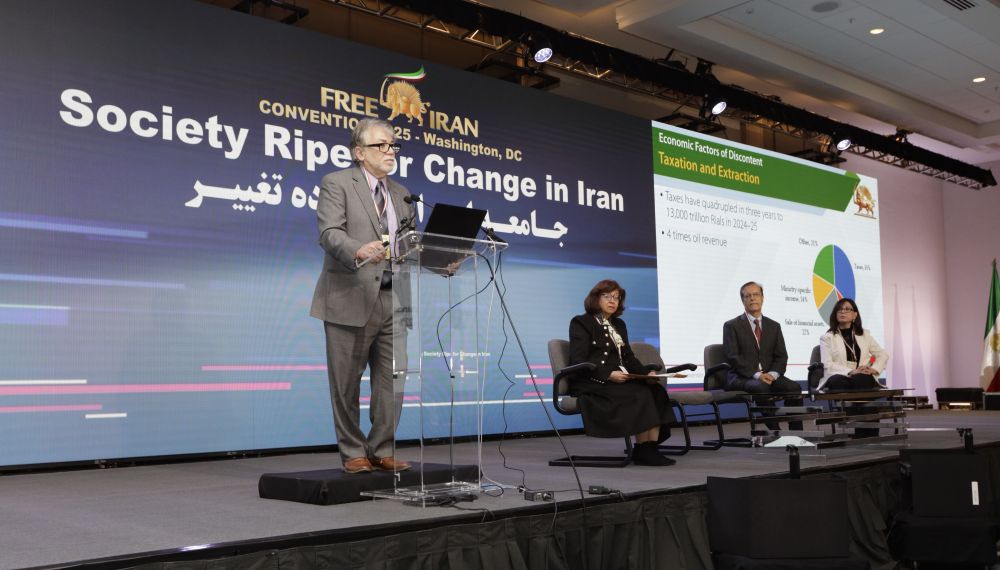
Free Iran Convention 2025 Opens in Washington, Charts Path Toward Democratic Iran
WASHINGTON, DC — The Free Iran Convention 2025 opened on Saturday, November 15, bringing together Iranian scholars, professionals, activists, and community leaders for an all-day program in the U.S. capital. The gathering centered on four thematic panels, special segments amplifying voices from inside Iran, and in-depth discussions on building a democratic future for the country.
Opening Remarks: A Crucial Moment for Democratic Change
Soona Samsami, the U.S. Representative of the National Council of Resistance of Iran (NCRI), welcomed attendees and described the convention as an “extraordinary gathering” of experts and youth committed to establishing a free and democratic republic in Iran. She emphasized that the regime is at its weakest point in decades and that the broad, experienced Iranian community represented in the hall is united around the goal of ending “religious tyranny.”
Samsami highlighted the NCRI as the only credible democratic alternative to Iran’s ruling theocracy, rejecting both clerical rule and monarchy. She underscored Maryam Rajavi’s Ten-Point Plan as a practical blueprint for a future Iran built on democratic governance, gender equality, human rights, and a non-nuclear framework. She also referenced the NCRI’s extensive record in exposing Tehran’s secret nuclear sites, documenting human-rights abuses, and confronting the regime’s terrorism.
Convention Framed as a Historic Turning Point
Ana Sami, attorney and second-generation Iranian American, served as emcee and characterized the event as “history in the making.” She emphasized that, for the first time, Iranian scholars and civic leaders from across the United States had come together not for a routine meeting, but to chart a concrete path from dictatorship to a secular, democratic, and non-nuclear republic.
Sami said the day’s program represented “more than an event; it is a movement” driven by conviction and the belief that freedom is a right. She noted that participants would hear from individuals who have resisted tyranny firsthand, as well as international supporters of the Iranian people’s struggle. “Today,” she concluded, “we don’t just imagine a free Iran—we commit to building it.”
.@AnaSami7: The first panel, “Society Ripe for Change,” brings leading scholars together to examine Iran’s challenges and the forces driving democratic transformation. A bold step toward a free Iran. #FreeIranConvention2025 #NCRIAlternative https://t.co/ILF5udz4u3
— Iran Freedom (@4FreedominIran) November 15, 2025
Panel 1: Society Ripe for Change
A Nation Approaching Transformational Shift
Panel moderator Sima Yazdani, an AI technology executive with four decades of experience, opened the first session by expressing “profound gratitude” to the NCRI for bringing international attention to the Iranian people’s “unyielding stand against tyranny.” She described Iran as undergoing a “seismic shift—a nation on the edge of transformational change.”
Yazdani argued that over forty years of corruption and repression had “cracked the regime’s façade,” forging unprecedented unity among citizens, the diaspora, and the organized resistance. She said this was not temporary unrest but “the maturation of social readiness for overthrow.” She framed the panel around three core questions:
-
the roots of Iran’s discontent,
-
how that discontent manifests,
-
and the direction of the organized opposition.
Rejecting slogans and speculation, she said the discussion would rely on fact-based research exposing fractures within the regime, which she described as defined by terrorism, massacres, and the world’s highest execution rate. She likened Iran’s evolving resistance—from underground activists to exiled leaders—to the spirit of America’s own 1776. “If not now, when? If not us, who?” she asked.
At #FreeIranConvention2025, @simayazdani says Iran is undergoing a seismic shift: decades of repression have forged unprecedented unity among the people and organized resistance. This is not unrest—it is social readiness for change. #NCRIAlternativehttps://t.co/IUqTqHNtb1
— Iran Freedom (@4FreedominIran) November 15, 2025
Expert Testimonies: Economic, Political, and Social Crisis
Dr. Kazem Kazerounian: Iran’s Economic Collapse Is Structural
Dr. Kazem Kazerounian, former dean of the University of Connecticut’s College of Engineering and fellow of ASME and AIMBE, presented what he called “three mega-trends” defining Iran’s structural economic breakdown. He argued that the collapse is not a result of sanctions but of a system that transformed the economy into “a tool for repression and plunder.”
He highlighted key indicators of decline:
-
Iran ranks 117th globally in GDP per capita, despite its natural resources.
-
Food inflation hovers near 60%.
-
Medicine prices have increased “700 to 800 times.”
-
Nearly 80% of Iranians now live below the poverty line.
Kazerounian detailed extreme inequality, noting that “1% of the country owns over 30% of its wealth,” and that almost 80% of the workforce lacks stable employment. He identified the IRGC as controlling up to 60% of the economy, forming a “military oligarchy.” He also estimated the regime’s nuclear program has cost Iran roughly $2 trillion.
“Iran’s social fabric is breaking under the weight of inequity,” he concluded. “Discontent has become defiance—and that defiance is accelerating the path toward total regime collapse.”
.@kazemkaz at #FreeIranConvention2025: Iran’s economic collapse is structural, not due to sanctions. 80% of people live in poverty, medicine costs rose 700x, and income stagnation persists. Discontent fuels revolutionary momentum. #NCRIAlternative https://t.co/BQVgX03fVU
— Iran Freedom (@4FreedominIran) November 15, 2025
Dr. Hossein Saiedian: Illegitimacy at the Core of the Crisis
Dr. Hossein Saiedian, professor of computer science at the University of Kansas, argued that the regime’s core crisis stems from “its illegitimacy.” He stated that the clerical leadership “has never been a legitimate government,” noting that Ayatollah Khomeini “stole the revolution” in 1979 by exploiting a power vacuum and derailing Iran’s long struggle for democracy.
He defined the regime’s pillars of survival as:
-
internal repression,
-
export of terrorism,
-
nuclear weapons development.
According to Saiedian, all three pillars are now failing. He credited the NCRI for exposing Iran’s secret nuclear site in Natanz in 2002, calling it “a courageous act of patriotic intelligence” that compelled global action. He observed that executions in Iran have tripled in the last three years and pointed to heightened persecution of MEK supporters, suppression of minorities, censorship, and environmental degradation.
Despite these conditions, he said, Iranians are “more defiant than ever,” concluding that “an explosion of freedom is not just possible—it is inevitable.”
.@HSaiedian at #FreeIranConvention2025: The Iranian regime is illegitimate, ruling without democratic mandate. Its pillars—nuclear weapons, export of terrorism, and repression—have all failed, leaving the country in crisis. #NCRIAlternative https://t.co/ZNJSmRnwid
— Iran Freedom (@4FreedominIran) November 15, 2025
Dr. Ashraf Zadshir: A Society in Permanent Revolt
Dr. Ashraf Zadshir, California-based physician, educator, and recipient of the Woman of the Year Award, focused on the social trajectory from sporadic protests to sustained, organized revolt. She outlined three major nationwide uprisings—2017, 2019, and 2022—as evidence that the regime has reached a point of no return.
Key points included:
-
2017 uprising: Spread to 142 cities, with the defining chant “Reformer, hardliner, the game is over,” signaling society’s rejection of the regime as a whole.
-
2019 fuel-price uprising: The largest in decades, reaching 200+ cities and targeting symbols of repression such as Basij bases.
-
2022 Mahsa Amini uprising: A “generational rebellion” led by women and youth with the chant “Down with the oppressor, be it the Shah or the Leader.”
Zadshir highlighted the growing influence of MEK-affiliated Resistance Units, attributing to them more than 39,000 acts of defiance last year. She also noted that election boycotts have reduced turnout to as low as 8–10%.
“Iran has entered a permanent state of defiance,” she concluded. “The next uprising is not a question of if—but when.”
Dr. Ashraf Zadshir @zads24418: Iran’s protests have evolved into sustained, organized revolts across 31 provinces. From 2017 to 2022, the people have rejected theocracy & monarchy, demanding full political change. #NCRIAlternative #FreeIranConvention2025https://t.co/bcXbKNMdSF
— Iran Freedom (@4FreedominIran) November 15, 2025
Conclusion
The Free Iran Convention 2025 provided a comprehensive assessment of Iran’s political, economic, and social crises, alongside a clear roadmap toward democratic change. Through detailed expert analysis and unified messages from organizers and scholars, the event underscored that the country is moving rapidly toward a pivotal moment—one shaped by sustained resistance, widespread discontent, and an organized vision for a free, secular, and non-nuclear Iran.