



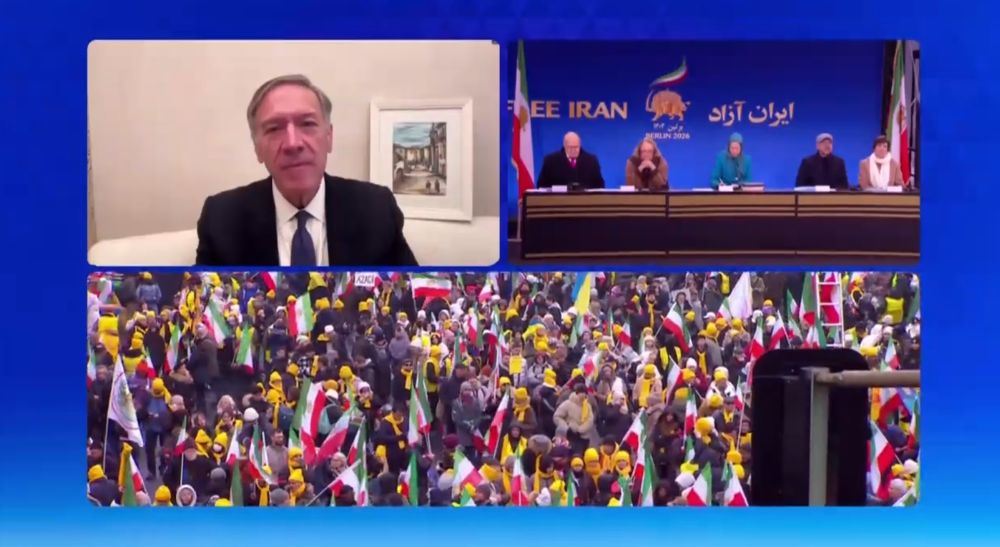
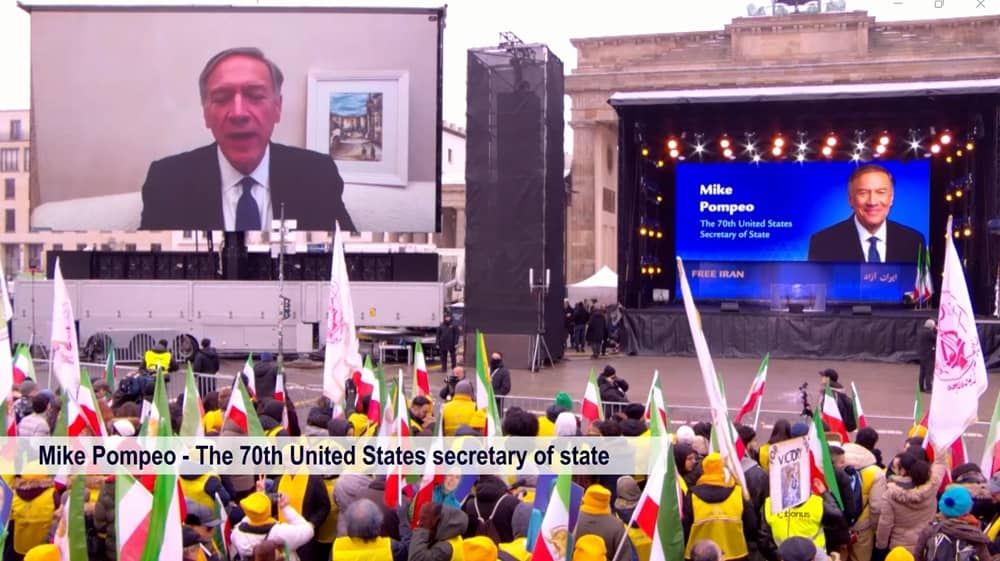
Speaking remotely to a large gathering of Iranians and supporters of the resistance at Brandenburg Gate in Berlin on February 7, 2026, former U.S. Secretary of State Mike Pompeo praised attendees for enduring the cold and said Iran has reached a decisive historical moment. He described the current wave of unrest not as a simple protest movement but as a revolution in the making. According to him, the regime’s recent violence reflects both hostility and deep fragility, sustained mainly through fear—an approach he argued is losing effectiveness against a population that is increasingly unafraid.
Pompeo said the fall of the ruling system is inevitable but emphasized that the key question is what will replace it. He rejected all forms of dictatorship, stating that Iranians do not want a theocracy, an autocracy, or a return to monarchy, but rather a free and democratic republic.
He pointed to the role of Maryam Rajavi and the National Council of Resistance of Iran (NCRI) as an organized alternative with a defined transition plan, including free elections, separation of religion and state, gender equality, and a non-nuclear Iran. He also called for continued maximum pressure and warned Western policymakers that claims there is “no alternative” are fundamentally misguided.
The former U.S. official stressed that the opposition’s path to change does not require American troops or foreign funding. Instead, he said, the central demand is political recognition of the Iranian people’s right to end the current system, including acknowledgment of what he described as the resistance’s right to confront the regime’s repressive institutions—particularly the IRGC.

The full text of Mike Pompeo’s speech follows:
I wish I could be there but travel simply wouldn’t permit. You gave an inspiring speech today, and the world is better for it.
While the weather in Berlin has kept me – like thousands of others – from joining your demonstration in person, I'm excited to virtually join on the anniversary of the 1979 Iranian revolution. The Iranian people want a democratic and free Iran, and the world should stand with…
— Mike Pompeo (@mikepompeo) February 7, 2026
As I begin, I want to take a moment to acknowledge the passion, the dedication, and the astounding bravery of the Iranian people. Many people, both in Iran and in the diaspora, have sacrificed so much to free your future. Bless you.
It is also the case that you all came out today to be there in Berlin, at this special place, the Brandenburg Gate, braving the cold to stand in support of a free Iran.
To many of you in the audience here, and many of you in the audience there at Ashraf 3 who are watching—you who have been displaced, forced into exile, survived imprisonment and torture—many of you have lost loved ones in this struggle. To you, as an American, I want to say thank you.
To you and the young people who I just saw on the stage singing the beautiful anthem along with Mrs. Rajavi—to all of you, you are the future of Iran. Thanks to your efforts, God willing, the Iranian people will very soon be free.
This place you are standing in front of today was a hinge point in world history. Today, it is unequivocal and unmistakable that we are at a hinge point in Iran’s history. You can see it. The people are fed up with a murderous, corrupt, and incompetent government that can’t even fulfill the basic needs of its citizens.
While there are tens of thousands today in Germany, there are millions of people that have taken to the streets of Iran, in towns all across the country, to say that enough is enough. Today, this hinge point in history must be honored. What we’re seeing in Iran today isn’t just a protest movement; we’ve seen those before. This is a revolution.
It is fitting that we gather here today on the 47th anniversary of the revolution that took place in 1979, which first rose up against the autocratic leadership to demand freedom and human rights, but whose movement was co-opted by the Ayatollah.
Back then, those patriots suffered torture, imprisonment, and exile. They have kept the flame burning, preparing for this very moment—a moment when it would be possible to take back their country. My friends, that moment has arrived. There is no going back to the dark days of Iran. Forward, forward together.
It’s been said that you become your truest self as you approach death, and that is certainly the case for this evil dictatorship. It just spent the last six weeks on a murderous rampage against its own people. The regime has shown its true colors as it is nearing its death—the death of this regime.
Now, I’ve seen different numbers, but the massacre of January 8th and January 9th killed at least 20,000, perhaps twice that many. These brave Iranians were murdered by the state, murdered by the Ayatollah and his henchmen.
Contrary to Ayatollah Khamenei's propaganda, the movement for change in Iran is an independent, homegrown struggle for freedom that stretches back more than a century.
Iran's organized democratic resistance isn't asking for boots on the ground. Their only request is the… pic.twitter.com/MFkzEpOhnf
— Mike Pompeo (@mikepompeo) February 10, 2026
In some ways, the behavior we’ve seen each time the Iranian people have risen up to demand their basic human rights reflects precisely what happened this week, but this was truer.
This was a testament not only to the malevolence that has always been the beating heart of the dictatorship, but also to the evidence of its profound weakness—a regime lacking popular legitimacy and completely unable to deliver for its own people.
It has one remaining instrument of control: the attempt to instill fear in its people. This will not succeed. The Iranian people will prove fearless. I can feel it; I know it.
I’ve spoken to many of you in past years, but today, both internally and externally, the situation is far more dire for the Iranian leadership. The economy is in shambles due to a combination of incompetence and corruption, massive international isolation, and a poisonous mindset.
The West has decimated the regime’s proxy forces across the region and severely weakened the Iranian military infrastructure. It has left the regime without its most powerful insurance policy: a nuclear program that was thriving.
Whether it occurs today, tomorrow, or five years from now, the collapse of the Islamic Republic is 100% inevitable. The question becomes for you: what will replace it?
The Iranian people have made their preference clear, abundantly clear, in repeated waves of uprisings. They do not want theocracy, they do not want autocracy, and they do not want a monarchy. They want a republic that is free, democratic, and accountable to the citizenry.
Thanks to the bravery of Iran’s organized political opposition, there is a real opportunity for this positive change and liberation. The uprisings that we have seen in these past days didn’t come out of nowhere. They did not spring from oblivion. They are rooted in a Resistance now four decades in the making by Iran’s pro-democracy movement.
Mrs. Rajavi, your movement has built the capacity for popular support, and a systemic plan has been laid out that needs to proceed to replace a moribund, murderous rule by autocracy with a government that reflects the will of the Iranian people.
Those of you sitting in Albania, in Ashraf, you know that the relentless persecution of this movement is a testament to your power for good. In addition to the brutal repression, the regime invests significant resources to sow discord within the pro-democracy movement inside of Iran and in the diaspora. But we here today all know the truth, and it is always the truth that will set us free.
America and the American people want to see the people of Iran thrive and to become a democratic, prosperous regional power. We want to see the world’s largest state sponsor of terrorism replaced with a government that represents the interests of the Iranian people, not the murderous extremists.
The prospect of a democratic Iran that seeks peace and prosperity would be transformative—certainly for the people of Iran, but also for every nation in the region: Israel, the Gulf States, and for the world. To achieve that, we need a policy that is grounded in strategic and moral clarity.
As you all know, I had the incredible privilege to work as United States CIA Director and then as 70th Secretary of State for President Trump for four years. When we came to office, we inherited a set of policies that were providing resources, prosperity, and support for the Iranian regime. It was a policy of appeasement on steroids.
But President Trump understood that this regime was fundamentally incapable of reform and that terror and cruelty are embedded in the regime’s DNA. Instead, we chose a different path.
Instead of supplying the Ayatollah with pallets of cash to use to brutalize his own people and support a global terrorism regime, we initiated a Maximum Pressure campaign. We re-established deterrence, and we took down one of their most important leaders, General Qasem Soleimani.
With the return of President Trump to the White House, we’ve seen that Maximum Pressure policy continue. Indeed, just today, the United States placed even more sanctions on Iranian crude oil and on the regime. President Trump has repeatedly vowed to come to the aid of the Iranian people—those people slaughtered by the regime.
It is my sincerest hope, and I am confident, that he will keep this promise. We should all continue, and America should continue, to cut off the lifelines and hasten the regime’s demise.
We also must be clear that the policy of the United States is to support the Iranian people today, tomorrow, and forever. We know, too, that any deal with this regime cannot lead to peace and prosperity. The only deal that is acceptable is a transition to a government that honors and respects the will of the Iranian people.
The regime cannot be overthrown from outside. The people of Iran will only be freed by those who have sacrificed for decades—those who have paid the highest price, those who have suffered massacres like the one of these past few days and the imprisonment that has taken place over these past years.

Iran and its people can only be freed by an organized, democratic Resistance. Mrs. Rajavi has laid out a roadmap—a roadmap for the regime’s end, and most importantly, a transition period. One that supports and relies upon the Iranian people and the Resistance inside of Iran.
This involves free elections, quickly, once we overthrow the regime. It involves the separation of religion and state, gender equality so that women participate in the free Iran, and a non-nuclear nation that does not threaten its neighbors and the world.
It is important to note that the plan forward does not ask for the United States to put soldiers on the ground. It does not ask for money from outside. No, the only demand for the Resistance is the recognition of the Iranian people’s right to bring about the end of their regime. It is the right of the Resistance to combat the regime’s repressive forces, most specifically the IRGC.
I’ve been speaking to you present today and to the Iranian people, but I have a quick note for those in the West. For those in the West who continue to labor under the misapprehension that there’s no alternative to the current government: you are wrong on every level.
To allow this regime to stay in place, or to make a deal to allow it to stay in place, erases the aspirations of millions of Iranians who have risked their lives. It ignores the nature of this regime and perpetuates the regime’s propaganda that the West must tolerate its brutality because the alternative is chaos. This is not true.
There is an alternative in front of us here, in the towns and cities across your beautiful country. It will be a glorious thing.
Ladies and gentlemen, we do not know the exact hour of freedom, just as the people of Germany did not know the exact date in which the Brandenburg Gate would open. But we know that the barbaric regime of the Ayatollah and his cronies will never again have the power over the Iranian people that it has had just these past few weeks.
The future of Iran is in your hands—those who have sacrificed and suffered. I pray that all of the world’s leaders, in nations of every faith and every religion, will fulfill their promise to defend the Iranian people and support their aspirations for freedom.
I pray that the next time we meet, it will be in Tehran. Thank you. Thank you so much. God bless you. God bless the freedom-loving people of Iran and God bless the United States of America.
Thank you.
.@mikepompeo: There is a real alternative to this regime—rooted in the courage of Iran’s people and their pro-democracy movement. The future of Iran belongs to them. #NCRIAlternative #OurChoiceMaryamRajavi #No2ShahNo2Mullahs #BerlinFreeIranRallyhttps://t.co/5efB1PLvhH
— Iran Freedom (@4FreedominIran) February 7, 2026