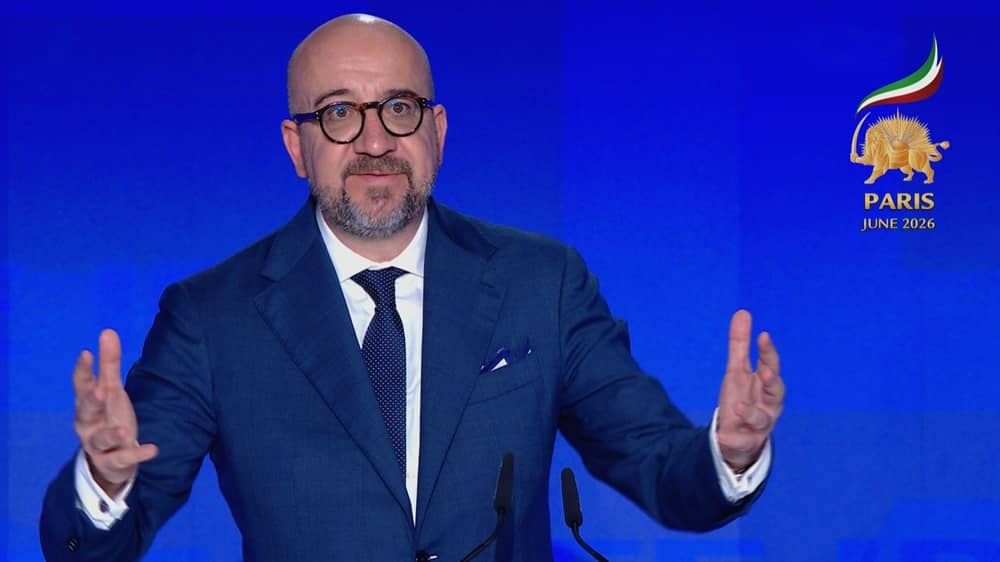
Former European Council President Charles Michel delivered a sharp critique of Western policy toward Iran during the Free Iran World Summit held in Paris on June 20, 2026. Speaking to an international audience, Michel stressed that appeasing authoritarian regimes has consistently failed, drawing comparisons to past Western miscalculations with Nazi Germany and Russia.
He argued that Tehran has repeatedly exploited diplomatic concessions to expand its nuclear and ballistic capabilities while intensifying domestic repression. Pointing to at least 2,159 executions in 2025, Michel warned that global inaction effectively grants the regime a “license to kill.” He called on European leaders to move beyond doubt and acknowledge the severity of the regime’s human rights violations.
Michel strongly endorsed the National Council of Resistance of Iran (NCRI) and Maryam Rajavi’s Ten-Point Plan, describing it as a credible roadmap for a democratic future. Highlighting its principles of democracy, gender equality, and secular governance, he referred to the plan as the “source code” for a new Iran.
He also described the Iranian regime as increasingly fragile, sustained through repression and fear, and operating on “borrowed time.” Concluding his remarks, Michel urged the international community to abandon ineffective policies and support organized democratic opposition, emphasizing that “the hour of choice is now” to stand with the Iranian people.
Former President of the European Council @CharlesMichel: The policy of appeasement has failed in Iran just as it failed with Hitler. It only allows the regime to gain time, develop nuclear weapons, and export terrorism. #100KFreeIranRallyhttps://t.co/Ecm0MbVDCq
— Iran Freedom (@4FreedominIran) June 20, 2026
A translated version from excerpts of Charles Michel’s speech follow:
Madam President, dear Maryam Rajavi, dear Boris Johnson, dear Dmytro Kuleba, members of parliaments, ladies and gentlemen, each in your respective title and capacity, but above all, dear friends, dear friends for a free Iran.
Paris, indeed, is much more than a European capital. Paris is a history. Paris is a human adventure.
And Paris is a symbol. It is the symbol of freedom. It is the symbol of resistance.
Blood has flowed. The people of Paris rose up against despotism, against arbitrariness, and for human dignity.
The French Revolution was a turning point. A turning point both in the history of France and also in the history of the world because it marks the genesis of a revolution of thought. It places aspiration, emancipation, and personal freedoms at the heart of our societies and at the heart of the general interest.
Ladies and gentlemen, Paris is also resistance. Resistance against fascism, resistance against Nazism, that totalitarian ideology that led to ignominies.
Resistance is ordinary women and men taking extraordinary risks to change the course of history. They are ordinary women and men driven by an extraordinary and irreversible faith in liberty, equality, and fraternity.
In 1948, it was in Paris that the Universal Declaration of Human Rights was adopted. All human beings are born free and equal in dignity and rights. They are endowed with reason and conscience and should act towards one another in a spirit of brotherhood.
Dear friends, Madam President, many of us are gathered around this universal appeal. All human beings are born free and equal in dignity and rights.
Indeed, I say it: nothing and no one can erase this, not even an administrative court in Paris.
My very dear friends, today, it is in Iran, once again, that this universal appeal takes on its full meaning. Denouncing and naming things is our primary responsibility, because otherwise, silence becomes a license to kill.
In 2025, there were 2,159 executions by hanging in Iran according to Amnesty International, double the previous year—six hangings per day.
Many non-governmental organizations, as well as the High Commissioner for Human Rights Volker Türk and the UN Special Rapporteur on Iran, strongly denounce these executions.
We, the Europeans, by our history, by our nature, must be on the front line. We must, I say, do more, and carry with an even stronger voice our refusal of inevitability, our support for freedom and dignity.
But, ladies and gentlemen, dear friends, this fight for freedom, this fight for dignity, at this very moment, is also taking place on European soil.
On European soil, it is the Ukrainians who are leading it, resisting, with painful sacrifices, Russia’s war of aggression waged with the support of the mullahs’ regime.
I would like to say to you, my dear Dmytro Kuleba, my friendship, my affection, my unbreakable support for the people of Ukraine. We are all impressed by your bravery. Thank you.
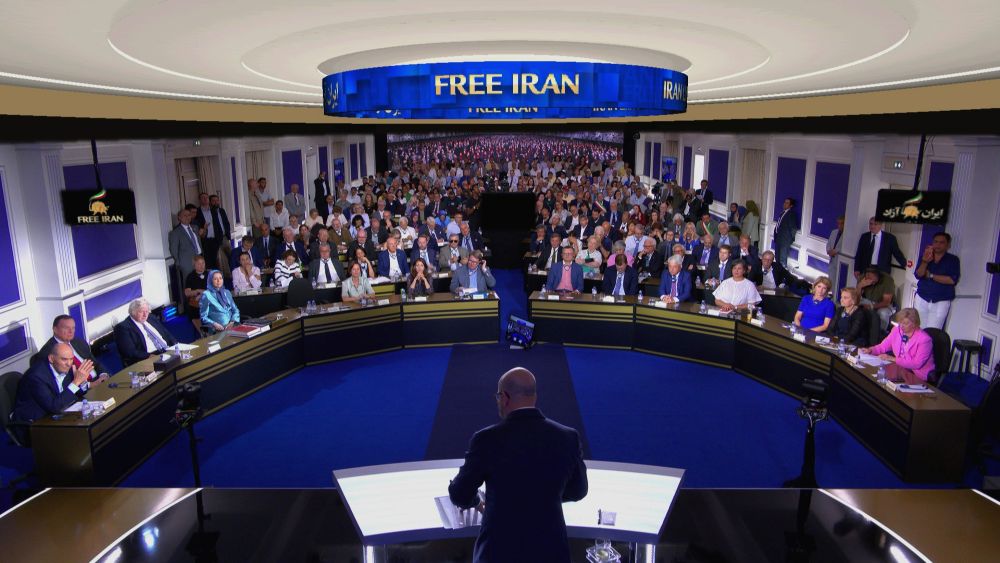
My dear friends, for decades the Iranian people have suffered and continue to suffer from dictatorships: the dictatorship of the shah and the dictatorship of the mullahs.
The atrocities committed by the SAVAK, the political police of the shah, are engraved in flesh and memory, and are an integral part of the political heritage of the shah and all those who claim it.
Today, a different time, a different dictatorship, other atrocities committed by the Revolutionary Guards.
Today, I stand before you with Boris Johnson, with Dmytro Kuleba, and with so many other friends of a free Iran, and I would like to send you three messages.
My first message: appeasement of a dictatorship does not work. Appeasement does not work, never.
Appeasement does not work, not under Nazism—Hitler in Europe—not in Russia, and not in Iran.
Appeasement of Hitler’s regime was tried; it did not prevent the Second World War and the horror of the Holocaust.
Appeasement of Russia was tried, notably after the annexation of Crimea; it did not prevent this painful war of aggression against Ukraine.
In Iran as well, the diplomacy of appeasement was tried, relentlessly. The same behaviors produce the same results and the same failures.
The strategy of appeasement was abused every single time by the mullahs’ regime to buy time, to develop nuclear weapons, to develop ballistic missile programs, to export hatred and terrorism, and to continue domestic oppression, while also using the kidnappings of foreigners as political bargaining chips abroad.
In fact, appeasement prolongs the suffering of the Iranian people. No to dictatorship, yes to freedom!
Dear friends, there is a second message I want to address to you today: war does not work. Yes, Madame Rajavi, you have repeated it often, time and again, war does not work.
Of course, the ceasefire offers some respite to the Iranian people, but who here can believe that this ceasefire addresses the root causes of the Iranian tragedy? And above all, who can believe the word of a regime, of a dictatorship that has betrayed again and again, beginning with the betrayal of its own people?
Ladies and gentlemen, in reality, we are convinced that there is another way. There is an alternative. There is another option.
This option is, of course, the organized, democratic, determined resistance, which believes in and wagers on the empowerment of the people in the face of tyranny.
I say this to you because I feel it in my very bones: when a people rises, united by suffering, united by executions, when a people rises, united by hunger and thirst, united by a common soul and a common destiny, by commitment to a shared project, nothing can stop a people that rises.
Of course, I am not Iranian. But I know. I know that the scale of democratic support from the outside can help make a difference.
That is why I refuse indifference. And because I refuse indifference, I stand alongside the organized, democratic Iranian opposition.
I invite more ordinary citizens and leaders around the world to refuse indifference, to stand up. No to dictatorship, yes to freedom!
Madame Rajavi, dear [National Council] of Resistance [of Iran] and all the coalescing organizations, you gather once again today, whether some like it or not, thousands of Iranians in Paris, just as you did yesterday in Berlin, Rome, and other places, much like the thousands of French who rose up in Paris for the French Revolution of 1789, much like the thousands of Ukrainians who rose up on the Maidan to carry this hope for freedom.
I would like to ask all my European friends, especially those who sometimes express doubts, shrug their shoulders, or show some skepticism: what organization in Europe, what political party in Europe is capable of mobilizing tens of thousands of activists in the streets for democracy, freedom, and hope?
You bring together in Europe, you bring together all over the world, you bring together in Iran, on the ground, the Resistance Units who, courageously, risking their lives, carry this hope and commitment for freedom, for a democratic Iran.
Ladies and gentlemen, the Iranian people have the right to choose. That is the fundamental question.
The Iranian people have the right to choose, and that is exactly the heart of the Ten-Point Plan that you carry.
I say once again to my European friends, those who sometimes show a certain skepticism: take a minute, two minutes, and read this document, this Ten-Point Plan.
This Ten-Point Plan, first: it is a choice for democracy, through a democratic republic of Iran anchored in legitimate institutions thanks to, as you said, free and transparent elections, an independent judiciary that guarantees the equality of everyone before the law, and the abolition of the death penalty. That is democracy.
Then, this plan is also about freedom. The freedom of women, Madame Rajavi. Equality between women and men must be guaranteed, along with freedom of opinion, freedom of expression, freedom to protest, and freedom of religion, through a secular and democratic republic of Iran.
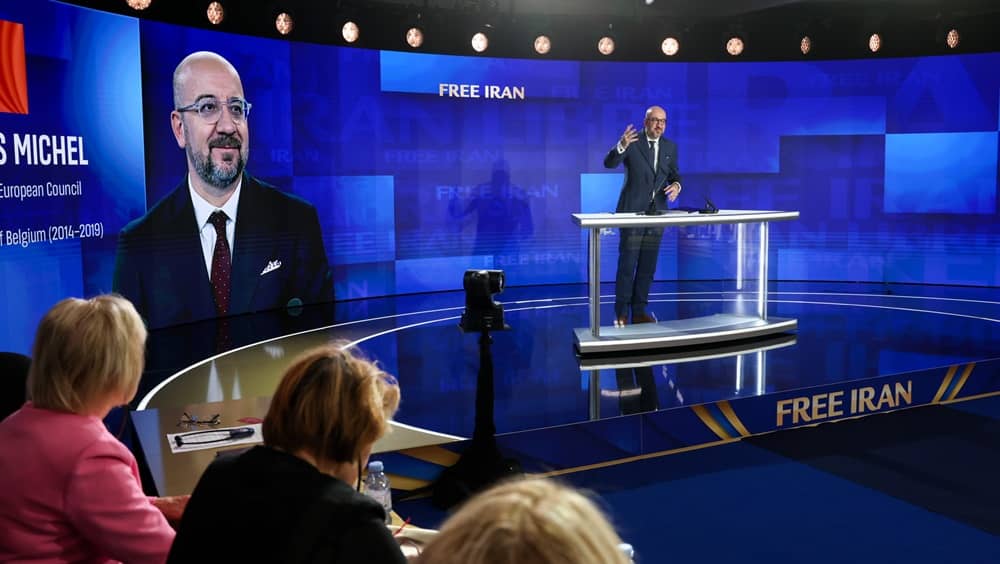
Finally, the third point is an Iran at peace. An Iran at peace with itself, an Iran at peace with its own population, but also an Iran at peace with its neighbors and the rest of the world—a non-nuclear Iran that cooperates for stability and prosperity.
There you have it, ladies and gentlemen, what this Ten-Point Plan is.
We must repeat it, constantly, tenaciously, so that this message finally gets through and is heard.
I would like to tell you—having been a member of this European Council for 10 years, where Boris Johnson also sat for a few years, a Council that brings together the 27 governments of the European Union—I would like to tell you that when I read this Ten-Point Plan, I see in it a powerful resonance.
I see a resonance because this Ten-Point Plan, in truth, is in my eyes equal to the promises made by the founding fathers of the European Union to European citizens after the tragedies of two world wars and the Holocaust: democracy, peace, freedom, prosperity. That is what the Ten-Point Plan is.
To move, in reality—and we know what this means in Europe—from obscurantism into light.
This Ten-Point Plan is the source code for an Iran of the future, an optimistic Iran, an Iran anchored in prosperity and anchored in freedom.
Mesdames et messieurs, Iran today, in reality, is the thermometer. It is the thermometer of our credibility and our sincerity, but also, perhaps, Iran is a test of our lucidity.
Once again, and this is nothing new, the regime wants people to believe in its invincibility, wants people to believe there is no alternative, wants to impose this idea that absolutely nothing could replace it.
To be sure, the war has indeed given it a semblance of internal respite because it slowed down the mobilization of the Iranian people.
But the fundamental parameters have not changed by a millimeter, have not changed by a iota.
Iran is a country rich in resources, but Iranians are left without resources. No bread, no electricity, no water, because the regime squanders the Iranians’ money on the nuclear and ballistic missile race.
A regime that is not capable of meeting the primary needs of its people is a vulnerable regime.
And the regime knows it. Moreover, the degree of the regime’s fear is measured by the degree of horror committed to maintain itself in power.
It is afraid of its youth, it is afraid of its students, it is afraid of Iranian women, it is afraid of the singing of Iranian women, it is afraid of the faces of Iranian women, it is afraid of the students and the merchants of the Grand Bazaar.
A regime that is afraid, that executes and terrorizes, is, I tell you, a regime on borrowed time.
History has often shown that change unfolds slowly, but then occurs suddenly and abruptly.
No system based on fear can withstand the test of time and the test of a determined people when they wage a just struggle.
The regime wants to make people believe that change is impossible. But change is possible, and change, in truth, is underway.
Change is in the heart of each of you here in Paris, in the heart of the activists I salute at Ashraf 3 who are also survivors. It is in every demonstration, in Tehran, in Mashhad, in Isfahan.
Change is in every act of resistance. Change is in the eyes of those condemned to death who, to their last breath, defy their executioners.
Change is in the dignity of women harassed by the morality police who keep their heads held high.
Change is in the dream of each student who raises a fist. Every act of resistance is a cry from the heart.
I say to you: we hear you. We listen to you, and you are not alone.
We admire your courage in the face of intimidation, in the face of defamation, in the face of disinformation, and in the face of threats.
You are not alone. Every day, more of us stand by your side.
The history of humanity is marked by trials, by cruelties and by injustices, but the history of humanity also reveals that there is no inevitability.
And when courageous, visionary, and united women and men stand up, they have the strength to change the course of history.
I deeply believe in the power of ordinary women and men transcended by their meeting with truth.
Let each of us be resisters, builders of freedom, because the hour of choice is near. The hour of choice is now.
We are on the right side of history, on the side of a republican, democratic, and free Iran.
Free Iran! Thank you. Thank you very much.