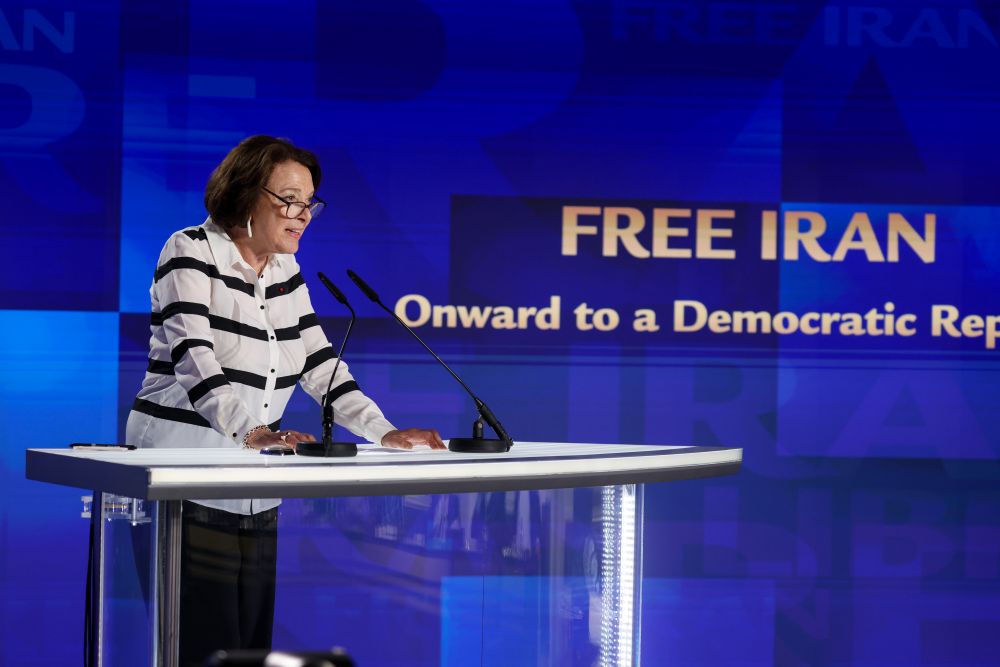
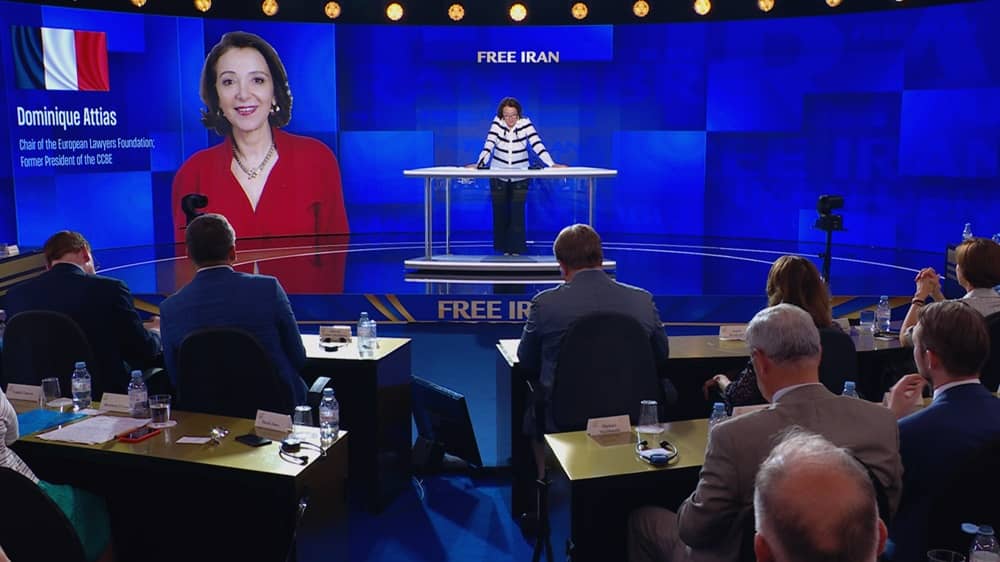
Addressing the Free Iran 2026 World Summit in Paris, renowned lawyer and Chairwoman of the Board of Directors of the European Lawyers Foundation Dominique Attias strongly criticized the French government’s decision to prohibit a planned peaceful rally in support of the Iranian Resistance.
The demonstration, which organizers expected would draw tens of thousands of participants from around the world, was blocked shortly before it was scheduled to take place. According to Attias, the decision came amid diplomatic pressure from the Iranian regime and represented a troubling setback for democratic freedoms in France.
Expressing her disappointment with the authorities’ actions, Attias argued that the ban undermined fundamental rights, including freedom of expression and peaceful assembly. She rejected the justification that the measure was necessary to preserve public order, describing the move as an unacceptable concession to authoritarian pressure.
Drawing on her experience as a lawyer who has represented and advocated for Iranian women subjected to imprisonment and abuse, Attias warned that restricting support for democratic movements abroad ultimately strengthens repressive forces inside Iran. She stressed that silence in democratic societies can have serious consequences for those fighting for freedom under authoritarian rule.
Attias also pledged to challenge the decision through every available legal avenue, including appeals before European judicial institutions. Reaffirming her commitment to defending human rights and democratic values, she declared that neither political pressure nor administrative restrictions would deter her from supporting the Iranian people’s struggle for liberty.
A translated version of Dominique Attias’ speech follows:
I am proud to be a woman.
Ladies and gentlemen, friends of Ashraf 3,
There are silences that kill. There are bans that dishonor.
Yes. Yes, Mr. Johnson, we are all disappointed, but more than that. We are very angry, very angry.
Today, it is our Republic, it is my Republic that is dishonoring itself.
A peaceful demonstration had been authorized.
Peaceful: not a single weapon, not a single threat, not a single cry of hate.
Only men and women standing up, who came to express their rejection of the gallows erected in Tehran, Isfahan, [and] Shiraz; who came to say that you cannot hang a nation’s youth without the free world raising its voice.
And now, the government, after having accepted it, bans it.
And now, a judge, invoking public order, validates this retreat.
Public order…
They dare to confront unarmed citizens with “public order,” when they have failed to confront the executioners who kill.
Whose order? What order?
For we are not fooled. When a democracy forbids the denunciation of a theocratic regime’s hangings, we must call it what it is: fear, complacency, and the hand of the mullahs weighing, from a distance, on our own institutions.
We do not silence human rights defenders to protect the peace. We silence them so as not to displease tyrants.
The freedom to demonstrate is not a favor granted by the state on sunny days.
It is a right—a right guaranteed by our Constitution, by the European Convention on Human Rights, and by the Declaration of 1789, which proclaims that the free communication of thoughts and opinions is one of the most precious rights of man.
To forbid is the exception; to authorize is the rule.
And when the exception becomes the instrument of diplomatic surrender, it is no longer law: it is cowardice dressed up as legality.
I am a lawyer. I defend Iranian women. I know their names, their faces, their cells.
I know what it means to be imprisoned, tortured for a slogan, and hanged for having dared to live free.
Those women did not lower their eyes before the Guardians of the Revolution.
And we, here, in the land of human rights—or rather, alas, as Robert Badinter so rightly pointed out, the land of the Declaration of the Rights of Man—would we lower our own eyes before a threat phoned in from an embassy?
Never!
For our silence would be their condemnation. Every demonstration banned in Paris is one more rope tightened in Tehran.
Every retreat by our leaders is one more smile on the faces of the torturers and the friends of the son of the Shah.
So, I say this with gravity and with anger: we will not ask for permission to defend human dignity.
We will continue to challenge this ban before every jurisdiction. We will take it, if necessary, all the way to Strasbourg.
And we will take to the streets, because a democracy that forbids defending the oppressed has nothing left to protect other than its own shame.
Long live the freedom to demonstrate! Long live Human Rights with a capital H!
And long live the women of Iran, we will not abandon you. Zan, Moqavemat, Azadi. Woman, Resistance, Freedom.
And long live these Iranian people who, through their courage, teach us the lesson that our leaders have forgotten.
Thank you.