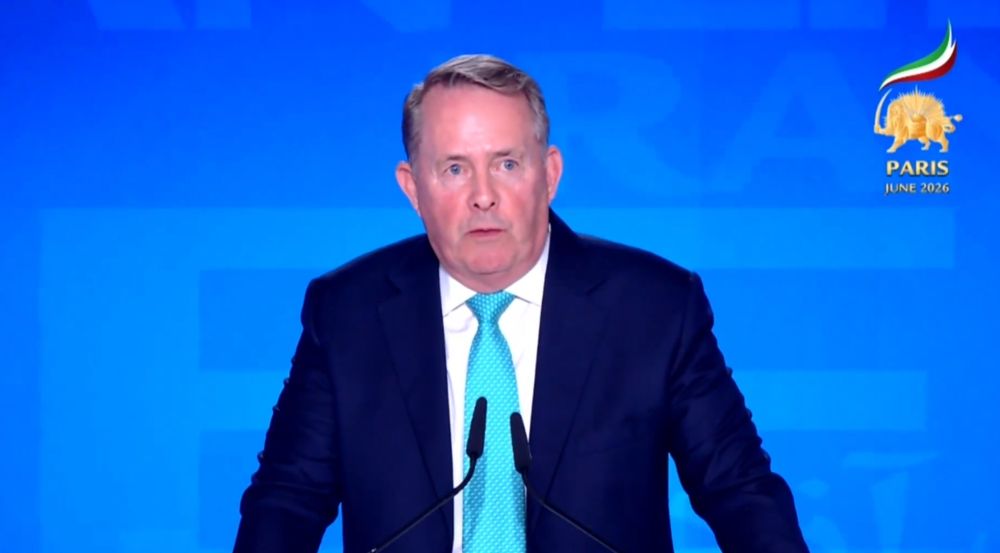
Addressing the Free Iran 2026 World Summit in Paris on June 21, 2026, British MP Sir Liam Fox delivered a speech focused on the Iranian people’s right to determine their own future and the urgent need for a secular and democratic system of governance. While acknowledging the wider geopolitical context, he directed attention to the human consequences of the current regime’s continued rule and argued that Iran’s democratic future ultimately depends on the will of its citizens.
Fox stressed that decisions about Iran’s political future belong solely to the Iranian people rather than foreign governments or authoritarian institutions. He highlighted the country’s young, well-informed generation, noting that their access to technology and awareness of democratic societies make them a driving force for meaningful change from within. Drawing attention to decades of economic hardship, political repression, and persistent human rights abuses, the former U.K. Defense Secretary said that the Iranian people themselves are best positioned to shape the country’s future.
During his remarks, Fox also rejected the portrayal of Iran’s ruling establishment as a legitimate religious authority. He argued that the leadership has used religion as a political instrument to preserve its grip on power, rather than reflecting authentic religious principles, describing this approach as a means of exploiting faith for political control.
He concluded by urging the international community to stand with the Iranian people in their pursuit of a secular and democratic republic. According to Fox, supporting the aspirations of the Iranian population represents not only a political choice but also a moral responsibility, one that can help lay the foundation for a future based on the rule of law, democratic governance, and respect for fundamental human rights.
Excerpts of Sir Liam Fox‘s speech follow:
Madam Rajavi, it’s lovely to see you again today. Even more to our friends in Ashraf 3, it’s wonderful to see you. And even though we’re not always able to see you, please be assured that you are always on our minds.
The MOU has been signed, [and] the talks in Switzerland have begun.
Profound questions demand honest reckoning, and profound truths need repeating. And the most profound truth is this: there will not be peace in the region and beyond as long as the current Iranian regime stays in power.
The West must learn that they can be no more reasoned with today or trusted today than at any time in the past 47 years. The wolf may lose its teeth, but it never loses its appetite.
The region that emerges from this war is not more stable than the one that entered it. Old alliances have been tested and some have been fractured.
Iran’s counterstrikes on the Arab Gulf states, some of whom had sought to deepen their relations with Iran, will leave Iran further isolated, not less.
And what’s been the effect on the wider world? This was never just a regional conflict.
The moment Iran closed the Strait of Hormuz, it became a crisis for every economy on earth.
The International Energy Agency characterized it as the largest supply disruption in the history of the global oil market, echoing the 1970s energy crisis through acute energy shortages, currency volatility, rising inflation, and heightened risks of stagflation and recession.
No one can say this is not our conflict, because the consequences are yours.
The reopening of the Strait under the MOU offers relief, but markets are clear-eyed about the timeline. Energy disruptions of this magnitude do not reverse overnight.
The world has been reminded brutally of its dependence on a narrow waterway, and Iran has seen what an easy weapon they can muster.
They must be told now, unequivocally: no right of blockade, no right to freeze, no breaking of international maritime law.
And the international community must be willing to face down the challenge by international force if necessary, or face anarchy on the high seas.
What about Iran’s ballistic missile arsenal?
Critically, the MOU offers no treatment of Iran’s ballistic missile arsenal whatsoever, leaving Iran’s neighbors to contend with a threat that remains very much alive.
The missile question is deferred to the 60-day final negotiations, where it will be, literally, the most explosive issue on the table.
The Institute for the Study of War assessed that Iran will likely use its renewed economic access to reconstitute the Axis of Resistance during the 60-day negotiating period, noting that Iran has already told Hezbollah that it will increase funding as soon as frozen assets are relaxed.
Iran has made no public statements committing to stop funding its proxies, despite this being reported as a condition in negotiations.
And the Houthi leader declared the ceasefire a great victory for Iran and the Axis of Resistance, which tells, I’m afraid, its own story.
But of all the consequences of the war, the suffering visited upon ordinary Iranians is the most consistently overlooked.
They didn’t choose their Supreme Leader. They didn’t choose their nuclear program. They didn’t choose the regime’s decades of confrontation with the West. But sadly, they are paying the price for it.
The conflict triggered rapid leadership transition and internal instability, while civilians experienced mass displacement, infrastructure damage, internet blackouts, and severe restrictions on daily life, with reports of deteriorating humanitarian conditions, increased oppression, and limited access to basic services.
And worst of all, the inhuman program of executions by the regime has continued as the world watches.
Young lives snuffed out simply to send a political message. What could be more immoral than that?
Some have argued that the war may actually have helped the Iranian regime, and this may have a small element of truth in the short term.
But as we’ve heard today, the factors driving Iran to an internally driven regime change remain unchanged: [a] failing economy leaving ordinary Iranians poorer than before the 1979 revolution, the sickening violent repression, the lack of political legitimacy, and a huge young population who can see on their phones how much better life could be without the regime.
Let me tell you, the young people of Iran will get to reclaim their birthright, to live in a secular, democratic republic, where the law is the impartial tool of justice, not a weapon of repression by the tyrants.
I wanted today, if I may, to make one plea to everyone here, all our friends and all the governments here today.
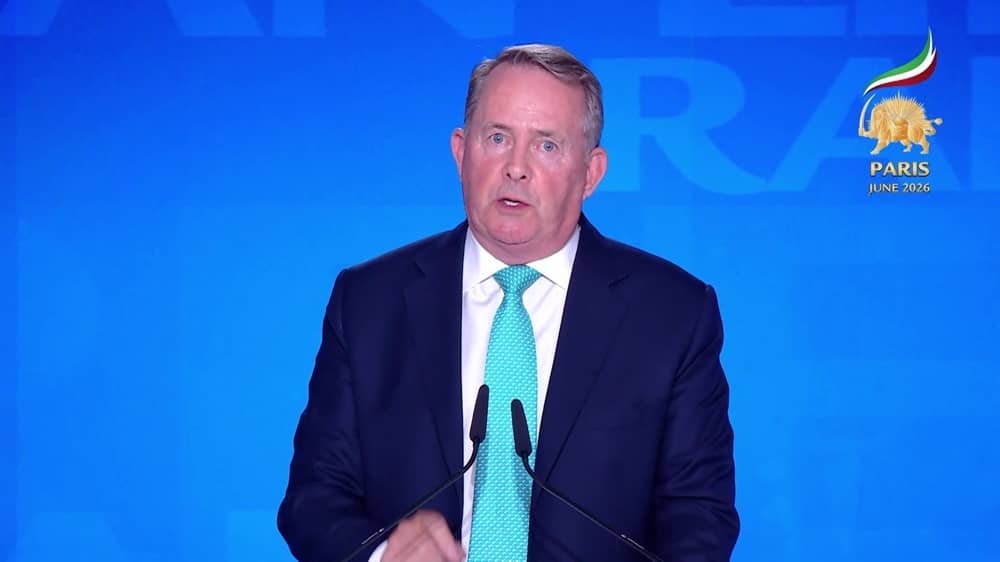
Please, can we stop talking about the Iranian regime as some sort of religious authority? Even to call them religious extremists gives them some of the legitimacy that they crave.
For theirs is religion without decency, religion without tolerance, religion without mercy, religion without compassion, [and] religion without the love of their fellow men and women. It is not religion at all.
They are not religious extremists. They are extremists who use religion as a vehicle in the vilest possible way.
The MOU is at its best a framework for a deal, not the deal itself. The hardest questions—missiles, proxies, enrichment, reconstruction—all remain open.
What has been achieved is the end of active combat and perhaps the reopening of global shipping. And that is not nothing, but it’s far from everything that we were promised or may have expected.
The next 60 days will determine whether this ceasefire becomes the foundation of a new order or merely the intermission before the next crisis.
I say this to our political friends, that self-delusion is not the road to peace.
Hope is no substitute for cold reason, and wishful thinking is a poor basis for foreign and security policy. History is very much in the balance, and it’s our job to make sure it tips the right way.
There is only one group in this world that has the right, the authority, and the power to determine who governs the people of Iran.
Not foreign governments, not tyrants, and certainly not monarchs. It is only the Iranian people themselves, and it’s our duty to fight for that freedom.