



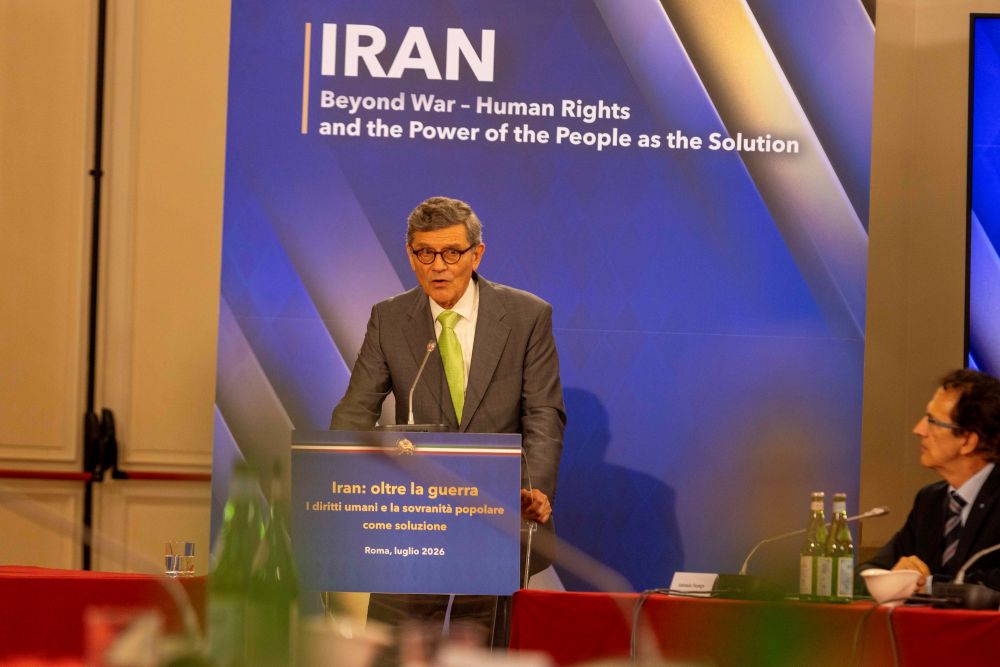
Rome – July 17, 2026 — Speaking at the international conference “Iran Beyond War, the Power of the People,” former German Ambassador to Afghanistan Hans-Ulrich Seidt argued that Iran’s ruling establishment is facing mounting pressure on multiple fronts and voiced strong support for Maryam Rajavi’s democratic vision for the country’s future.
At the outset of his address, Seidt observed that despite the instability shaping today’s international landscape, the Iranian regime itself is entering an increasingly fragile phase.
“There is no doubt that the foundations of the Iranian regime are shaking.”
He structured his assessment around three key areas—military, economic, and political—contending that together they reveal a regime whose ability to sustain itself is steadily eroding.
Military Action Is Not a Substitute for Political Change
Addressing recent military developments, Seidt maintained that military force alone cannot resolve Iran’s long-standing political crisis. While acknowledging the ongoing conflict, he stressed that airstrikes are incapable of bringing about democratic transformation.
“Political change in Iran will not be brought about by the American and Israeli air campaigns.”
He emphasized that genuine and lasting political change must be driven by the Iranian people themselves rather than imposed through foreign military intervention.
The Iranian People Remain the Driving Force for Change
Reflecting on successive nationwide uprisings over the past decade, Seidt said these movements demonstrate that a significant portion of Iranian society no longer accepts the existing political order.
“The January uprising demonstrated the people’s willingness to challenge their repression and to end the regime.”
He argued that Iran’s future ultimately depends on the determination of its democratic opposition rather than on external actors.
“The future of Iran will not depend on foreign intervention, but on the democratic opposition within the country.”
Endorsement of the NCRI and Maryam Rajavi’s Democratic Platform
Seidt expressed strong backing for the National Council of Resistance of Iran (NCRI), describing it as a credible democratic movement committed to freedom and democratic values.
“This opposition is genuine. It is ready to make sacrifices for freedom and democracy.”
He also cautioned against attempts to promote alternative political figures from outside the country, arguing that such efforts divert attention from Iran’s organized democratic opposition and weaken the broader movement for change.
Seidt praised Maryam Rajavi’s Ten-Point Plan, calling it a practical and achievable blueprint for a democratic transition in Iran.
“Maryam Rajavi’s Ten-Point Plan reflects the aspirations of the Iranian people.”
He noted that the plan envisions holding free and fair elections within six months following the collapse of the current regime.
“Today, such a scenario is no utopian idea. It is a realistic option for the future.”
A Message to Europe
In his concluding remarks, Seidt argued that the emergence of a secular, democratic Iran founded on human rights and the rule of law would benefit not only the Iranian people but also the broader Middle East and the international community.
He called on European governments to actively support this democratic alternative.
“The member states of the European Union must support it.”
Seidt concluded that meaningful European engagement in support of the Iranian people’s democratic aspirations offers the most promising path toward lasting peace, regional stability, and the establishment of a democratic, secular Iran that respects fundamental human rights.