



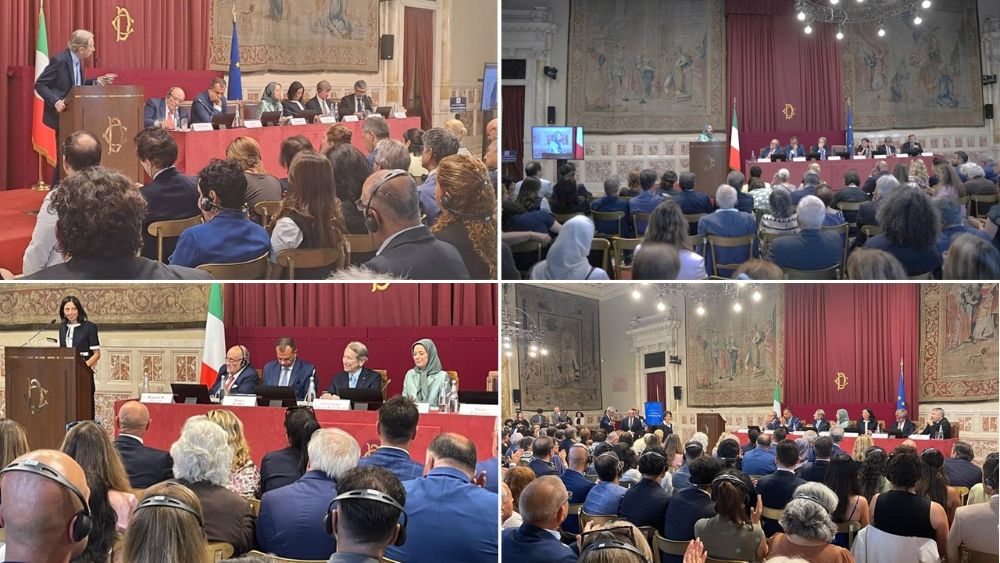
Iran’s Crisis: The Democratic Path Forward — Italian Lawmakers Stand with the Iranian People’s Democratic Aspirations
On July 16, 2026, the Italian Chamber of Deputies hosted a major conference entitled “Iran’s Crisis: The Democratic Path Forward” in Regina Hall in Rome. The gathering brought together leading Italian lawmakers, former international officials, and representatives of the Iranian democratic opposition to discuss the deepening political and human rights crisis in Iran, regional instability, and the broader security consequences of the current regime’s policies.
During the conference, Italian lawmakers emphasized the importance of maintaining the designation of the Islamic Revolutionary Guard Corps (IRGC) as a terrorist organization, ending the failed policy of Western appeasement toward Tehran, and rejecting all forms of dictatorship—whether the current theocratic rule or any attempt to restore the former monarchy.
The speakers stressed that lasting peace and security in the region and beyond are closely connected to supporting the Iranian people and their organized Resistance Units in their efforts to establish a free, secular, and democratic republic.
🇮🇹 Conference on Iran’s Democratic Future Held at the Italian Parliament
A conference titled “The Iranian Crisis and a Democratic Solution for the Future” was held today at the Italian parliament.pic.twitter.com/owvNh1rjCe
The event featured speeches by Italian lawmakers, Mrs.…
— SIMAY AZADI TV (@en_simayazadi) July 16, 2026
Maryam Rajavi: A Democratic Republic Based on Freedom, Equality, and Human Rights
As the keynote speaker, Mrs. Maryam Rajavi, President-elect of the National Council of Resistance of Iran (NCRI), addressed the severe political deadlock facing Iran’s ruling religious dictatorship. She explained that the regime’s survival depends on three main pillars: domestic repression, efforts to acquire nuclear weapons, and regional warmongering.
Presenting the NCRI’s Ten-Point Plan as a roadmap for Iran’s democratic future, Mrs. Rajavi stated:
“We seek a democratic republic based on the separation of religion and state, gender equality, and the abolition of the death penalty; a non-nuclear Iran, free of weapons of mass destruction, founded upon peace, coexistence, and international and regional cooperation.”
Mrs. Rajavi firmly rejected any possibility of returning to dictatorship, emphasizing that attempts by the Shah’s son to promote a restoration of the monarchy contradict the democratic aspirations of the Iranian people.
She stressed that the true force capable of bringing fundamental change in Iran is the organized resistance movement and the Resistance Units operating inside the country.
“I must emphasize that by ignoring the Iranian people and their organized resistance, Europe has deprived itself of its most effective leverage in its policy toward Iran,” she stressed.
Warning about the consequences of allowing the current regime to remain in power, Mrs. Rajavi stated:
“As long as this regime remains in power, the region will never see peace and tranquility.”
She continued:
“No matter how much financial resources and commercial contracts it receives, it will never abandon its warmongering. It is a profound mistake to believe that a day will ever come when this regime abandons its hostility toward Iranian society and the international community to embrace peace and coexistence.”
The NCRI President-elect concluded her remarks by calling on Europe to recognize the role of the Iranian people and their organized resistance in shaping the country’s future:
“Let me make it clear that Europe will regain its credibility in the Middle East only when it plays an effective and active role at the very epicenter of the region’s crisis, namely, in Iran. And this is nothing other than recognizing the will of the Iranian people to overthrow the regime and establish a democratic republic.”
Italian Parliament: The Iranian Crisis and a Democratic Solution for the Future
By adopting a resolute stance against the terrorist dictatorship ruling Iran, Italy and the European Union must not turn a blind eye to the regime's crimes against humanity, nor grant impunity to its… pic.twitter.com/ORNL6AC8xi
— Maryam Rajavi (@Maryam_Rajavi) July 16, 2026
Naike Gruppioni: The International Community Must Support the Iranian People’s Struggle
The conference organizer, Naike Gruppioni, Member of the Foreign Affairs Committee of the Italian Chamber of Deputies, highlighted what she described as the moral and institutional responsibility of democratic countries to support the Iranian people’s pursuit of freedom.
Welcoming Mrs. Rajavi, Gruppioni described her as a symbol of hope and determination for millions of Iranians who aspire to live in a free and peaceful country. She emphasized the importance of the Iranian Resistance’s democratic program and explicitly supported its vision for Iran’s future.
Referring to Mrs. Rajavi’s leadership and political vision, the Italian lawmaker stated:
“Hers [Maryam Rajavi’s] is a vision that looks to the future and continues to inspire those who believe that change can be born from the strength of ideas and the will of the people, the Italian MP said. “With courage, determination, and extraordinary consistency, she has continued for years to carry forward a battle founded on the universal values of freedom, democracy, the rule of law…”
She further praised the NCRI’s Ten-Point Plan as a clear political framework for a democratic Iran:
“Her Ten-Point Plan constitutes a clear and credible political proposal for a free, pluralistic Iran that respects human dignity,” she stated.
Gruppioni warned that silence in the face of systematic repression, particularly against women and young people, cannot be considered neutrality.
She argued that when a regime violates fundamental rights on such a scale, the international community has a responsibility to take meaningful political action and that defending human rights requires a firm rejection of dictatorship.
🇮🇹 MP @naike_gruppioni said it was both a great responsibility and an honour to host, in the Italian Parliament, a conference dedicated to a free Iran and the defence of human rights.
Addressing #MaryamRajavi directly, she said that her presence represented far more than that of… pic.twitter.com/lEYO6ZX33f— Javad Dabiran (@JavadDabiran) July 16, 2026
Rudy Giuliani: The NCRI and MEK Represent the Viable Democratic Alternative
Adding an international perspective to the discussion, former Mayor of New York and former U.S. Federal Prosecutor Rudy Giuliani delivered a strong criticism of both the ruling Iranian regime and any attempts to revive the former monarchy.
Giuliani argued that the National Council of Resistance of Iran (NCRI) and the People’s Mojahedin Organization of Iran (MEK) represent the only organized democratic alternative capable of leading Iran toward freedom and democracy.
Rejecting the possibility of restoring the monarchy, he sharply criticized the ambitions of the Shah’s son, describing him as a figure disconnected from the democratic aspirations of the Iranian people and surrounded by remnants of the former security apparatus.
Addressing the issue of a possible return to monarchist rule, Giuliani stated:
“When they give you the Shah, bring him to me. And tell him, when he returns the money that he stole and the food that he took out of the mouths of his people, maybe we can give him a job in the post office.”
In Rome today, @RudyGiuliani says the Shah’s son Reza Pahlavi is not a credible alternative to the mullahs in Iran.
“After you overthrow one tyrant and then you overthrow the second tyrant, you don’t put the first tyrant back in charge. That’s stupid.”
CC: @RapidResponse47 https://t.co/uTV85x1MPG pic.twitter.com/sxJSnUuKVg
— M. Hanif Jazayeri (@HanifJazayeri) July 16, 2026
Giuliani emphasized that the MEK’s legitimacy has been built through decades of sacrifice, organization, and political preparation. He specifically praised Mrs. Rajavi’s framework for a transition government and the NCRI’s Ten-Point Plan, highlighting their commitment to protecting civil liberties, women’s rights, and democratic principles.
Condemning the Western policy of appeasement toward Tehran, Giuliani argued that the religious dictatorship cannot be defeated through negotiations or concessions alone, but requires support for the organized forces inside Iran that are prepared to challenge the regime.
Expressing his confidence in the leadership of Mrs. Rajavi and the Iranian Resistance, he stated:
“We know what we’re getting in Madame Rajavi and we know what we’re getting in the MEK and the NCRI and the various groups that have been working not for a day, not for a week, not for a month, for 47 years and before that against the Shah.”
Addressing the regime’s extensive propaganda campaign against the Resistance, Giuliani emphasized the importance of international political support:
“The only way we can do [confront] that, and this is where political support is enormously important, is my people in all these governments, all over Europe, all over the United States, and every place else we have to go, standing up and saying, we got an answer, MEK is the answer.”
An honor to speak in front of this distinguished group. There is an alternative to the current evil regime of Mullahs and IRGC. @Maryam_Rajavi offers a framework for a democratic republic. She is poised to offer an interim government and hold a free and fair election in six… https://t.co/3E1qsp0pmQ
— Rudy W. Giuliani (@RudyGiuliani) July 16, 2026
Fabio Rampelli: Tehran’s Regional Destabilization Requires a Firm International Response
Providing an institutional perspective, Fabio Rampelli, Member of the Italian Parliament, highlighted the broad political support for the Iranian people’s aspirations for freedom and democracy.
Rampelli referred to ongoing investigations by the United Nations Human Rights Council into the Iranian regime’s serious violations, including mass arrests, executions, and the use of repression as a tool to silence opposition.
He strongly condemned Tehran’s regional policies, emphasizing the role of the Islamic Revolutionary Guard Corps (IRGC) and affiliated proxy groups in spreading instability beyond Iran’s borders.
Discussing the regime’s international activities, Rampelli stated:
“The military aid provided to the Russian Federation in the war of aggression against Ukraine with the transfer of drones and ballistic missiles, the support to non-state armed groups in the Middle East and the Red Sea area, the Houthis, so to speak, and the actions that have hindered free navigation in the Strait of Hormuz have contributed to a crisis involving essential energy and commercial routes.”
By highlighting these actions, Rampelli stressed the urgent need to prevent Tehran from continuing its export of violence and terrorism and called for a stronger international response to the regime’s destabilizing policies.
Giulio Terzi: Appeasement Strengthens the Iranian Regime and Undermines Freedom
Giulio Terzi, President of the EU Policies Committee of the Italian Senate and former Italian Foreign Minister, delivered a forceful criticism of the Iranian regime, comparing its actions to some of the most destructive forms of totalitarianism witnessed in the 20th century.
Senator Terzi rejected the continuation of appeasement policies toward Tehran, arguing that diplomatic engagement without accountability only provides the regime with additional opportunities to strengthen its military capabilities and continue suppressing its opponents.
He also dismissed any proposal to restore the monarchy, criticizing the Shah’s son for avoiding responsibility regarding the authoritarian legacy of his father’s rule.
Commenting on this issue, Senator Terzi stated:
“This is a bit the mental attitude of a monarch who would like to propose himself with self-painted noble titles and who is certainly not up to representing that charge of freedom, of strength, and of will to go forward of the Iranian people which is that of Maryam Rajavi.”
Terzi praised the courage and perseverance of the MEK and the Iranian Resistance, emphasizing that European policy must recognize the organized opposition movement as an essential actor in Iran’s future.
#IRAN: TERZI "TRADIZIONE STRAORDINARIA, NON PUÒ ESSERE DISTRUTTA DA CHI LA GOVERNA"
ROMA (ITALPRESS) – "È una grande emozione prendere la parola dopo Madame Rajavi, Presidente eletta del Consiglio Nazionale della Resistenza Iraniana. L'Iran ha una tradizione straordinaria e… pic.twitter.com/NfVjWfZPg6— Giulio Terzi (@GiulioTerzi) July 16, 2026
Marco Scurria: The Wind of Freedom Cannot Be Stopped
Senator Marco Scurria connected the Iranian people’s struggle for freedom with historic moments of democratic transformation around the world, drawing parallels between the fall of the Berlin Wall and what he described as the possible collapse of the theocratic system in Tehran.
He expressed deep skepticism toward negotiations with the Iranian regime, arguing that Tehran has repeatedly deceived the international community while continuing its repression at home and supporting terrorism abroad.
Senator Scurria emphasized that the existence of an organized resistance movement provides the necessary alternative to break what he described as the regime’s wall of oppression.
Addressing the Iranian diaspora and those resisting inside Iran, he declared:
“Tell them that there is no prison that can stop the wind of freedom.”
He continued:
“Tell them that there is no fear that can subdue millions of citizens, and that there is a struggle worth fighting so that a people can have a free and democratic future.”
Senator Scurria concluded by praising Mrs. Rajavi and the Resistance Units for their courage and determination in continuing their struggle for a democratic Iran.
Patrick Kennedy: Supporting the Iranian Resistance Is the Path Toward Change
Former U.S. Representative Patrick Kennedy concluded the conference discussion by describing the Iranian crisis as one of the most important human rights challenges of the present era.
Kennedy condemned the Iranian clerical regime as one of the world’s leading state sponsors of terrorism and the foremost executioner of its own citizens. He argued that decades of attempts at negotiations and so-called “grand bargains” have repeatedly failed, demonstrating that ending appeasement and confronting the IRGC’s networks are necessary steps toward meaningful change.
Recognizing the strength and endurance of the Iranian Resistance, Kennedy stated:
“We need to be supporting Maryam Rajavi and NCRI and the legions of organized Resistance Units throughout Iran, the MEK’s resistance fighters who’ve been waging this fight for decades.”
He emphasized that just as apartheid and the Iron Curtain eventually collapsed despite widespread doubts, the Iranian clerical regime will also face the same historical fate.
Expressing his full solidarity with the Iranian people and their struggle for freedom, Kennedy concluded his remarks with the powerful declaration:
“I am Iranian.”
Intervento di Patrick J. Kennedy, già membro del Congresso USA, al Convegno "Iran del Futuro. Diritti Umani, Sicurezza e stabilità per una transizione democratica" alla Camera dei Deputati.@FratellidItalia @fdieuropa @FDI_Parlamento @ecrgroup @PJK4brainhealth @fabiorampelli… pic.twitter.com/vRE9J01HJr
— Giulio Terzi (@GiulioTerzi) July 16, 2026