Italian Senate Hearing Focuses on Iran’s Human Rights Crisis
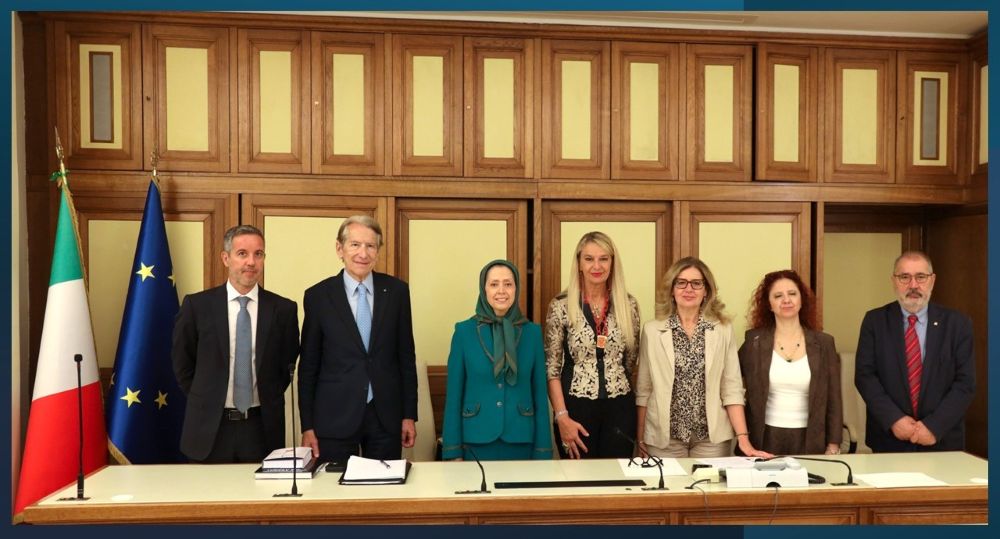
On July 16, 2026, the Human Rights Commission of the Italian Senate held an official hearing with Mrs. Maryam Rajavi, President-elect of the National Council of Resistance of Iran (NCRI). Convened through a formal invitation issued by the Senate Commission, the session was officially broadcast live on the Italian Senate’s WebTV platform. Chaired by Senator Stefania Pucciarelli, President of the Human Rights Commission, the hearing provided an important European forum to address the worsening human rights situation in Iran while outlining a principled, human rights-based approach for Italy and the European Union toward Tehran.
Maryam Rajavi: The Death Penalty Must Be Abolished in a Future Democratic Iran
Addressing members of the Commission, Mrs. Rajavi described the grave deterioration of human rights conditions across Iran. She warned that the ruling clerical regime has dramatically intensified arbitrary executions and mass arrests, using capital punishment as a deliberate instrument of intimidation to suppress public dissent and prevent future nationwide protests.
Recalling Italy’s historic leadership in the international movement to abolish the death penalty, Mrs. Rajavi urged the Italian government to assume a leading role within the European Union in holding the Iranian regime accountable for its systematic violations of fundamental human rights.
Today, Thursday, at a hearing of the #HumanRights Commission of the Italian Senate, I expounded on the critical human rights situation in Iran and reminded the responsibility of European countries, including Italy, in this regard.
Senators strongly condemned the regime’s… pic.twitter.com/Vwds6eOod1— Maryam Rajavi (@Maryam_Rajavi) July 16, 2026
“The Iranian people and their Resistance look to Italy—historically a global pioneer in the movement to abolish the death penalty—to lead the way within the European Union in spearheading decisive measures against the ongoing executions and massacres in Iran.”
Mrs. Rajavi pointed to the execution of political prisoners, including ten members of the MEK Resistance Units in recent months, as evidence of the regime’s intensifying campaign of repression. She also warned that death sentences continue to be issued at an alarming pace.
“The issuance of death sentences continues unabated. The most recent and egregious case involves Arghavan Fallahi, a 25-year-old woman who has endured months of solitary confinement and severe torture, and whose father also remains unjustly imprisoned.”
Presenting the NCRI’s vision for a democratic future, Mrs. Rajavi reaffirmed the movement’s unwavering opposition to torture and capital punishment.
“For the free Iran of tomorrow, we advocate for a complete ban on torture and the total abolition of the death penalty.”
She emphasized that, for more than four decades, the Iranian Resistance has openly rejected Ayatollah Khomeini’s interpretation of Islamic law.
“For over four decades, standing in direct opposition to Khomeini, we have declared the mullahs’ Sharia laws and their retributive penal code (Qesas) to be profoundly inhumane and entirely incompatible with the true teachings of Islam.”
Mrs. Rajavi further outlined the democratic principles envisioned for a future Iran.
“In tomorrow’s Iran, the separation of religion and state, complete gender equality, and all individual and social rights and liberties will be fully guaranteed in accordance with the Universal Declaration of Human Rights. All apparatuses of repression, censorship, and inquisitorial control will be dismantled.”
Madam Chair, Honorable Members of the Human Rights Commission of the Italian Senate,
I am deeply grateful for your steadfast attention to the human rights crisis in Iran. https://t.co/ENHWalGfny— Maryam Rajavi (@Maryam_Rajavi) July 16, 2026
Turning from principles to policy, Mrs. Rajavi called on Italy and the European Union to adopt three urgent measures designed to translate moral responsibility into concrete political action.
Conditional Diplomatic Relations: All diplomatic and economic engagement with Tehran should be conditioned on an immediate halt to executions.
Universal Jurisdiction: Individuals responsible for systematic human rights violations should be prosecuted under the internationally recognized principle of universal jurisdiction, ending the culture of impunity enjoyed by Iranian officials.
Multilateral Accountability: Iran’s human rights violations should be referred to the United Nations Security Council. Any future international agreements with Tehran should be made contingent upon ending executions, while the regime must be compelled to grant unrestricted access to UN fact-finding missions and Special Rapporteurs, including access to political prisoners and detention facilities.
Senator Stefania Pucciarelli: Human Rights Must Remain a Priority
Opening the hearing, Senator Stefania Pucciarelli welcomed Mrs. Rajavi on behalf of the Human Rights Commission and expressed the Commission’s solidarity with the Iranian people in their struggle against severe human rights abuses.
Highlighting the Commission’s longstanding commitment to humanitarian causes, Senator Pucciarelli strongly condemned the Iranian regime’s systematic execution of political opponents. She noted that broadcasting the hearing live through the Senate’s official WebTV platform reflected the institution’s determination to ensure that the voices of Iran’s democratic opposition are heard openly and transparently by the international community.
“Respect for human rights in Iran is among the priorities of this commission.”
She reaffirmed the Commission’s solidarity with both the Iranian people and Iranian women, who continue to suffer under the ruling regime.
“We express our profound solidarity with the Iranian people and particularly with Iranian women, who are suffering due to a regime and have been suffering for too long. Also, through the work of this commission, we seek to advance the protection of human rights [everywhere].”
Senator Giulio Terzi: The Iranian Resistance Is Closely Aligned with the Rule of Law
Providing a broader historical and geopolitical assessment, Senator Giulio Terzi of the Brothers of Italy (FdI) described the hearing as an “extremely important opportunity” to confront the threat posed by the Iranian clerical regime.
Senator Terzi presented alarming statistics regarding the regime’s extensive use of capital punishment, stating that more than 818 arbitrary executions had been recorded in the current year alone. He voiced strong support for the NCRI’s “No to Executions” campaign and drew particular attention to the weekly hunger strikes carried out by political prisoners every Tuesday in more than 25 prisons across Iran.
He described the prisoners’ 45-week campaign as a courageous struggle for freedom and human dignity, emphasizing that their resistance had become a powerful symbol of the fight for civilization against tyranny.
#Iran. Terzi (FdI) : un onore ascoltare in Senato Maryam Rajavi, presidente eletta del Consiglio Nazionale della Resistenza Iranianahttps://t.co/d4FJLO538e
“Oggi l’Iran vive sempre più sprofondato nel baratro delle terribili violazioni di diritti umani e delle atrocità che il… pic.twitter.com/kmAnHwRiZn— Giulio Terzi (@GiulioTerzi) July 16, 2026
The senator also reminded participants of the regime’s international terrorist network, referring to the 1993 assassination of Mohammad-Hossein Naghdi, the NCRI’s representative in Rome, by agents of the Iranian Ministry of Intelligence. He said the killing served as a stark reminder that Tehran’s repression extends far beyond Iran’s borders.
Addressing Mrs. Rajavi directly, Senator Terzi said:
He further emphasized the breadth and depth of the resistance movement:
The former Italian foreign minister concluded by suggesting that the NCRI’s growing support demonstrates that a democratic alternative to the current regime is becoming increasingly credible both inside Iran and internationally.
Senator Gisella Naturale: Italy Has a Moral Duty Toward Iranians Living Under Threat
Senator Gisella Naturale expressed deep concern over what she described as the unrelenting and immeasurable suffering imposed on the Iranian people by the ruling regime. She lamented the absence of any meaningful signs that the ongoing wave of executions and repression might soon come to an end.
The senator also voiced concern that the Iranian Resistance continues to pay a heavy human cost, warning that these losses could hinder the emergence of a force capable of effectively challenging and ultimately overthrowing the regime.
At the same time, she acknowledged the complex geopolitical constraints facing foreign governments, including Italy, noting that the struggle for Iran’s future must ultimately be determined by the Iranian people themselves and by the various components of the resistance movement.
Nevertheless, Senator Naturale argued that Italy bears a clear moral responsibility to protect Iranian expatriates living in Italy, many of whom experience constant anxiety and emotional distress over the safety of their relatives and loved ones inside Iran.
Addressing Mrs. Rajavi, she stated:
She also reflected on the contradiction between Iran’s rich cultural heritage and the continuation of such violence:
Reaffirming Italy’s solidarity with the Iranian people, Senator Naturale concluded with a message of hope for a peaceful and democratic future:
Senator Bartolomeo Amidei: Human Rights Must Not Be Overshadowed by Geopolitical Interests
Senator Bartolomeo Amidei praised the hearing for redirecting public attention from geopolitical and commercial concerns—particularly the international focus on oil tankers navigating the Strait of Hormuz—to the far more urgent issue of systematic repression and human rights violations in Iran.
He stressed that bringing international attention back to the fate of those imprisoned, persecuted, and executed for opposing the regime was both timely and essential.
Addressing the Commission, Senator Amidei stated:
“I believe that at a time when world public opinion, and also Italian public opinion, is more focused on the oil tankers passing through the Strait of Hormuz, turning the spotlight on what is happening in terms of repression, of the lives and deaths of those who protested against the regime, is fundamental.”
The senator formally requested that Mrs. Rajavi’s testimony be entered into the official records of the Human Rights Commission, underscoring the importance of preserving the hearing as part of the Senate’s institutional documentation.
He also warned of an increasingly severe wave of repression inside Iran, referring to reports that Tehran Prosecutor Ali Salehi has established specialized judicial branches tasked with accelerating the issuance of death sentences against detained protesters. According to Senator Amidei, these developments signal an intensified campaign of state violence aimed at crushing public dissent.
Reflecting on the sacrifices made by the Iranian Resistance over the past decades, he acknowledged the heavy price paid by the People’s Mojahedin Organization of Iran (MEK), particularly since the 1988 massacre of political prisoners. He called on all groups opposing the ruling establishment to set aside their differences and unite around the common objective of ending the current regime.
Senator Amidei further urged European governments to adopt a more principled and proactive policy toward Tehran by demanding an immediate halt to executions, securing the release of hostages and political prisoners, and pressing the Iranian authorities to restore unrestricted internet access for the Iranian people.
He also highlighted initiatives he had personally undertaken within the Italian government, explaining that he had appealed to Interior Minister Matteo Piantedosi and Foreign Minister Antonio Tajani to facilitate automatic passport renewals for Iranian students and workers residing in Italy. Such measures, he argued, would provide practical protection for Iranians abroad who often face serious administrative difficulties because of the policies of the Iranian regime.
Concluding his remarks, Senator Amidei emphasized that democratic nations must ensure that the defense of human rights remains at the center of their engagement with Iran, rather than allowing strategic or economic interests to eclipse the plight of the Iranian people.
Iran. Terzi (FdI) : un onore ascoltare in Senato Maryam Rajavi, presidente eletta del Consiglio Nazionale della Resistenza Iraniana https://t.co/1Z6A8Eqj9v via @vocedelpatriota
— 🇮🇹 La Voce del Patriota (@vocedelpatriota) July 16, 2026