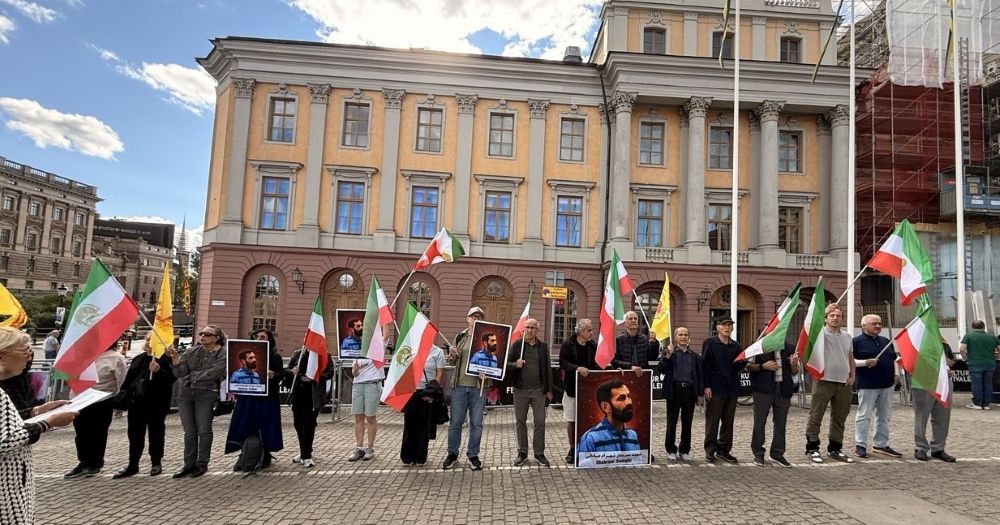

Amnesty International has issued an urgent call to halt the execution of six Iranian men sentenced to death following a trial marred by allegations of torture and severe violations of fair trial standards. The men—Abolhassan Montazer, Akbar (Shahrokh) Daneshvarkar, Babak Alipour, Mohammad Taghavi Sangdehi, Pouya Ghobadi, and Vahid Bani Amerian—were convicted of “armed rebellion against the state” (baghi) by Tehran’s Revolutionary Court (Branch 26) in October 2024. Amnesty International has criticized their case as a glaring example of the Iranian judiciary’s flawed and unjust practices.
The six men, aged 31 to 65, were arrested between December 2023 and February 2024 in Tehran and West Azerbaijan provinces. They were accused of links to the People’s Mojahedin Organization of Iran (PMOI). During their detention in Tehran’s infamous Evin Prison, they reportedly endured severe torture, including beatings, floggings, death threats at gunpoint, and prolonged solitary confinement. Amnesty International claims these methods were used to coerce forced “confessions,” which were later admitted as evidence in court.
The organization further reports that some defendants only met their legal counsel for the first time during a brief two-hour trial. In court, several of the accused revealed that their confessions were extracted under torture, but these claims were dismissed by the judge without investigation.
Abolhassan Montazer, Akbar (Shahrokh) Daneshvarkar, Babak Alipour, Mohammad Taghavi Sangdehi, Pouya Ghobadi & Vahid Bani Amerian are at risk of execution in Iran following a grossly unfair trial. Their death sentences must be intermediately quashed! https://t.co/SIWHPu1xbi https://t.co/8wDgcqpDLY pic.twitter.com/dwtJU0XlHV
— Amnesty Iran (@AmnestyIran) January 24, 2025
Denial of Medical Care
The detainees have also faced denial of proper medical treatment, worsening the health problems caused by torture and the poor conditions of their imprisonment. For instance, Vahid Bani Amerian sustained eye injuries during his arrest, while Abolhassan Montazer suffered severe chest and lung pain due to beatings and exposure to freezing temperatures in unheated cells. Meanwhile, Pouya Ghobadi and Mohammad Taghavi Sangdehi were denied essential medications during lengthy interrogations.
Widening Use of the Death Penalty
This case highlights an alarming trend in Iran, where the authorities increasingly employ the death penalty as a means of quelling dissent. Since the 2022 protests and continuing through 2024, Revolutionary Courts have been issuing harsh sentences—often including death—against protesters, dissidents, and ethnic minorities in proceedings that have drawn widespread international condemnation for their lack of fairness.
Amnesty International is urging immediate action to stop these executions and calling on the global community to hold Iranian authorities accountable for their violations of human rights.
🧵Amid a horrific execution spike in Iran, Amnesty International calls on Iranian authorities to immediately halt the executions of Behrouz Ehsani, 69, and Mehdi Hassani, 48, who were notified last week that their death sentences have been upheld by the Supreme Court. 1/3 pic.twitter.com/UQhAYNJnQs
— Amnesty Iran (@AmnestyIran) January 16, 2025
Following their arrests in 2022, they were subjected to torture & other ill-treatment, including prolonged solitary confinement, to force them to self-incriminate. Their trial by a Revolutionary Court in Tehran was grossly unfair. 3/3
— Amnesty Iran (@AmnestyIran) January 16, 2025
Amnesty International’s Call to Action
Amnesty International has urged Iranian authorities to:
- Immediately halt the executions of the six men.
- Quash their convictions and death sentences, as their detention is arbitrary and violates international standards of a fair trial.
- Conduct an independent investigation into allegations of torture and hold perpetrators accountable.
- Ensure the men have access to adequate medical care and allow meaningful contact with their families and legal counsel.
- Impose a moratorium on executions with a view toward abolishing the death penalty.
The organization has also called on the international community to amplify pressure on Iranian authorities to address these violations and protect the rights of all detainees.
Urgency of Action
Amnesty International warns that time is running out to prevent the executions. The organization emphasizes that the death penalty is a violation of the right to life as enshrined in the Universal Declaration of Human Rights and constitutes the ultimate cruel, inhuman, and degrading punishment.
This case represents yet another example of Iran’s systemic abuse of the death penalty and disregard for human rights. As the international community continues to condemn these practices, Amnesty International stresses the need for immediate action to save the lives of these six men and prevent further injustices under Iran’s judicial system.