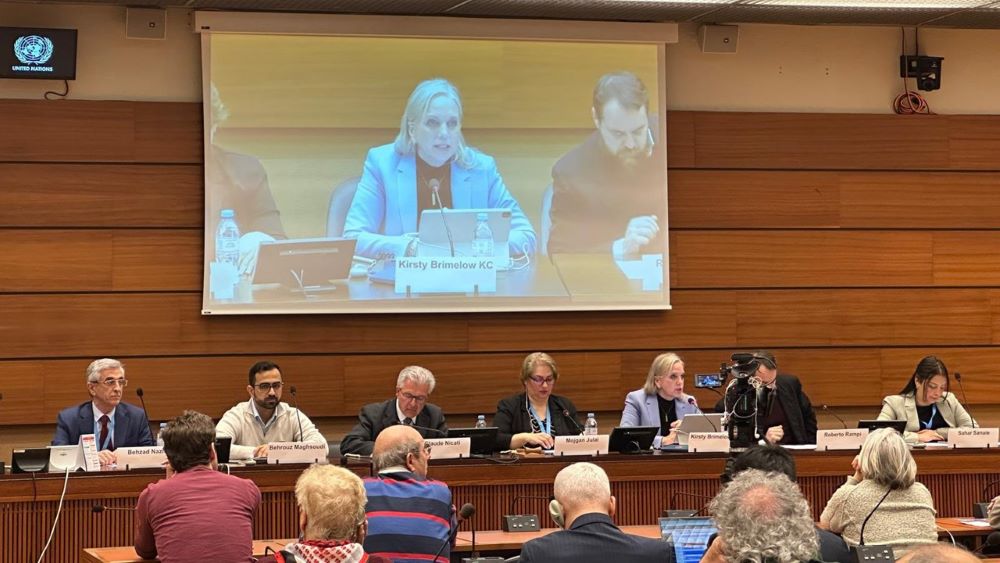
On March 13, 2025, during the 58th session of the UN Human Rights Council, a conference was convened at the European headquarters of the United Nations in Geneva to address Iran’s worsening human rights situation, particularly the alarming rise in executions. The event brought together political figures, legal experts, former political prisoners, and relatives of executed individuals to discuss urgent actions needed to address these violations.
Key Discussions and Calls to Action
Speakers at the conference underscored the critical need for the international community to adopt a firm stance against the Iranian regime, holding its leaders accountable for the 1988 massacre of political prisoners and ongoing crimes against humanity.
Distinguished Speakers:
- Kirsty Brimelow, former Chair of the Human Rights Committee of the Bar of England and Wales (2012–2018) and former President of the Criminal Bar Association of England and Wales (2022–2023).
- Claude Nicati, former Deputy Attorney General of Switzerland (2001–2009) and former President of the Neuchâtel Canton (2010–2011).
- Senator Roberto Rampi, Italian legislator and human rights advocate.
- Behzad Naziri, former journalist and a member of the National Council of Resistance of Iran (NCRI) Foreign Affairs Committee.
- Sahar Sanaii, women’s rights advocate.
- Behrooz Maqsoudi, relative of executed political prisoners.
- Mojgan Joulaee, activist and event moderator.
Insights from the Conference
Opening Remarks: Mojgan Joulaee set the tone by highlighting Iran’s escalating execution rate and broader human rights abuses. She stressed the necessity of international scrutiny and coordinated efforts to seek justice for victims and their families.
Kirsty Brimelow on the 1988 Massacre: Brimelow described the massacre as a systematic campaign against civilians, leading to the execution of around 30,000 political prisoners. She cited UN reports confirming these extrajudicial killings and emphasized the lack of accountability for perpetrators, many of whom still hold high-ranking positions in Iran. She called for preserving evidence to facilitate future trials.
1988 executions in Iran.
Part of my speech @UN_HRC
“The executions had already been decreed against those who did not renounce their political beliefs or hesitated in renouncing their beliefs.
There was a crude and cruel questionnaire. The person did not know that their… pic.twitter.com/oCoGso41te— Kirsty Brimelow KC (@Kirsty_Brimelow) March 14, 2025
Claude Nicati on Accountability for Past Crimes: Nicati discussed the assassination of Dr. Kazem Rajavi, a prominent human rights defender and NCRI Representative in Switzerland, murdered in Geneva in 1990. He argued that the failure to hold Iran accountable for past crimes has emboldened its continued execution policies. Nicati also condemned recent executions of political prisoners Behrooz Ehsani and Mehdi Hassani, dismissing the regime’s claims of due process and labeling Iran’s judiciary a tool of repression.
Sahar Sanaii on Systemic Violence Against Women: Sanaii highlighted Iran’s high rate of female executions and the ongoing repression of women. She pointed to the leadership role Iranian women played in the 2022 uprisings and the growing prison hunger strikes protesting executions and government oppression. She urged global support for Iranian women in their struggle for rights and freedoms.
Senator Roberto Rampi on State Hostage-Taking: Rampi denounced Iran’s use of state hostage-taking, citing cases where Western nationals were detained to pressure foreign governments. He referenced the exchange of convicted Iranian officials, such as Assadi and Hamid Noury, for European hostages, warning that such concessions encourage further human rights abuses and state-sponsored terrorism.
Behrooz Maqsoudi’s Personal Testimony: Maqsoudi shared his family’s tragic history, recounting the execution of three uncles in the 1980s for their political beliefs. He stressed the importance of global advocacy efforts like the “No to Executions” campaign, which has gained traction despite government crackdowns.
Behzad Naziri on the Link Between the 1988 Massacre and Current Executions: Naziri drew a direct connection between the 1988 massacre and today’s execution policies, emphasizing that the regime continues using executions to suppress dissent, particularly targeting opposition members. He urged the international community to renew the UN Special Rapporteur’s mandate and expand investigations into Iran’s human rights abuses.
Panel alarmant sur la peine de mort en #Iran ce jour à @ONUGeneve en marge de la session du Conseil des Droits de l’Homme #HRC58 avec les juristes @Kirsty_Brimelow & @CNicati et plusieurs témoins @SanaieSahar avec le soutien de @Francelibertes #StopExecutionsInIran pic.twitter.com/xiLvJRcSU7
— Behzad Naziri (@BehzadNaziri) March 13, 2025
Conclusion and Call for Action
The speakers collectively called for stronger international measures, including diplomatic and legal actions, to hold Iran accountable for its human rights violations. They warned that without decisive global intervention, the Iranian regime would persist in its policies of repression, executions, and political persecution.