



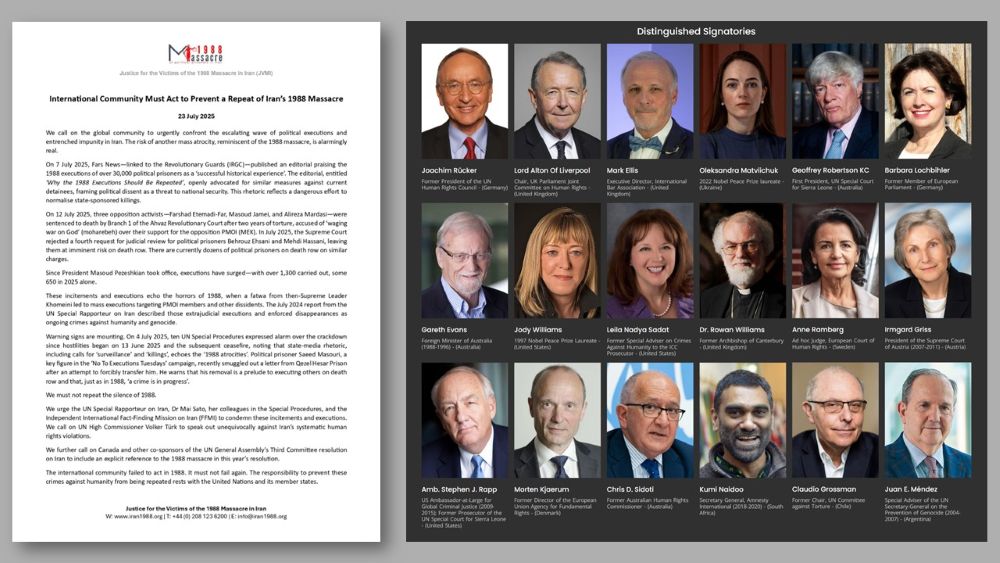
In a powerful and urgent appeal published on July 23, 2025, by Justice for the Victims of the 1988 Massacre in Iran (JVMI), a coalition of 301 leading international figures—including Nobel laureates, former UN officials, human rights experts, and political leaders from over 60 countries—has called on the United Nations to take immediate action to prevent what they describe as a dangerously real risk of another mass atrocity in Iran.
This high-profile statement follows a deeply troubling editorial published on July 7 by Fars News, a media outlet affiliated with Iran’s Revolutionary Guards (IRGC), which hailed the 1988 mass execution of over 30,000 political prisoners as a “successful historical experience” and openly encouraged a repeat of such killings targeting current political detainees. The statement’s signatories warn that this rhetoric, combined with a spike in executions and systematic repression of dissent, suggests the early stages of another state-sponsored campaign of mass murder.
The JVMI statement serves as both a reminder of the silence that surrounded the 1988 massacre and a call to the global community to ensure that history does not repeat itself.
Joint statement by international experts, Nobel laureates and political leaders urging immediate UN action to save the lives of Iranian political prisoners & to prevent a repeat of Iran's #1988Massacre
CC: @drmaisato @volker_turk #StopExecutionsInIran pic.twitter.com/1jfSFQpPiX
— Justice for the Victims of 1988 Massacre in Iran (@jvmifoundation) July 23, 2025
Key Highlights of the Statement:
-
Alarming Incitement to Violence: The IRGC-linked editorial explicitly calls for the repeat of the 1988 executions, framing dissent as a threat to national security. This normalization of state violence is seen as a precursor to mass atrocity.
-
Ongoing Political Executions: The statement cites recent death sentences, including those of Farshad Etemadi-Far, Masoud Jamei, and Alireza Mardasi, handed down after prolonged torture and on vague charges such as “waging war on God.” Other political prisoners, including Behrouz Ehsani and Mehdi Hassani, face imminent execution following the denial of judicial review.
-
Execution Surge under President Pezeshkian: Since President Masoud Pezeshkian took office, executions in Iran have reportedly surged, with over 1,300 carried out, including more than 650 in the first half of 2025 alone.
-
UN Special Procedures’ Alarm: Ten UN Special Rapporteurs recently expressed grave concern over the Iranian regime’s escalating repression and incitement to violence following recent unrest and ceasefire developments.
-
Ongoing Crimes Against Humanity: The statement references the July 2024 report by the UN Special Rapporteur on Iran, which classifies the 1988 massacre as an ongoing crime against humanity and potential genocide.
-
Calls for Accountability: The signatories urge UN officials, including Special Rapporteur Dr. Mai Sato and High Commissioner Volker Türk, to publicly condemn the incitement and executions and to take concrete steps toward accountability.
-
Concrete Policy Recommendations: The statement calls on Canada and other co-sponsors of the UNGA Third Committee resolution on Iran to explicitly include reference to the 1988 massacre in the upcoming resolution.
“The international community failed to act in 1988. It must not fail again.”
🚨 Over 300 human rights figures appeal to the UN to save the lives of Iran's political prisoners and to prevent a repeat of the #1988Massacre
“The risk of another mass atrocity, reminiscent of the 1988 massacre, is alarmingly real.”
CC: @drmaisato @volker_turk @AgnesCallamard https://t.co/qgi6zNgZ8j pic.twitter.com/qw0kKOxI31
— M. Hanif Jazayeri (@HanifJazayeri) July 23, 2025
Read the Full Statement and List of 301 Signatories:
For the complete text of the statement and the full list of the 301 international experts, Nobel laureates, and political leaders who have endorsed this urgent appeal, please visit:
🔗 Full Statement on JVMI Website