



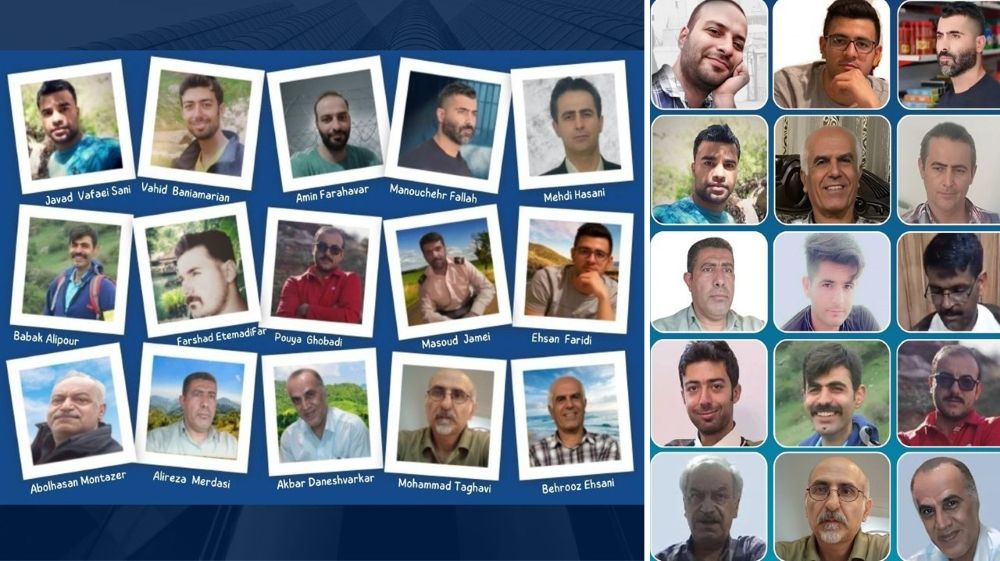
The International Committee in Search of Justice (ISJ) has issued a pressing appeal to top officials of the European Union and the broader international community, urging immediate intervention to prevent the execution of fifteen political prisoners in Iran. This call comes amid growing concern over intensified repression targeting dissidents, particularly supporters of the People’s Mojahedin Organization of Iran (PMOI/MEK).
In a formal letter addressed to the Presidents of the European Commission and Council, the EU High Representative, and the President of the European Parliament, the ISJ warns of the grave danger facing political prisoners in Iran. This warning follows the Iranian judiciary’s recent sentencing of three prisoners—Farshad Etemadi-Far, Masoud Jamei, and Alireza Mardasi—to double death penalties and lengthy imprisonment after enduring two years of torture and solitary confinement. Their sole “crime” is affiliation with the PMOI/MEK. Similarly, Saman and Davood Hormat-Nejad have been sentenced to long prison terms under comparable accusations.
According to the ISJ, these sentences reflect a broader strategy of domestic repression. At least fifteen political prisoners currently face execution, with seven death sentences already confirmed by Iran’s Supreme Court. The condemned are detained in some of Iran’s most notorious prisons, while dozens more await trial on similar charges.
🚨 Iran is poised to execute political prisoners: Farshad Etemadi-Far, Masoud Jamei & Alireza Mardasi—after sham trials, 2 years of torture.
ISJ calls on EU:
📢 Act now stop these killings, prevent a repeat of a 1988-style massacre#StopExecutionsInIranhttps://t.co/sqVdv5v6YU— International Committee in Search of Justice (@isjcommittee) July 18, 2025
Particular concern surrounds the case of Saeed Masouri, recognized as one of Iran’s longest-held political prisoners. After enduring 25 years of imprisonment without furlough, Masouri was forcibly removed from his ward at Ghezel Hesar Prison on July 16 and threatened with transfer to an undisclosed location. In a message smuggled from prison, Masouri warned that his abduction signals a broader plan to silence political prisoners and pave the way for mass executions reminiscent of the 1988 massacre. His fellow inmates issued a joint statement echoing these fears, emphasizing that the Iranian regime views its own citizens, rather than foreign powers, as its main adversaries.
The ISJ also highlights alarming rhetoric from Iranian officials, who now publicly reference the 1988 mass executions as a precedent to be repeated. State media, including Fars News Agency, recently referred to the massacre as a “successful historical experience” that should be reenacted.
In response to this dire situation, the ISJ, led by Professor Alejo Vidal-Quadras, Struan Stevenson, and Paulo Casaca, calls on the European Union to undertake the following immediate actions:
-
Publicly denounce the death sentences and persecution of PMOI/MEK supporters.
-
Summon Iranian ambassadors to issue strong protests and demand a halt to executions.
-
Advocate for the creation of an independent UN fact-finding mission to investigate human rights violations in Iran.
-
Enforce targeted sanctions against Iranian judicial and prison officials involved in torture and unlawful sentencing.
-
Abandon silence and inaction to prevent further loss of innocent lives.
Describing the current moment as a critical test for European leadership, the ISJ concludes its appeal with a clear message: the EU must side with justice and human rights to ensure history does not repeat itself.