



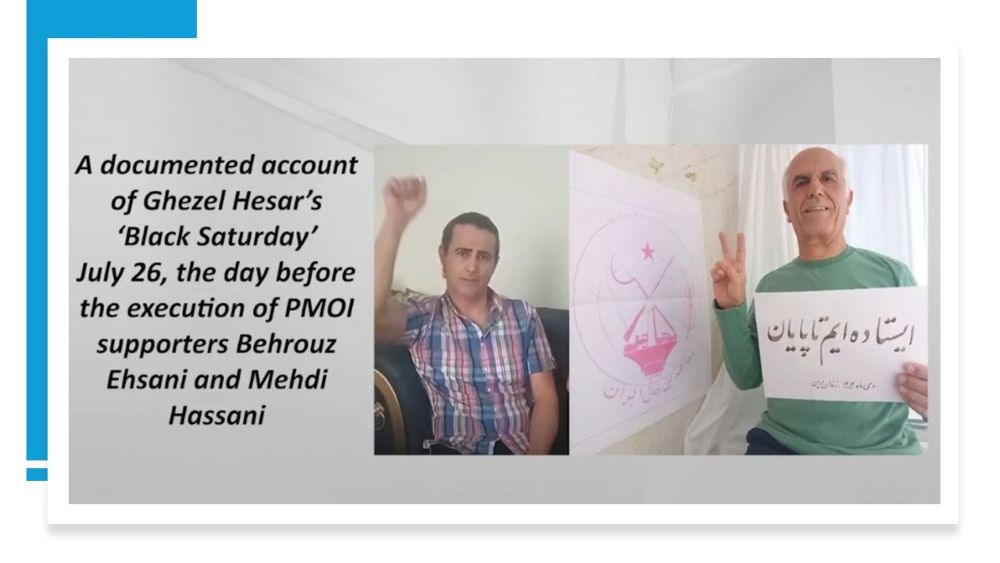
A documented account of Ghezel Hesar’s Black Saturday begins on July 26 — the day before the execution of PMOI supporters Behrouz Ehsani and Mehdi Hassani. This is a firsthand account by a prisoner about the night of their execution at dawn on July 27, 2025.
On the night of July 27, I was in Ghezel Hesar Prison, where the usual noise from the guard towers made it impossible to sleep. Like many others, I was forced to wear noise-canceling earphones just to make it through the night. But that night was different.
Something felt wrong. I didn’t know what was coming, but I would soon find out. Around dawn, masked execution officers entered our hall. They began shouting and dragging us out of our cells. I saw Lukman Aminpour and Hamzeh Savari, among others, being beaten violently.
At first, I wasn’t sure if I was awake or still dreaming. Then I realized it was real. Qasem Sari, a notorious executioner, led the guards, screaming, “We will kill all of you!” They handcuffed us, pushed us toward the wall, and began the brutal assault. In the chaos, I noticed Saeed Mousavi, his hands bound behind his back, being held lower than the rest of us.
Then I saw them drag Mehdi Hassani and Behrouz Ehsani out of their cells, their hands bound behind their backs. Behrouz, defiant as ever, shouted:
“These are your last breaths! If it weren’t for that, you wouldn’t hide your faces!”
His words were met with further violence from the guards. As we were forced to face the wall, a wave of anger and fear surged within me.
We stood there powerless as the execution officers taunted us. One of them shouted, “Turn to the wall!” The others, like wolves, repeated the order. In that moment, I could feel the burning hatred and rage at this injustice. I spat on the ground toward the Yazidi forces, only to realize my lip had split from the force.
After what felt like an eternity, we were dragged to the main door of the unit. There, I saw fifty soldiers waiting with batons and shields. Saeed, Mehdi, and Behrouz were forced into a minibus. It wasn’t just us — the guards had sent one hundred officers for a maximum of twenty political prisoners.
The brutality continued as they transferred the three into a van while the rest of us were forced to remain in the minibus. Suddenly, we began chanting “The blood of the red roses…” and the mercenary Qasem Sari swore at us again: “We will kill all of you!” They took us to solitary confinement in Unit 3, where the beatings continued. Amid the pain and anger, we decided to go on hunger strike. There was nothing left to do but resist.
The next day, when they brought us back to our hall, everything was ransacked, as if wild animals had been let loose. We still hadn’t heard the news that Behrouz and Mehdi had been executed. I tried to get information from outside. By sunset, the phone line was reconnected, and I called my family. On the other end, they asked me: “Did they execute your friends?”
At first, I denied it, saying they had sentences but hadn’t been executed. But the voice on the other side replied: “No, they were executed,” and I heard the sound of crying. I couldn’t speak anymore.
My gaze met that of the other prisoners, and I simply said: “It’s over… they executed them.” I don’t remember much after that, but I felt the presence of Behrouz and Mehdi with me. All the memories — our volleyball games, the tea after the games, and the laughs we shared — rushed through my mind. Slowly, I began to cry.
I made a vow to my dear brothers: “We will take revenge for you.” The trumpet of freedom that Behrouz had planted in the yard now reached the barbed wire. It is only a matter of time before it breaks free. The dawn of freedom is near.
On July 27, 2025, the Iranian regime executed two @Mojahedineng supporters, Behrouz Ehsani and Mehdi Hassani, in Ghezel Hesar Prison. The night before the executions was filled with violence and fear, later dubbed "Black Saturday." The following clip is from a first-hand account… pic.twitter.com/mLF7VuyOOk
— SIMAY AZADI TV (@en_simayazadi) August 12, 2025