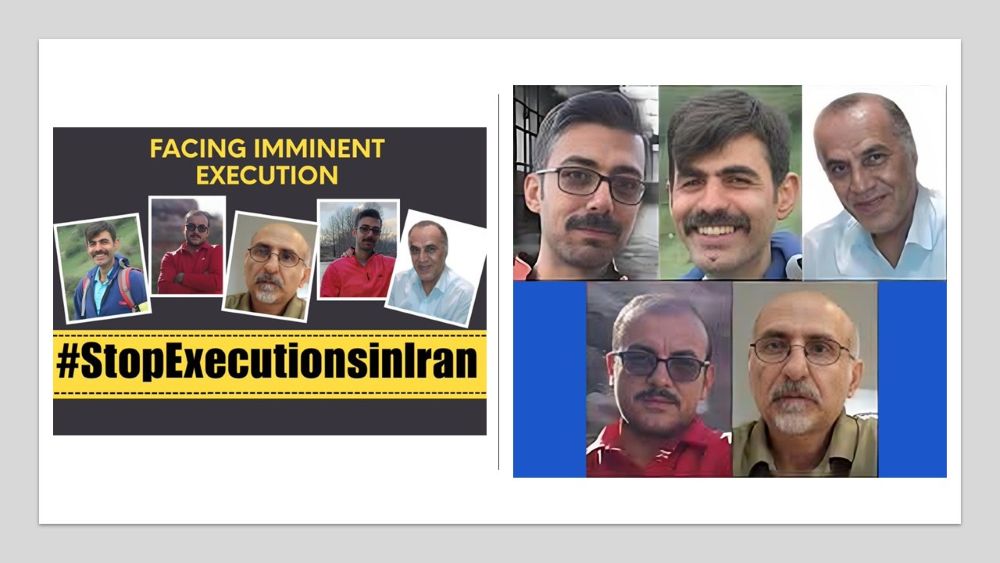
On the morning of Friday, August 8, 2025, Iranian authorities forcibly separated five death-row political prisoners from other detainees during a transfer from Fashafuyeh Prison back to Tehran’s Evin Prison. Instead of returning with the others, they were taken to an undisclosed location—believed to be Ghezel Hesar Prison, one of Iran’s most notorious execution sites.
The men—Vahid Bani-Amerian, 33, master’s in management; Babak Alipour, 34, law graduate, prior four-year prison term; Shahrokh Daneshvarkar, 58, civil engineer; Pouya Ghobadi, 33, electrical engineer with previous arrests; and Mohammad Taghavi, 59, veteran political prisoner from the 1980s and 1990s—were sentenced to death in December 2024 by Branch 26 of the Tehran Revolutionary Court, presided over by Iman Afshari. The charges included “membership in the People’s Mojahedin Organization of Iran (PMOI/MEK),” “assembly and collusion against national security,” and “armed rebellion against the state.”
🚨 Urgent: Lives of 5 Iranian Political Prisoners at Risk!🚨
The Iranian regime has transferred 5 death row political prisoners—Vahid Bani-Amerian, Pouya Ghobadi, Shahrokh Daneshvarkar, Mohammad Taghavi, and Babak Alipour—to Ghezel Hesar Prison, an execution site. Their lives… pic.twitter.com/TtWngAEKAJ— Iran Freedom (@4FreedominIran) August 8, 2025
A Pattern of State Violence
The transfer follows a chaotic reshuffling of prisoners that began in late June, after an airstrike damaged part of Evin Prison. The regime claimed the relocation to Fashafuyeh was for security reasons, but political prisoners and rights groups say it was used as a pretext for repression. On June 25, authorities violently moved inmates from Evin’s wards 4, 7, and 8—home to many political prisoners—to Fashafuyeh.
When prisoners were returned to Evin on August 8, guards singled out the five PMOI supporters, beating and separating them from others. Witnesses reported that fellow inmates who protested were also assaulted. This treatment reflects the regime’s longstanding intolerance of dissent and its drive to crush organized opposition.
Ghezel Hesar’s Bloody Record
The danger is amplified by Ghezel Hesar’s recent history. Just two weeks earlier, on July 26, over 100 armed guards stormed Unit 4 in a military-style raid, executing PMOI members Behrouz Ehsani and Mehdi Hassani. Their bodies were withheld from their families to prevent public mourning. In the same operation, political prisoner Saeed Masouri—one of the longest-serving in Iran—was exiled to Zahedan Prison in apparent reprisal for resisting an earlier abduction attempt. Before his transfer, Masouri warned that the regime was preparing “a repeat of the 1988 massacre” and urged the world to recognize that “a crime is in progress.”
Urgent International Calls
The Iranian Resistance and international human rights advocates, including Amnesty International, have issued urgent appeals to the UN High Commissioner for Human Rights, the Human Rights Council, the UN Special Rapporteur on Iran, and global human rights organizations to:
-
Verify the location and safety of the five prisoners.
-
Intervene immediately to halt their potential executions.
-
Demand transparency regarding the transfer of all political prisoners.
🧵URGENT: Iranian authorities must immediately halt any plans to execute Akbar (Shahrokh) Daneshvarkar, Babak Alipour, Mohammad Taghavi Sangdehi, Pouya Ghobadi & Vahid Bani Amerian. On 7 August, authorities violently transferred them out of the Greater Tehran Penitentiary. 1/3 https://t.co/oLa3pQgdpa
— Amnesty Iran (@AmnestyIran) August 8, 2025
Given Ghezel Hesar’s record of secret, expedited executions without family or legal notification, fears are mounting that the killings could occur within hours or days. Rights defenders warn that silence and inaction from the global community would amount to complicity in what they describe as state-sanctioned murder.