


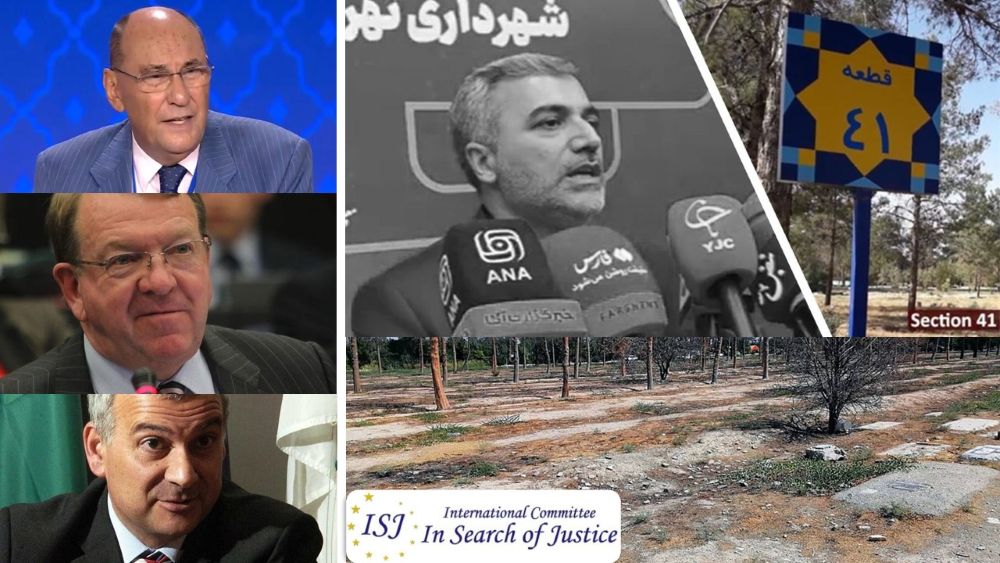
Brussels, Belgium – August 22, 2025: The International Committee in Search of Justice (ISJ) took a stand against Iran’s escalating human rights violations. Their plea, penned in a letter to Volker Türk, the United Nations High Commissioner for Human Rights, and Dr. Mai Sato, the UN Special Rapporteur on the Situation of Human Rights in Iran, carried the weight of urgency.
The ISJ, led by Alejo Vidal-Quadras, a former Vice-President of the European Parliament, Struan Stevenson, Chair of the ISJ Committee on the Protection of Political Freedoms in Iran, and Paulo Casaca, a former MEP, demanded immediate action to stop the Iranian regime’s plan to demolish Section 41 of Behesht-e Zahra Cemetery in Tehran.
This section of the cemetery was no ordinary burial ground. It held the remains of nearly 9,500 political prisoners, most of them members of the People’s Mojahedin Organization of Iran (PMOI/MEK), executed during the brutal purges of the 1980s. The regime’s intention, as revealed by Tehran’s Deputy Mayor, was to transform this sacred site into a car park, an act the ISJ condemned as an assault on memory, truth, and justice.
The cemetery director’s chilling admission that the site had already been “leveled” only deepened the outrage. The ISJ leaders saw this as a deliberate attempt to erase evidence of mass executions, acts that UN experts had previously classified as crimes against humanity and genocide.
The letter painted a stark picture of the regime’s contempt, noting the Deputy Mayor’s reference to the buried as “the hypocrites,” a derogatory term used for PMOI members. This was not just destruction, the ISJ argued, but an effort to obliterate the legacy of those who dared to resist the regime’s tyranny.
The authors reminded the UN that preserving such burial sites was critical for truth-telling and accountability in the aftermath of mass atrocities. Yet, in Iran, these principles were being trampled without consequence, and the UN’s silence thus far stung as a failure to uphold its own resolutions.
Beyond the desecration of graves, the ISJ highlighted the regime’s ongoing campaign of repression. Two PMOI members had recently been executed on charges of Moharebeh and membership in the organization, with at least 14 others awaiting the same fate. Their only crime, the letter asserted, was their dream of a democratic Iran.
Among the persecuted was Maryam Akbari Monfared, a mother of three who had endured 15 years in prison without a single day of furlough. Her offense? Seeking justice for her three brothers and one sister, two of whom perished in the 1988 Massacre. Her story, the ISJ wrote, was a stark symbol of a regime that punished not only activists but also those who dared to demand truth.
The ISJ’s words carried a warning: silence in the face of such crimes was not neutrality but complicity. When human rights defenders failed to act, they signaled that the lives of PMOI activists and their families were expendable, undermining the very foundation of universal human rights.
The letter called on the UN to take four decisive steps: condemn the destruction of Section 41 and investigate Iran’s mass graves; denounce the executions and persecution of political prisoners; demand accountability for the desecration of burial sites; and uphold the rights of all Iranians to freedom of expression, association, and belief.
As the ISJ concluded, the Iranian regime could not be allowed to rewrite history with bulldozers. The memory of the 9,500 martyrs buried in Section 41 deserved preservation, not erasure. Their sacrifice demanded honor, not asphalt. For the ISJ, the time for moral clarity and action had come.