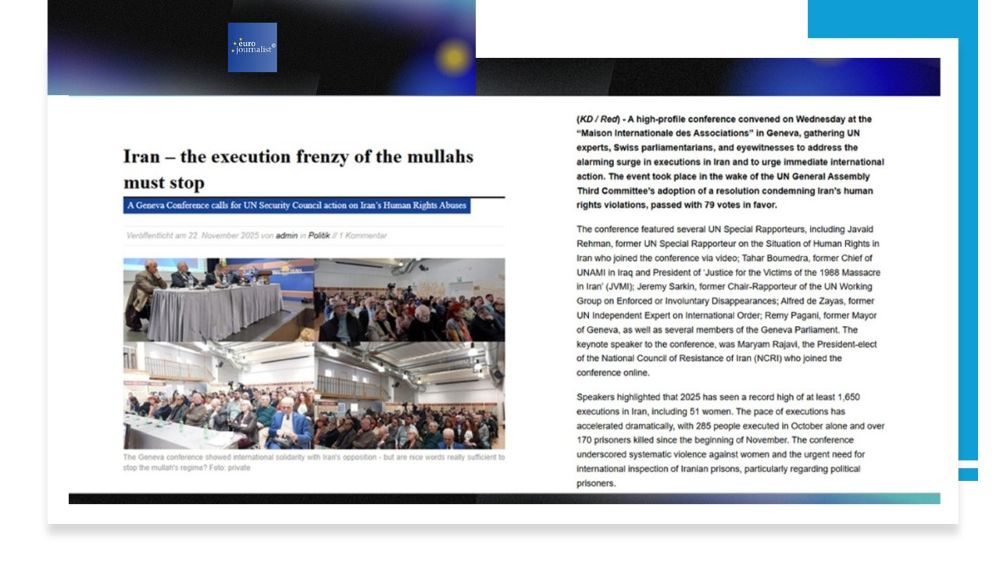
This news report reflects the coverage of the Geneva conference published on Maryam Rajavi’s website, originally sourced from Eurojournalist.
A high-level conference held on Wednesday at the Maison Internationale des Associations in Geneva brought together UN experts, Swiss parliamentarians, and eyewitnesses to address what participants described as an unprecedented escalation of executions in Iran. The event followed the UN General Assembly Third Committee’s recent adoption of a resolution condemning human rights violations in Iran, passed with 79 votes in favor.
Speakers included former UN Special Rapporteurs Javaid Rehman, Tahar Boumedra, Jeremy Sarkin, Alfred de Zayas, former Geneva Mayor Remy Pagani, and several members of the Geneva Parliament. The keynote address was delivered online by Maryam Rajavi, President-elect of the National Council of Resistance of Iran (NCRI).
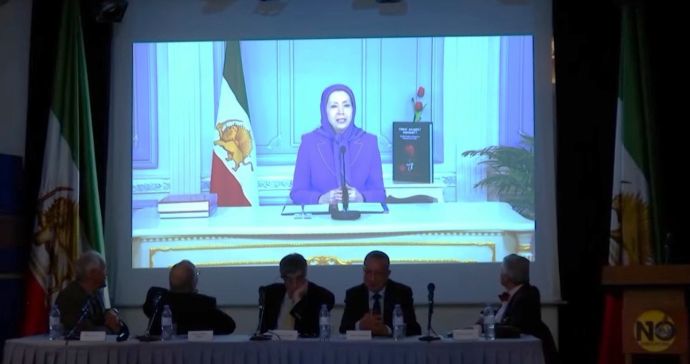
According to experts, Iran has carried out at least 1,650 executions in 2025—including 51 women—marking the highest annual rate in decades. October alone saw 285 executions, followed by over 170 more in the first weeks of November. The speakers underscored the worsening violence against women and political prisoners and called for immediate international inspections of Iranian detention facilities.
Maryam Rajavi characterized the ongoing wave of executions as “Khamenei’s war against the people of Iran,” asserting that the crisis presents a major test for the international community. She welcomed the UN resolution for acknowledging, for the first time, the mass killings of political prisoners in the 1980s—particularly the 1988 massacre—as acts that may constitute genocide and crimes against humanity. Mrs. Rajavi urged the United Nations to refer Iran’s human rights violations to the Security Council and enact mechanisms for accountability.
It is encouraging that the 3rd Committee of the UN General Assembly, in its resolution, referred to the massacre of political prisoners in Iran in 1988.pic.twitter.com/t6JH5EndC6
— Maryam Rajavi (@Maryam_Rajavi) November 20, 2025
Javaid Rehman emphasized that the current execution rate is the most intense since 1988, pointing to the destruction of mass graves and public praise for past atrocities by regime-linked media as evidence of ongoing impunity. He called for an international mechanism to investigate and prosecute crimes against humanity committed during the 1988 massacre.
Tahar Boumedra of the Justice for the Victims of the 1988 Massacre (JVMI) hailed the UN Third Committee’s resolution as a significant milestone, noting that it specifically identified Iran’s judiciary and the Revolutionary Guards as responsible for extrajudicial killings. He urged governments to apply universal jurisdiction to hold perpetrators accountable.
Jeremy Sarkin highlighted unresolved cases of enforced disappearances and Iran’s refusal to permit UN visits to investigate them. He condemned the regime’s rising use of the death penalty—particularly against ethnic, religious, and other vulnerable minorities.
Despite increasing international recognition of Iran’s human rights violations, participants warned that expressions of concern are no longer sufficient. As executions accelerate at an alarming pace, speakers urged the global community to take decisive action before Iran’s regime silences the remaining political opposition.