


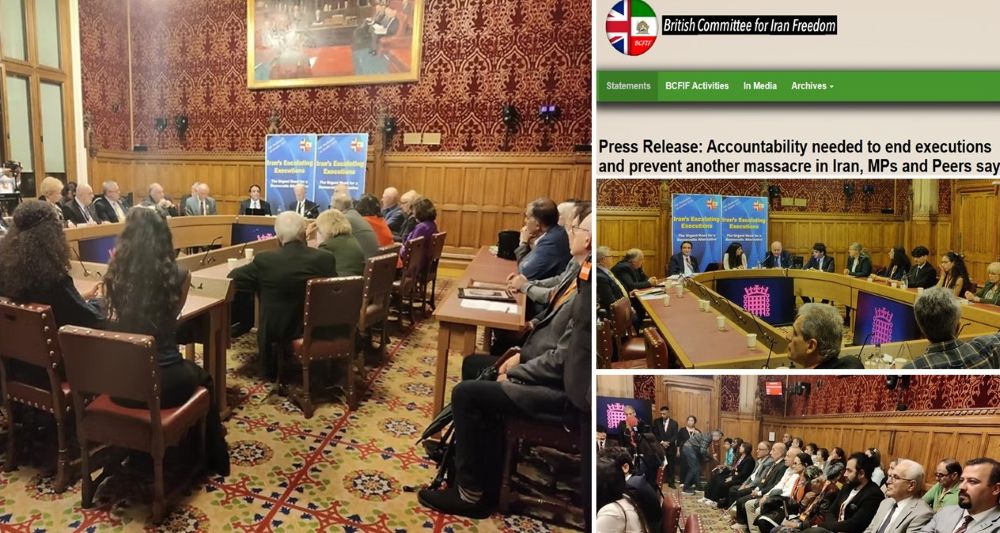
London, 30 October 2025 — Cross-party Members of Parliament and Peers in the UK have urged urgent international intervention to stop the escalating wave of executions in Iran, warning that the regime’s actions risk another massacre reminiscent of 1988.
The call came during a meeting in Parliament this week, detailed in a statement by the British Committee for Iran Freedom, which urged stronger international accountability measures to save political prisoners on death row and to hold Tehran responsible for systematic human rights violations.
Lawmakers demanded immediate action to protect 17 political prisoners reportedly at imminent risk of execution for their association with Iran’s democratic opposition, the People’s Mojahedin Organisation of Iran (PMOI/MEK).
Maryam Rajavi, President-elect of the National Council of Resistance of Iran (NCRI), addressed the meeting virtually, thanking MPs and Peers for supporting the Iranian people’s struggle for freedom and justice. She called on the international community to pressure Tehran to allow an independent delegation to visit prisoners on death row and inspect torture centres and sham courts.
Rajavi emphasised that the “policy of relentless executions” has sparked growing resistance inside Iran, urging world governments to recognise the legitimacy of the Iranian people’s movement for democracy and to proscribe the Islamic Revolutionary Guard Corps (IRGC).
Lawmakers denounced Iran’s judiciary for what they described as politically motivated death sentences following unfair trials. Particular concern was raised over the case of political prisoner Zahra Tabari, sentenced to death after a 10-minute trial without legal representation. MPs said such verdicts expose Iran’s judiciary as “a tool of repression” enabling executions under fabricated “national security” charges.
Speakers noted that more than 2,000 executions have been carried out since President Masoud Pezeshkian took office, while officials have openly called for a new mass execution campaign targeting dissidents. They urged the UK Government to lead an international response, including the creation of a UN accountability mechanism, the use of universal jurisdiction, and the imposition of targeted human rights sanctions.
Several MPs and Peers—including Sir Roger Gale, Bob Blackman, Rachael Maskell, Jim Shannon, and Lord McCabe—stressed that defending human rights in Iran is both a moral duty and a matter of global security.
Bob Blackman CBE MP said:
“Holding Tehran accountable for executing political prisoners is both a moral duty and a national security necessity. The UK must move from words to action and stand with the Iranian people.”
Speakers also praised the courage of Iranian political prisoners protesting executions from within prisons, including the recent “No to Execution Tuesdays” campaign and sit-ins at Ghezel Hesar Prison.
Baroness O’Loan and Professor Sara Chandler KC (Hon), representing over 200,000 European lawyers, called for the regime’s human rights violations—past and present—to be referred to the UN Security Council and the International Criminal Court. They urged Western governments to apply universal jurisdiction to prosecute those responsible for crimes against humanity, including the 1988 massacre.
Former MP Mark Williams reiterated that the IRGC should be banned in the UK, saying:
“Iran’s regime is not merely repressive—it is criminal. Hope lies in Maryam Rajavi’s Ten-Point Plan for a secular, democratic, and non-nuclear Iran.”
The meeting concluded with a call for the UK Government to engage directly with the NCRI and support Iran’s pro-democracy forces, described as the only viable path to ending executions and achieving lasting democratic change.
— British Committee for Iran Freedom