



Global Appeal Warns of Intensifying Human Rights Crisis and Calls for Immediate International Response
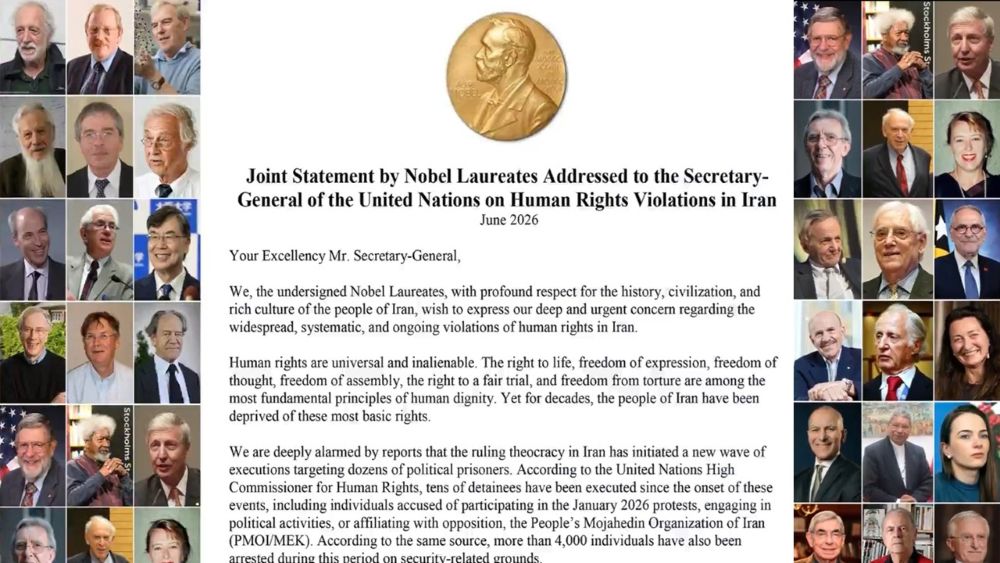
A coalition of 78 Nobel Prize laureates from around the world has issued a joint appeal to United Nations Secretary-General António Guterres, expressing grave concern over what they describe as an escalating campaign of repression and political executions in Iran.
Representing a broad spectrum of disciplines—including Peace, Medicine, Physics, Chemistry, Literature, and Economics—the signatories have urged the international community to take swift action to address what they characterize as widespread and systematic violations of fundamental human rights.
🚨 Iran: 78 Nobel Laureates Urge UN Action Over Human Rights Violations
In a joint statement addressed to the UN Secretary-General, 78 Nobel Prize laureates expressed deep concern over what they described as ongoing and systematic human rights violations in Iran.
The… pic.twitter.com/EjVrNQvRqp
— SIMAY AZADI TV (@en_simayazadi) June 10, 2026
Concerns Over Growing Repression Following Nationwide Protests
In their statement, the laureates point to a significant increase in government crackdowns following nationwide protests reported in January 2026. Referencing information from international human rights sources, including the Office of the UN High Commissioner for Human Rights, they note that numerous political detainees have reportedly been executed in recent months.
According to the statement, those affected include protest participants, political activists, and individuals accused of links to the opposition movement known as the People’s Mojahedin Organization of Iran (PMOI/MEK). The document also cites reports indicating that more than 4,000 people have been detained on security-related charges, while unofficial estimates suggest that the death toll during the suppression of the demonstrations may be substantially higher.
The Nobel laureates warned that continued international inaction could further embolden authorities. They argued that silence from the global community risks enabling additional human rights abuses and placing more lives in danger.
Four Key Demands Presented to the United Nations
To address the worsening situation, the signatories outlined four urgent requests:
- An immediate suspension of all executions, particularly in cases involving political charges.
- The unconditional release of political prisoners and individuals detained during protests.
- Full access for international monitoring bodies to Iranian detention facilities, along with independent oversight of prison conditions.
- A reassessment of diplomatic and economic engagement with Iran by democratic governments, with the abolition of the death penalty established as a fundamental condition for future relations.
Support for a Democratic and Peaceful Future
The statement emphasizes that Iran’s future should be determined exclusively by its citizens through democratic means. The laureates rejected both foreign military intervention and any return to authoritarian forms of governance, whether religious or monarchical.
They expressed support for the democratic framework proposed by the National Council of Resistance of Iran (NCRI), highlighting the Ten-Point Plan presented by NCRI President-elect Maryam Rajavi. According to the signatories, the proposal offers a roadmap for a peaceful transition toward democratic governance and popular sovereignty through a temporary transitional administration.
The appeal was released ahead of June 20, 2026, a date observed by supporters as the Day of Martyrs and Political Prisoners. Organizers expect tens of thousands of Iranians and international supporters to gather in Paris to draw further attention to the issue and advocate for stronger international action.
Broad International Support From Leading Nobel Laureates
The signatories come from more than 25 countries, including the United States, France, Germany, the United Kingdom, Japan, Canada, and Ukraine. Their collective endorsement reflects a rare level of agreement among distinguished figures from the worlds of science, literature, economics, medicine, and peace advocacy.
The group includes 22 Nobel laureates in Chemistry, 21 in Physics, 18 in Medicine, seven in Literature, six in Peace, and four in Economics. Among the most prominent supporters are Timor-Leste President José Ramos-Horta, artificial intelligence pioneer Geoffrey Hinton, NASA scientist John Mather, former Costa Rican President Oscar Arias, Ukrainian human rights advocate Oleksandra Matviichuk, and acclaimed authors Kazuo Ishiguro, Wole Soyinka, and Herta Müller.
The breadth and diversity of support behind the appeal underscore growing international concern over developments in Iran and reinforce calls for stronger global engagement on issues of human rights, political freedoms, and the protection of detainees.
The complete list of signatories, including the names, Nobel Prize distinctions, and signatures of all 78 laureates supporting the appeal, can be found in the PDF document attached to this article.