



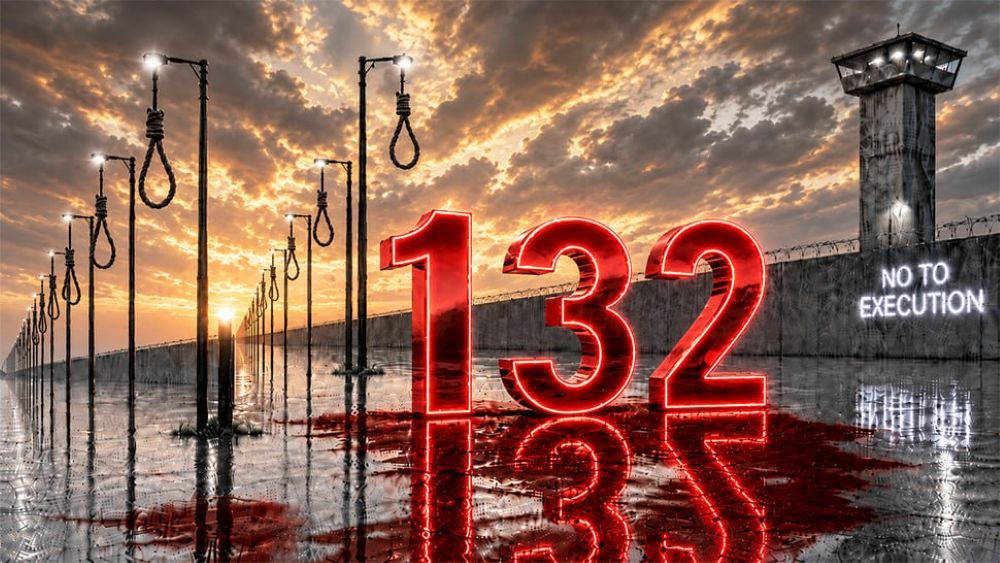
Political and conscience prisoners participating in the “No to Execution Tuesdays” campaign marked its 132nd consecutive week on Tuesday with a coordinated hunger strike across 59 prisons throughout Iran. In a new statement, the prisoners warned that the Iranian regime is accelerating executions to spread fear and suppress growing public dissent, while renewing their call for nationwide and international solidarity to halt the execution of prisoners.
Prisoners condemn surge in executions
The campaign said the authorities have sharply intensified executions in recent weeks, reporting that 35 prisoners have been executed since the beginning of Mordad (July 23, 2026), including a woman and a juvenile offender. According to the statement, 28 executions took place between July 28 and August 4, with three victims identified as detainees connected to the January uprising.
Campaign members argued that the regime increasingly relies on executions as a political tool to intimidate society and prevent the emergence of new protests.
Executions and repression used to maintain power
The statement describes executions as part of a broader strategy of repression, accusing the ruling establishment of exploiting external tensions while expanding domestic crackdowns. It says increased security deployments, checkpoints, and militarization are intended to deter public resistance rather than address the country’s deepening crises.
The prisoners also reiterated their opposition to both executions and foreign military intervention, stressing that democracy, freedom, and justice can only be achieved through the collective struggle of the Iranian people.
Public executions meant to spread fear
The campaign specifically condemned the public executions of Amir Hossein Safari and Abolfazl Sepahi, describing them as deliberate attempts to spread fear among the public. It also denounced the execution of 19-year-old Arvin Kheirkhahan in Shahroud, saying the authorities continue to target young protesters in an effort to crush any prospect of renewed popular resistance.


The statement questioned the lack of transparent judicial proceedings, arguing that defendants in such cases are subjected to secret trials and torture allegations before being sentenced to death. According to the campaign, the regime uses public executions not as a means of justice but as an instrument of political intimidation.
Prison resistance continues despite repression
Despite growing pressure, the campaign said resistance inside Iranian prisons remains strong. Political prisoners continue to protest through hunger strikes and other forms of civil resistance, despite being subjected to solitary confinement, transfers, beatings, and other punitive measures.
The statement also highlighted a recent hunger strike by approximately 1,500 prisoners in Unit 2 of Ghezel Hesar Prison, who reportedly maintained their protest for more than two weeks until prison authorities pledged to suspend planned executions.
Campaign members said these developments demonstrate that opposition to executions extends beyond political prisoners and is increasingly embraced by prisoners from different backgrounds.
Call for broader solidarity against executions
Marking the campaign’s 132nd week, the prisoners thanked political organizations, human rights groups, labor unions, civil society organizations, and activists inside and outside Iran for supporting the movement. At the same time, they urged all opponents of capital punishment to move beyond statements of support and take coordinated practical action to stop executions.
The statement emphasized that members of the campaign have endured solitary confinement, physical abuse, and even execution during more than two years of sustained protest, insisting that broader public solidarity is now essential.
The prisoners concluded by reaffirming that every execution in Iran serves a political purpose aimed at terrorizing society, and that only unity, resistance, and organized action can end the regime’s use of the death penalty.
On Tuesday, August 4, 2026, participants in the 132nd week of the campaign carried out a coordinated hunger strike in 59 prisons across Iran, including Evin, Ghezel Hesar, Greater Tehran, Karaj Central, Qarchak, Adel Abad, Sheiban, Sepidar, Zahedan, Urmia, Sanandaj, Tabriz, Kerman, Mashhad, Rasht, and dozens of other prisons nationwide.