


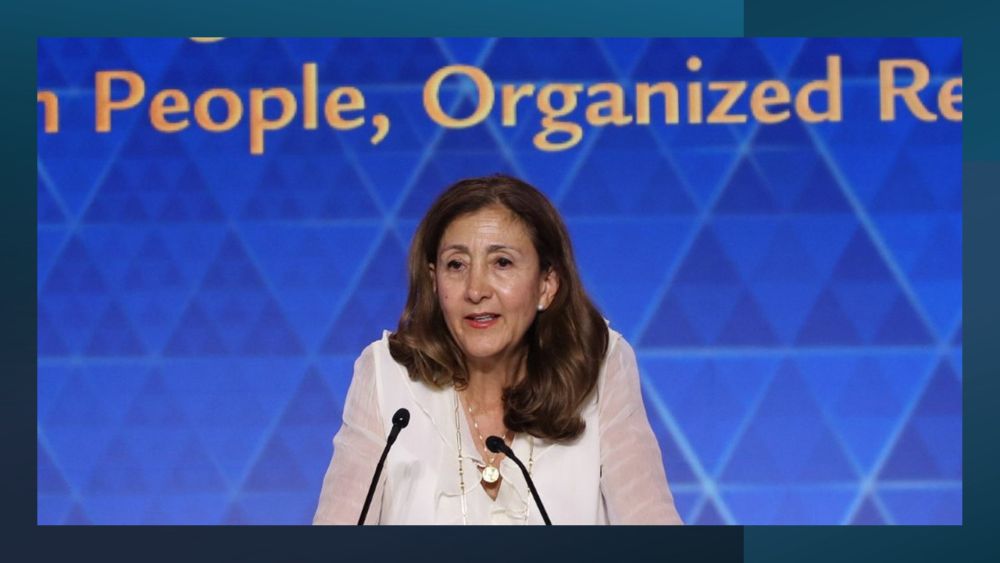
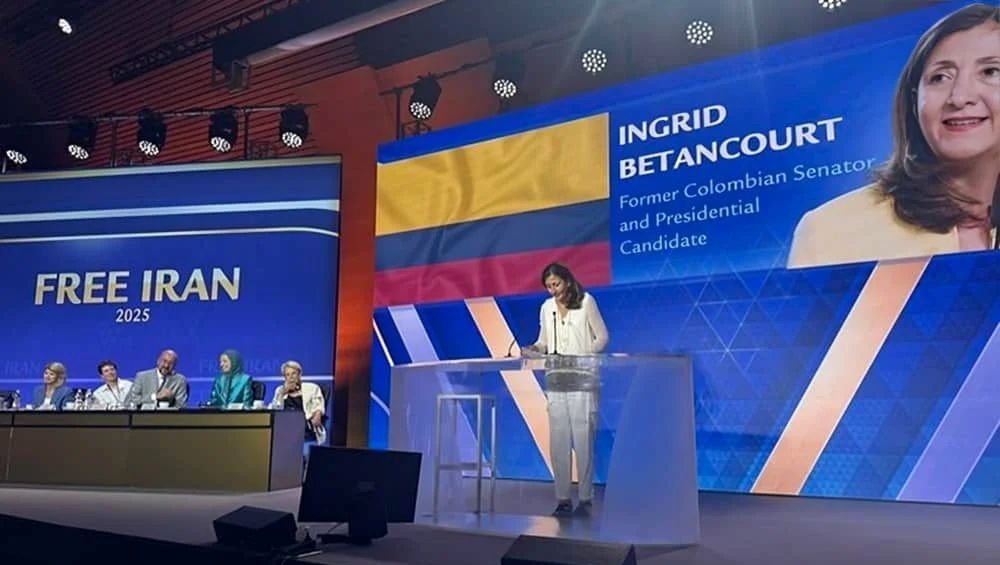
At the third session of the Free Iran World Summit 2025 in Rome, Colombian political leader and former presidential candidate Ingrid Betancourt delivered a passionate message of support for the Iranian Resistance. She emphasized that her commitment to the People’s Mojahedin Organization of Iran (PMOI/MEK) goes beyond politics—it is a matter of deep conviction.
Wearing the Ashraf 3 uniform as a symbol of solidarity, Betancourt recounted how her initial public endorsement of the MEK was met with a wave of disinformation. Rather than retreat, she investigated further and discovered a disciplined, humble, and determined movement.
Betancourt highlighted six key reasons why the Tehran regime fears the Iranian Resistance: its organizational discipline, its leadership by an empowered woman, its clear Ten-Point Plan for a secular democratic Iran, its active internal network, its enduring legacy of resistance, and its record of ultimate sacrifice. She declared clearly: “The MEK is not an option; it is the only option.”
Former Colombian Senator @IBetancourtCol: My first encounter with the MEK was at a Paris conference on #Iran’s human rights.
Speaking up for the Resistance sparked waves of disinformation aimed at silencing debate and truth.#NCRIAlternativehttps://t.co/bnhDqvNtSa— Iran Freedom (@4FreedominIran) July 31, 2025
The full text of Ingrid Betancourt’s speech follows.
Ingrid Betancourt: PMOI—The Sole Path to Iran’s Freedom
Ladies and gentlemen, long-time friends of a free Iran, new friends of a free Iran, as you can see, I’m wearing the Ashraf 3 outfit. And it is so because this is not a topic that is only political to me, but it’s deeply personal. My first encounter with the MEK many years ago came when I was invited to attend a conference in Paris on human rights in Iran. I remember I stood proudly alongside people I deeply admired, including the late Elie Wiesel, a man who once spoke out on my behalf when I was abducted by the FARC terrorist group. And I remember that his words were light in my darkest hour. So, in that conference, I wanted to follow his lead, and I felt a duty to raise my voice for others too. Others who had endured injustice and continued to resist. And I spoke about the Iranian Resistance; I spoke about the MEK.
Days after, something unexpected happened. I became the target of a wave of emotional pressure and coordinated disinformation—not threats, but calculated attempts to shape perception and silence discussion. Articles filled with falsehoods appeared on my screen. Social media echoed slogans and sneers, not debate, just manufactured outrage aimed at discouraging me or anyone who dared speak in defense of this movement. It was really troubling. I hadn’t anticipated this backlash. But instead of stepping back, which was the first thing I thought I should do, I decided to dive in and do my own research. So, I began by asking questions, by listening, and I spoke to people who knew the movement. I discussed with journalists and politicians that disliked the MEK, [who were] very critical of the movement. And I also met with MEK members. I attended their meetings—always very disciplined, respectful, focused—and I also visited Camp Ashraf 3 when it was being built. I saw women and men carrying construction materials in thick mud and working like ants to raise the camp. I saw a community grounded in conviction, humility, and unshakable resolve, and always smiling.
And that’s when the truth became clear to me. This campaign of demonization wasn’t rooted in facts. It was rooted in fear. Fear from a regime that doesn’t just see the MEK as an opposition, but as a credible alternative. So, let’s ask the real question. Why is there so much demonization against the MEK? What makes this movement so threatening to Tehran’s regime? I think there are at least six reasons.
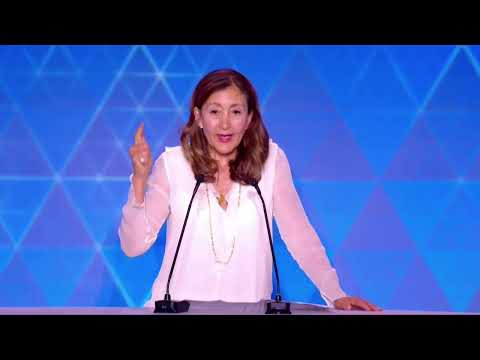
First, I think it is their structure, your structure. You are the enemy of chaos. And you know, authoritarian regimes feed on chaos. But when resistance is focused, structured, and strategic, it becomes very dangerous. That’s why the regime calls it a cult, not because the label fits, but because an effective opposition unmasks what they really are. And in a sort of inverted mirror tactic, they need to accuse their strongest opponent of being precisely what they are themselves.
Second, their leadership: a woman they cannot silence. Yes, the MEK is led by an indomitable woman they cannot control, and we love her for that. Maryam Rajavi is a Muslim woman calling for a secular, democratic Iran. She defends gender equality, freedom of belief, and separation of religion and state. In a region where authoritarianism and patriarchy often go hand in hand, her leadership is both revolutionary and empowering because it threatens the core of their system, of the social organization they want to impose on you by dividing families, dividing your society, by gagging women. The regime can’t defeat Maryam’s ideas, so they attack her personally. But that desperation only shows how much they fear you.
Third, the MEK is dangerous because they are credible. They are a credible alternative. And let’s talk about the Ten-Point Plan. Maryam’s Ten-Point Plan includes free and fair elections, equality between men and women, abolition of the death penalty, freedom of speech, religion, and press, minority rights, a nuclear-free Iran, and a market economy. So, you see, the MEK presents more than protests. It presents a plan for the future, and that’s not just rhetoric. That’s a governing agenda, and that’s very dangerous.
Fourth, the MEK has a network inside Iran. You see, the MEK is not just in exile. It has a growing network inside Iran—men and women of all conditions and ages, young people, students, workers, risking their lives to resist from within. That gives the MEK something very rare: legitimacy on the ground. And that’s what the regime fears the most.
Fifth, the MEK has a history, a legacy of resistance. All of you know that. The MEK’s resistance is not new. It has spanned more than 60 years. You stood against the Shah’s dictatorship when that was very dangerous. You stood against Khomeini’s theocracy when thousands were silenced. You have faced executions, torture, exile, and you have never stopped. This is not a fringe group. This is a political force with experience.

Sixth, you have been willing to pay the ultimate price. The cost: maximum sacrifice. When we talk about the MEK—and you know this better than I do—we have to remember the cost. We’re talking about 120,000 men and women—members and supporters who have been imprisoned, executed, tortured, or driven from their homes. So, this is not a movement for profit or for power. This is a grassroots force grounded in principle and having the willingness to sacrifice everything for freedom. And no lies can erase that history. No propaganda can undo that truth. So, what must be added? [We must add] that we need to ensure that the MEK is recognized for what it is: the only way out from the Iranian global threat.
Again, why so much demonization? Because the MEK is not just background noise; it is the voice of those who refuse to surrender. It is the foundation of change, its vision, its plan. It is the face of hope for the people of Iran. And not only that. The MEK is the only option. It’s not an option; it’s the only option. That’s why it’s not enough to reject the lies. The fight for freedom in Iran is the frontline in the global struggle for justice and peace. It’s time for the free world to embrace its mission. The tyranny today is at its weakest point. Let’s act in unity and courage to contribute to defeating the most vicious global threat since the end of the Second World War.