


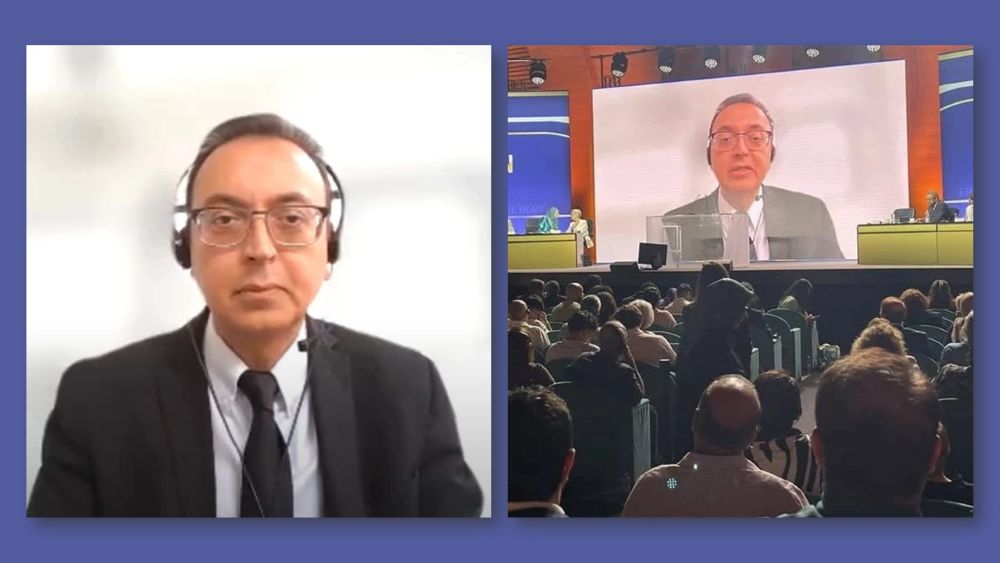
Speaking at the third session of the Free Iran World Summit 2025 via video link from Australia, Professor Javaid Rehman, former United Nations Special Rapporteur on the human rights situation in Iran, delivered a grave warning about the Iranian regime’s escalating use of executions and torture—signs he described as deeply alarming and indicative of a potential recurrence of the 1988 massacre.
He began his address by extending condolences to the families of recently executed political prisoners Mehdi Hassani and Behrouz Ehsani. Their deaths, he stated, were the result of arbitrary and secret trials, based on forced confessions obtained under torture. Professor Rehman highlighted numerous reports detailing the inhumane treatment of detainees, including forced transfers and threats of large-scale executions.
He condemned a recent editorial from Fars News, a media outlet tied to the Islamic Revolutionary Guard Corps, which praised the 1988 mass executions as a “successful historical experience” and openly called for them to be repeated.
Professor Rehman accused the regime of weaponizing the death penalty as a means of repression, labeling such actions as crimes against humanity and, in some cases, acts of genocide. Referring to his 2024 report to the United Nations, he reiterated the urgent need for an international investigative and accountability mechanism. He concluded with a powerful reminder: the international community’s failure to act in 1988 must not be repeated, and it is now the responsibility of the UN and its member states to prevent another atrocity.

The full text of Professor Javaid Rehman’s speech follows:
Greetings to you from Australia. Thank you very much for this generous invitation for me to contribute to this important conference.
Please allow me to begin my remarks with my sincere condolences and sympathies for the families of Mehdi Hassani and Behrouz Ehsani. Only three days back, on July 27, 2025, these two political prisoners were executed in secret. They had been tortured, subjected to ill-treatment including beatings and prolonged solitary confinement, and their families were threatened with harm in order to extract forced confessions. They were subjected to a completely unfair, arbitrary, summary trial that denied them access to a lawyer and were convicted by the notorious Revolutionary Court in Tehran.
It was a barbaric political decision by the regime to execute them. I was shocked and heartbroken to see the video of Maryam Hassani confirming her father’s execution. In addition, tragically, a significant number of political prisoners are on death row and are facing imminent execution. Political prisoners are also being forcibly abducted, transferred to other prisons, and increasingly subjected to torture and extremely inhumane prison conditions. Alongside these increasing executions, torture, repression, and forced transfers, the brutal state machinery and its agents are also aggressively threatening to repeat the atrocity crimes committed by this same regime during the 1988 massacre.
On July 7, 2025, Fars News, a state-affiliated outlet linked to the Islamic Revolutionary Guard Corps (IRGC), published an editorial in which it praised the mass murder, summary, arbitrary and extrajudicial executions, and enforced disappearances of thousands of political prisoners in 1988, terming it a “successful historical experience.” The editorial, entitled “Why the 1988 executions should be repeated,” advocates and openly calls for a repeat of the 1988 massacre against current detainees, equating political dissent with a threat to national security deserving of execution in the style of 1988.
These state-sponsored statements present a dangerous prognosis of the regime’s intention to repeat the atrocity crimes committed against the Iranian people in 1988. There are already real fears of mass executions among political prisoners, including Saeed Masouri, who has been imprisoned for 25 years without a single day of furlough and has now been forcibly abducted to a prison in Zahedan. Earlier, he had written a letter from prison warning against the repetition of the 1988 massacre. He noted, and I quote: “This abduction under the pretext of transfer is not solely about me. It is fundamentally aimed at controlling, isolating, and silencing prisoners for further repression and an insistence on more killings and executions, exactly like what happened in 1988.” He added that he refused to comply with forced exile because, in his words, “a crime is in progress, and therefore it is necessary to prevent another silent and unreported massacre like in 1988. Let the world hear this time that a crime is happening and, of course, there is resistance against it.”
The regime has weaponized the death penalty and mass executions as an instrument of repression and fear. They exterminate all those challenging the brutality of this regime. In my final detailed findings in July 2024, I expressed alarm and shock at the summary, arbitrary, and extrajudicial executions, the torture, and the ill-treatment of tens of thousands of political opponents of the regime ever since the inception of the Islamic Republic in 1979. I documented the summary, arbitrary, and extrajudicial executions of thousands of arbitrarily imprisoned political opponents—amounting to the crimes against humanity of murder and extermination, as well as genocide—between 1979 and 1988. There must be global public condemnation and a show of anger and resentment by the international community, including by all member states of the United Nations and its mechanisms.
In my 2024 report, I had urged the international community to establish an international investigative and accountability mechanism to ensure prompt, thorough, and transparent criminal investigations. It is now all the more important and urgent. The international community failed to act in 1988. It must not fail again. The responsibility to prevent these atrocity crimes from being repeated rests with the United Nations and its member states.
Thank you very much.