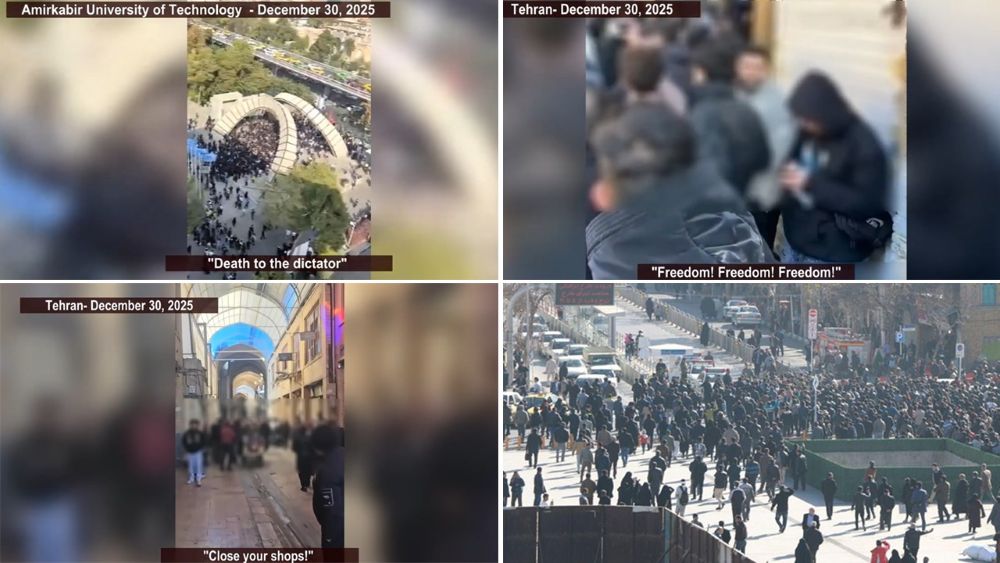
Tehran Bazaar Strike and Nationwide Student Protests Enter Third Day
December 31, 2025 – As Iran’s national currency plunges and inflation soars, a new wave of protests led by bazaar merchants and university students has entered its third consecutive day despite an intense security crackdown. Demonstrations and strikes have spread from Tehran’s Grand Bazaar to major cities across the country, reflecting mounting public anger over economic hardship, repression, and the ruling theocratic system.
Scale of Bazaar Strikes and Citywide Protests
On Tuesday, December 30, 2025, bazaar merchants and shopkeepers in multiple sections of Tehran, including the goldsmiths’ bazaar, Saray-e Melli, Seyed Esmail, Bein-ol-Haramein, Souresrafil, Amin Hozour, Jafari, Pachenar, and parts of the Shush market, shut their shops in solidarity with the growing protest movement. Protesters also gathered at Tehran’s Shadabad iron market, while surrounding neighborhoods such as Shush and Javadieh squares saw large demonstrations and clashes with security forces.
The strike rapidly expanded beyond the capital to cities including Shiraz, Isfahan, Kermanshah, Mashhad, Ahvaz, Yazd, Karaj, Malard, Pardis, Hamedan, Qeshm, Zanjan, and Tabriz, where BRT bus drivers also joined the movement. In many of these locations, commercial centers partially or fully closed, and residents joined street rallies condemning the regime’s economic mismanagement and repression.
University Students Join and Lead Protests
Students from major universities, including Tehran University, Sharif University of Technology, Khajeh Nasir Toosi University, Shahid Beheshti (National University), Amirkabir University, Iran University of Science and Technology, Allameh Tabataba’i University, the University of Science and Culture, Isfahan University of Technology, and Yazd University, joined the bazaar uprising with on-campus marches and protests. They chanted slogans such as “Death to the dictator,” “The student will die but will not accept humiliation,” and “So many years of crime, death to this Velayat (Guardianship),” directly targeting the system of Velayat-e Faqih.
At several campuses, including National University and Khajeh Nasir, students confronted Basij members and plainclothes agents, responding to threats and attacks with chants of “Dishonorable, dishonorable.” The participation of students has given the protests a more organized and political character, linking economic grievances with demands for fundamental political change.
Heavy Security Deployment and Violent Crackdown
In Tehran, the Special Unit deployed heavily on Mellat Street as well as Shush and Javadieh squares, using tear gas to disperse crowds and attempting to prevent gatherings through mass arrests and violent dispersal tactics. Security and intelligence bodies, including the Islamic Revolutionary Guard Corps (IRGC), State Security Force, Ministry of Intelligence, and plainclothes agents, were placed on full alert and widely deployed around key locations such as Ferdowsi, Valiasr, and Sattar Khan streets and around the bazaar.
Similar measures were reported in other cities, including Karaj and Mashhad, where security forces flooded main squares and thoroughfares in an effort to intimidate residents and suppress further rallies. Despite this heavy presence, protesters continued to regroup, with defiant youth and local residents resisting attacks and maintaining street demonstrations late into the day.
Political Context and Opposition Response
The National Council of Resistance of Iran (NCRI) described the bazaar uprising and expanding protests as the expression of “the anger of tens of millions of Iranians” who are fed up with the rapid fall of the national currency, soaring inflation, deep recession, and systemic corruption and discrimination. NCRI President‑elect Mrs. Maryam Rajavi said the slogans heard in bazaars and universities show that protesters are targeting the core of the problem—the Velayat-e Faqih system—and pointing to resistance and uprising as the path to change.
The strike and protests by the honorable Tehran bazaar merchants expanded further for a second consecutive day, spreading across multiple markets and areas, including Beyn-ol-Haramayn, Chaharsouq, the Aluminum Building, Jafari Bazaar, Saray-e Melli, Lalehzar, Toopkhaneh,… pic.twitter.com/kO6cZhR0Bt
— Maryam Rajavi (@Maryam_Rajavi) December 29, 2025
Salutes to the freedom-loving students at universities across Iran, including the University of Tehran, Sharif University of Technology, Kharazmi University, Allameh Tabataba’i University, Amirkabir University of Technology, University of Science and Technology, and others, who… pic.twitter.com/LWwvrfT9Bl
— Maryam Rajavi (@Maryam_Rajavi) December 30, 2025