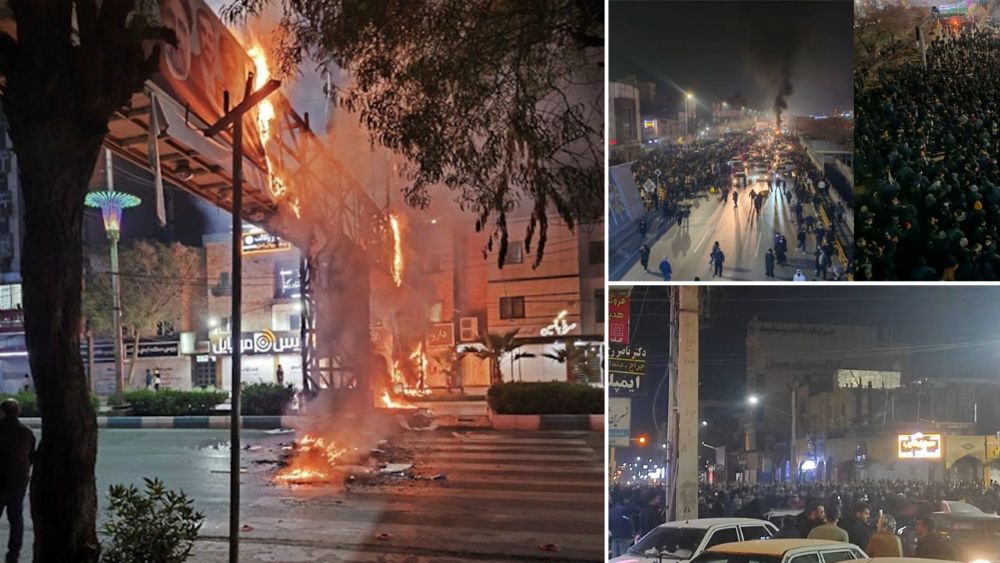
Nationwide Protests and Internet Blackout
On Thursday, January 8, 2026, the twelfth consecutive day of Iran’s nationwide uprising, protests and clashes continued across multiple provinces, turning demonstrations into open confrontations with security forces. Sparked on December 28, 2025 by the collapse of the rial and soaring inflation, the movement has evolved into an uprising demanding the overthrow of the ruling regime.
By Thursday night, Iran was under a nationwide internet blackout confirmed by NetBlocks, with specific loss of connectivity on the TCI backbone in the restive city of Kermanshah. The blackout followed escalating digital censorship targeting protests and was widely interpreted as an attempt to conceal rising casualties and disrupt coordination among protesters.
Foreign Mercenaries and Regime Crackdown
Reports from Kermanshah indicated that the Islamic Revolutionary Guard Corps (IRGC) deployed Arabic‑speaking members of Iraq’s Hashd al‑Shaabi (Popular Mobilization Forces) to assist in suppressing protesters. Local witnesses described these foreign forces operating alongside IRGC units, reflecting the regime’s mounting manpower crisis and reliance on external proxies. Security forces in several cities, including Kermanshah and Sanandaj, used live ammunition against demonstrators, turning parts of western Iran into de facto conflict zones.
In Lordegan, western Iran, security forces opened fire on rallies that had continued from the previous night into early morning, resulting in the killing of eight protesters. Local reports also indicated that during fierce clashes, a regime colonel and two Basij agents were killed as protesters resisted and blocked the Ahvaz road to prevent reinforcements. According to the People’s Mojahedin Organization of Iran (PMOI/MEK), the confirmed number of protesters killed nationwide since the start of the uprising has reached 44.
Expanding Death Toll and Identified Victims
The PMOI/MEK announced on January 8 that the names of 13 additional slain protesters had been confirmed, bringing the total number of identified martyrs of the uprising to 44. These victims were killed in recent days by direct fire from the Revolutionary Guards and other security forces in cities including Khoshk‑e Bijar, Lordegan, Azna, Malekshahi, Qom, and Neyshabur. Seven of the newly identified martyrs were from Lordegan, killed in a brutal attack by regime agents on January 7, among them a woman and two teenagers aged 16 and 17.
The updated list released by the PMOI/MEK shows that at least seven teenagers are among the 44 confirmed dead, including 15‑, 16‑, and 17‑year‑old protesters from Azna, Marvdasht, Kermanshah, Qom, Malekshahi, and Khoshk‑e Bijar. In a rare admission on state television, the deputy governor of Razavi Khorasan acknowledged that security forces killed five protesters in Chenaran on January 7, with their names to be announced later.
Targeting Regime Institutions and Security Centers
Across the country, protesters escalated their actions by attacking and burning buildings associated with repression and propaganda. In Isfahan, demonstrators set fire to the headquarters of the state broadcaster, while in Gorgan they torched the governorate building, and in Lordegan residents set the governor’s office ablaze. In Lumar, Ilam province, protesters burned regime buildings and IRGC‑affiliated centers, having already taken to the streets earlier in large numbers.
Rebellious youth also targeted security infrastructure in several cities. In Tehran’s Mehrabad district, protesters set fire to a Basij base, while at Sattarkhan Bridge they burned vehicles belonging to IRGC Basij forces; in Naziabad, security forces fled, leaving motorcycles that were then set ablaze by demonstrators. In Asemanabad, near Sarableh in Ilam province, youths reportedly seized an IRGC center, and in Bijar and other locations protesters burned regime buildings and monuments linked to the security apparatus.
Tehran, Provincial Cities, and Street Clashes
Tehran saw nightly protests spreading across neighborhoods such as Sadeghiyeh, Haft Howz, Pirouzi, Ferdows Boulevard, Mehrabad, Sattarkhan, Naziabad, and Kashani Boulevard. Demonstrators chanted slogans including “Down with Khamenei” and “Don’t be afraid, we are all together,” while engaging in direct confrontations with security forces and setting fire to Basij facilities and vehicles. In Varamin, following an SSF shooting that injured a woman, youths clashed with security units along the Varamin road, resulting in the killing of two regime agents.
In Kermanshah’s Dareh Deraz, Maskan, Elahieh, and Dolatabad districts, security forces used live fire against large crowds, but protesters continued rallies, built roadblocks, and chanted anti‑regime slogans. In Sanandaj, Ardabil, and Urmia, protests turned into clashes, with reports of live rounds being used as demonstrators answered with continued marches and political chants such as “Freedom, justice, popular government” and “Azarbaijan is honorable, Pahlavi does not have honor.”
Widespread Strikes and Economic Paralysis
On the morning of January 8, widespread strikes by bazaaris and merchants paralyzed commercial centers in Tehran and at least 15 other cities. The grand bazaars of Tehran, Saqqez, Shahrekord, Dizelabad in Kermanshah, Hashtbandi in Hormozgan, Sanandaj, Marivan, Divandarreh, Kamyaran, Mahabad, Urmia, Piranshahr, Fasa, Sarpol‑e Zahab, Kerman, and additional cities were reported to be on complete strike.
Parallel reports described total or near‑total shutdowns in Sanandaj, Marivan, Baneh, Saqqez, and other Kurdish cities, as well as strikes in Tabriz’s historic bazaar, Bandar Abbas, Ilam, Sabzevar, Neyshabur, Fardis, Hamedan, and several other urban centers. These coordinated closures signaled a deepening rupture between the traditional merchant class and the state and demonstrated broad support for the uprising beyond street protests.