



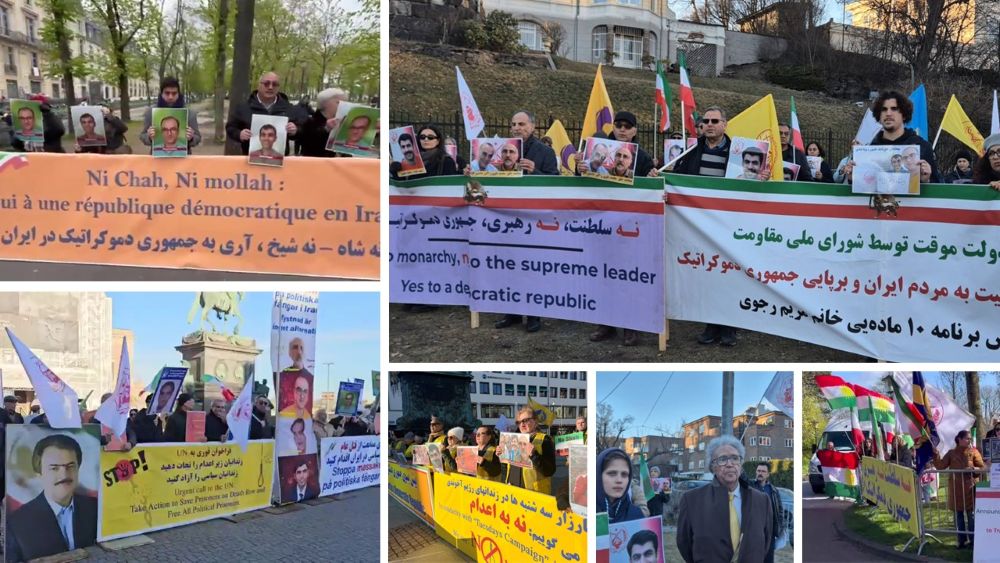
March 31, 2026 — Supporters of the Iranian Resistance held coordinated rallies across several European cities on March 31 to condemn the execution of four political prisoners affiliated with the People’s Mojahedin Organization of Iran (PMOI/MEK in Qezel Hesar Prison: Babak Alipour and Pouya Ghobadi, Mohammad Taghavi and Akbar Daneshvarkar
In Oslo, demonstrators gathered in front of the Iranian regime’s embassy, where Mr. Parviz Khazaei, the representative of the National Council of Resistance of Iran (NCRI) in Nordic countries, addressed the crowd. He strongly condemned the executions, describing them as a brutal crime aimed at silencing dissent and instilling fear among the population.
Video
1-Iranian Resistance supporters gather in Oslo on March 31 outside the Iranian regime’s embassy to condemn executions of MEK political prisoners & honor the victims. They call on the international community to act & end impunity. #StopExecutionsInIran #NoImpunity4Mullahs pic.twitter.com/Tc2gZaG5xc— Iran Freedom (@4FreedominIran) April 2, 2026
A similar protest took place in The Hague, Netherlands, where supporters of the Iranian Resistance, joined by Kurdish compatriots, rallied outside the Iranian embassy. Participants expressed solidarity with the executed prisoners and denounced the regime’s escalating use of capital punishment against political opponents.
Iranian Resistance supporters gather in The Hague on March 31 outside the Iranian regime’s embassy to condemn executions of MEK political prisoners and honor the victims. They call on the international community to act & end impunity.#StopExecutionsInIran #NoImpunity4Mullahs pic.twitter.com/B0YgWbz9Aa
— Iran Freedom (@4FreedominIran) April 1, 2026
In Stockholm, protesters assembled in front of the Swedish Ministry of Foreign Affairs, voicing outrage over the executions and calling for urgent international action. Demonstrators emphasized that such acts reflect the regime’s deepening crisis and fear of organized resistance.
Iranian Resistance supporters rally in #Stockholm on March 31 outside Sweden’s Foreign Ministry to condemn executions of MEK political prisoners and honor victims. They urge global action to end impunity.#StopExecutionsInIran #NoImpunity4Mullahs pic.twitter.com/bZNNjiO3r9
— Iran Freedom (@4FreedominIran) April 2, 2026
Meanwhile, in Gothenburg, Sweden, Iranian Resistance supporters held a parallel gathering, echoing the same demands for accountability and justice. Protesters highlighted the growing wave of executions as a sign of the regime’s desperation in the face of increasing domestic unrest.
In Paris, demonstrators gathered in front of the French National Assembly, condemning the executions and urging European lawmakers to adopt a firmer stance against the Iranian regime. Participants stressed that continued silence by the international community emboldens further human rights violations.
On March 31, Iranian Resistance supporters gathered outside France’s National Assembly in Paris to condemn the arbitrary executions of MEK members by the Iranian regime. They called for closing its political offices & urged global action. #StopExecutionsInIran #NoImpunity4Mullahs pic.twitter.com/gafwxBtDa4
— Iran Freedom (@4FreedominIran) April 1, 2026
Participants called on European governments and the broader international community to take decisive action to halt executions in Iran and to hold the regime accountable for its crimes. They warned that failure to act risks enabling further atrocities against political prisoners.
Demonstrators underscored that executions are being used as a tool of repression and intimidation, but ultimately reveal the regime’s weakness and fear of the Iranian people’s demand for freedom.
Background:
Mrs. Maryam Rajavi, President-elect of the National Council of Resistance of Iran (NCRI), strongly condemned the executions of Babak Alipour and Pouya Ghobadi, describing them as evidence of the regime’s fear and desperation in the face of growing public unrest and expanding support for resistance movements.
At dawn today(Tuesday31March) #BabakAlipour and #PouyaGhobadi, two members of the People’s Mojahedin Organization of Iran (PMOI/MEK), were executed in Qezel Hesar Prison by the religious fascism ruling Iran.
The brutal execution of these PMOI members reflects the clerical… pic.twitter.com/enAaf3zChQ— Maryam Rajavi (@Maryam_Rajavi) March 31, 2026
She stated that carrying out such executions, particularly amid external pressures, reveals that the regime views the Iranian people and organized resistance as its primary threat. Rajavi emphasized that those executed, along with Mohammad Taghavi and Akbar Daneshvarkar, represent enduring symbols of sacrifice and steadfast resistance who refused to yield under pressure.

Calling the executions a grave crime, she urged the United Nations, its member states, and human rights organizations to take immediate and concrete action to prevent further executions. She stressed the need for practical measures, including holding Iranian officials accountable and increasing diplomatic pressure, warning that continued inaction could lead to more loss of life among political prisoners.
