



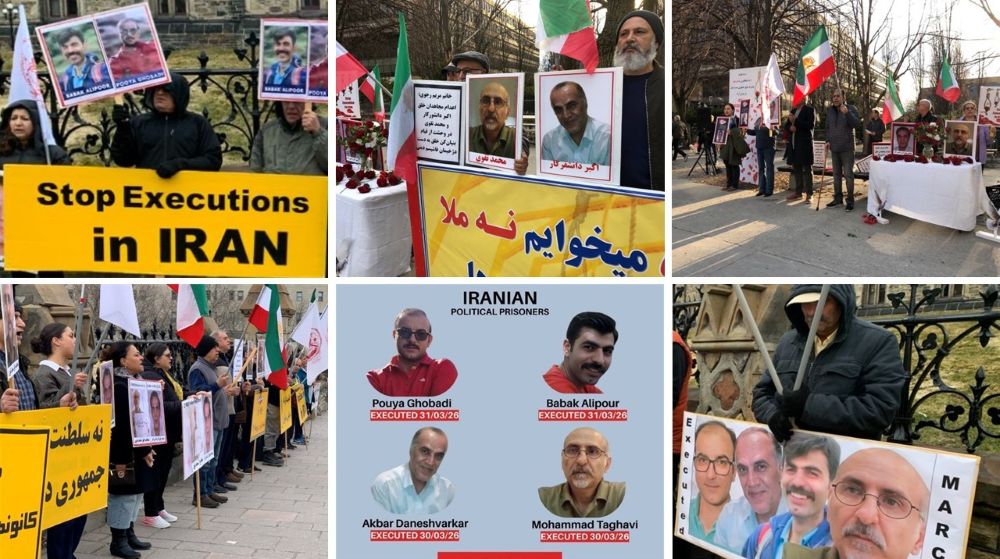
March 31, 2026 — Iranian communities in Canada held coordinated protests in Ottawa and Toronto to condemn the execution of political prisoners affiliated with the People’s Mojahedin Organization of Iran (PMOI/MEK).
In both cities, demonstrators gathered to honor Babak Alipour, 34, and Pouya Ghobadi, 33, who were executed on Tuesday, March 31, by Iranian authorities. The rallies also commemorated the execution of two other PMOI members, Mohammad Taghavi, 59, and Akbar Daneshvarkar, 58, carried out the previous day, underscoring a sharp escalation in the regime’s use of capital punishment against political prisoners.
🇨🇦Ottawa Mar 31, 2026
Freedom loving Iranians rally to commemorate the PMOI members Babak Alipour,34, and Pouya Ghbadi, 33, executed by Iran’s regime today.This follows the executions of other PMOI members of Mohammad Taghavi, 59, & Ali Akbar Daneshvarkar, 58, yesterday.… pic.twitter.com/r8wFTJpcjQ
— Iran Democratic Association (IDA) Canada 🇨🇦 (@IDA_Canada) April 1, 2026
Participants described the executions as part of a broader strategy by the Iranian regime to suppress social unrest and growing opposition, particularly during a period of heightened internal and external pressures. They stressed that the increasing reliance on executions reflects the regime’s fear of organized resistance and its inability to contain public dissent.
Protesters in Ottawa and Toronto called on the international community and democratic governments to break their silence and take decisive action. They warned that continued inaction risks enabling further atrocities and could lead to a repetition of past crimes, including the mass execution of political prisoners in 1988.
🇨🇦Toronto, Mar 31, 2026
Freedom loving Iranians rally to commemorate the PMOI members Babak Alipour,34, and Pouya Ghbadi, 33, executed by Iran’s regime today.This follows the executions of other PMOI members of Mohammad Taghavi, 59, & Ali Akbar Daneshvarkar, 58, yesterday.… pic.twitter.com/7Xw0TPqML1
— Iran Democratic Association (IDA) Canada 🇨🇦 (@IDA_Canada) April 1, 2026
Demonstrators urged global institutions and human rights organizations to intervene urgently to stop ongoing executions and to hold Iranian officials accountable for what they described as crimes against humanity. They emphasized that silence and indifference would only embolden further repression.
Background:
Mrs. Maryam Rajavi, President-elect of the National Council of Resistance of Iran (NCRI), strongly condemned the executions of Babak Alipour and Pouya Ghobadi, describing them as evidence of the regime’s fear and desperation in the face of growing public unrest and expanding support for resistance movements.
At dawn today(Tuesday31March) #BabakAlipour and #PouyaGhobadi, two members of the People’s Mojahedin Organization of Iran (PMOI/MEK), were executed in Qezel Hesar Prison by the religious fascism ruling Iran.
The brutal execution of these PMOI members reflects the clerical… pic.twitter.com/enAaf3zChQ— Maryam Rajavi (@Maryam_Rajavi) March 31, 2026
She stated that carrying out such executions, particularly amid external pressures, reveals that the regime views the Iranian people and organized resistance as its primary threat. Rajavi emphasized that those executed, along with Mohammad Taghavi and Akbar Daneshvarkar, represent enduring symbols of sacrifice and steadfast resistance who refused to yield under pressure.

Calling the executions a grave crime, she urged the United Nations, its member states, and human rights organizations to take immediate and concrete action to prevent further executions. She stressed the need for practical measures, including holding Iranian officials accountable and increasing diplomatic pressure, warning that continued inaction could lead to more loss of life among political prisoners.
