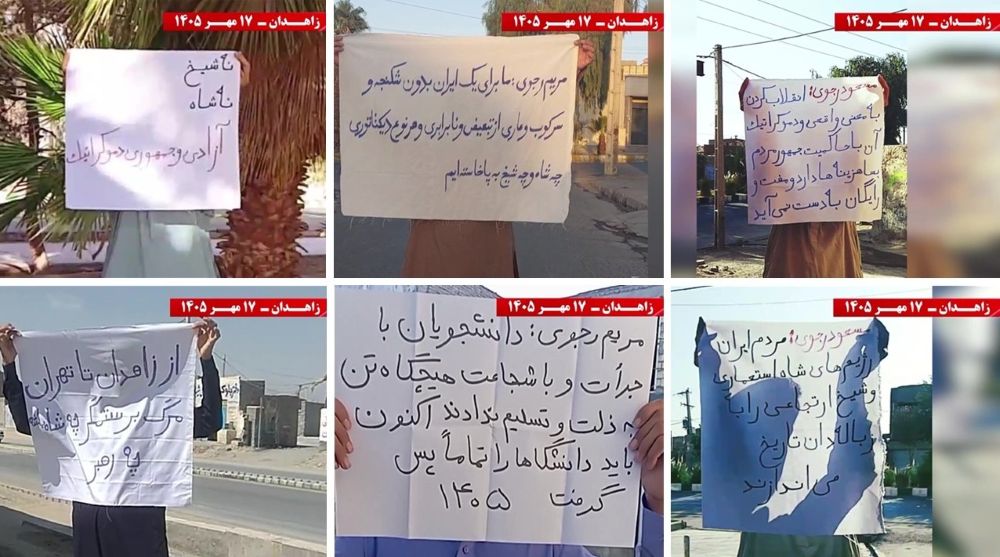
Banners support student protests and reject both monarchical and religious dictatorship.
Friday, October 9, 2026 — Zahedan, Sistan and Baluchestan Province: Resistance Units of the People’s Mojahedin Organization of Iran (PMOI/MEK) displayed banners and placards in Zahedan. They condemned executions and expressed support for student protests.
The banners featured messages from Iranian Resistance Leader Massoud Rajavi and Mrs. Maryam Rajavi, President-elect of the National Council of Resistance of Iran (NCRI). These messages called for academic freedom, resistance to repression, and the overthrow of the ruling clerical regime.
They also called for a democratic republic based on freedom, equality, and popular sovereignty. In addition, the slogans rejected both the Shah’s monarchy and the mullahs’ religious dictatorship.
Maryam Rajavi’s Messages: Freedom, Equality, and an End to Dictatorship
Rejecting Both Monarchical and Religious Dictatorship
The banners highlighted Mrs. Maryam Rajavi’s call for an Iran free from torture, repression, discrimination, inequality, and all forms of dictatorship.
“We have risen up for an Iran free from torture and repression, free from discrimination and inequality, and free from every form of dictatorship, whether the Shah or the mullahs.”
“The Velayat-e Faqih (the mullahs’ absolute dictatorship) regime must be removed in its entirety and replaced by a democratic republic.”
Supporting Students and Defending University Freedom
The messages also underscored the role of students in the struggle for freedom and the need to reclaim universities from repression.
“Students have never bowed to humiliation or surrender; they have stood courageously and fearlessly. Now, the universities must be fully reclaimed.”
“As in the time of the Shah and the monarchical dictatorship, universities must always be at the forefront of the struggle and uprising for freedom.”
Executions, Repression, and the Necessity of an Uprising
Addressing the escalation of executions, the messages linked the regime’s resort to capital punishment to its fear of popular resistance.
“The increase in executions is directly correlated with the growth of resistance and popular uprisings, demonstrating the regime’s fear of the people and the Resistance.”
“Terrified of an uprising, the regime commits such crimes. But it cannot escape its inevitable overthrow by the people and the Resistance.”
“As long as fascism and dictatorship rule, and the people’s sovereignty remains usurped and stolen, the confrontation between the people’s front and the anti-people’s front must first be resolved.”
Overthrowing the Regime and Establishing Popular Sovereignty
Mrs. Rajavi’s messages stressed that the overthrow of the ruling regime would be achieved through the Iranian people’s uprising and the National Liberation Army.
“The overthrow of the regime is inevitable, and it will be accomplished by the Iranian people, their uprising, and the National Liberation Army.”
“The ruling regime is on the brink of overthrow and has never been as shaken, weak, and vulnerable as it is today.”
Massoud Rajavi’s Messages: The Struggle for a Democratic Republic
Freedom and Popular Sovereignty
Iranian Resistance Leader Massoud Rajavi emphasized the cost of achieving a genuine democratic revolution.
“Making a revolution in its true and democratic sense, with sovereignty resting with the people, comes at a considerable cost; it is not achieved for free.”
He also reaffirmed the Mojahedin’s commitment to continuing their struggle.
“The Mojahedin have always stood firm and resolute, ready under all circumstances to fight and struggle to overthrow the enemy of humanity. They have been, are, and will remain so—with a hundredfold battle.”
No to the Shah, No to the Mullahs
Mr. Rajavi’s messages rejected both monarchical and clerical dictatorship. They also called for resistance and an end to authoritarian rule.
“With the banner of ‘No to Shah, No to Mullahs,’ the cry for freedom must be raised, arms must be taken up, and resistance must be waged. It must be emphasized that no power in the world can prevent the uprising and victory of the Iranian people.”
Another message rejected dictatorship in every form.
“Dictatorship, in any form and under any name, has no place in Iran. Uprising participants across Iran have shouted: ‘Death to the oppressor, be it the Shah or the Supreme Leader.’”
The messages also condemned both the former monarchy and the current clerical system.
“The Iranian people will consign the colonial Shah’s regime and the reactionary mullahs to the dustbin of history.”
“The shops of the mullahs and the Shah—which represent the same system of despotism and dependence—must be shut down at their very foundations.”
Resistance Slogans in Zahedan: Rejecting Dictatorship and Condemning Executions
The activities of the Resistance Units in Zahedan also featured slogans condemning executions, rejecting dictatorship, and affirming the demand for freedom and a democratic republic.
Rejecting Both the Shah and the Mullahs
The slogans included:
- “Death to the oppressor, be it the Shah or the Supreme Leader.”
- “Monarchy and Velayat-e Faqih (the mullahs’ absolute dictatorship): One hundred years of crimes.”
- “The people and history curse the bloodthirsty Shah and mullah.”
- “Baluchistan is awake; it rejects both the Shah and the mullahs.”
No Shah, No Mullahs—Freedom and a Democratic Republic
Other slogans called for an end to both forms of dictatorship and the establishment of a democratic political system:
- “We want neither Shah nor mullahs—damn the dictators!”
- “No to Shah, no to mullahs—freedom and a democratic republic.”
- “From Zahedan to Tehran: Death to the oppressor, be it the Shah or the Supreme Leader.”
The activities in Zahedan highlighted support for student protests and opposition to executions. They also reaffirmed the rejection of both monarchical and religious dictatorship.
The central message was a call for freedom, equality, popular sovereignty, and a democratic republic in Iran.