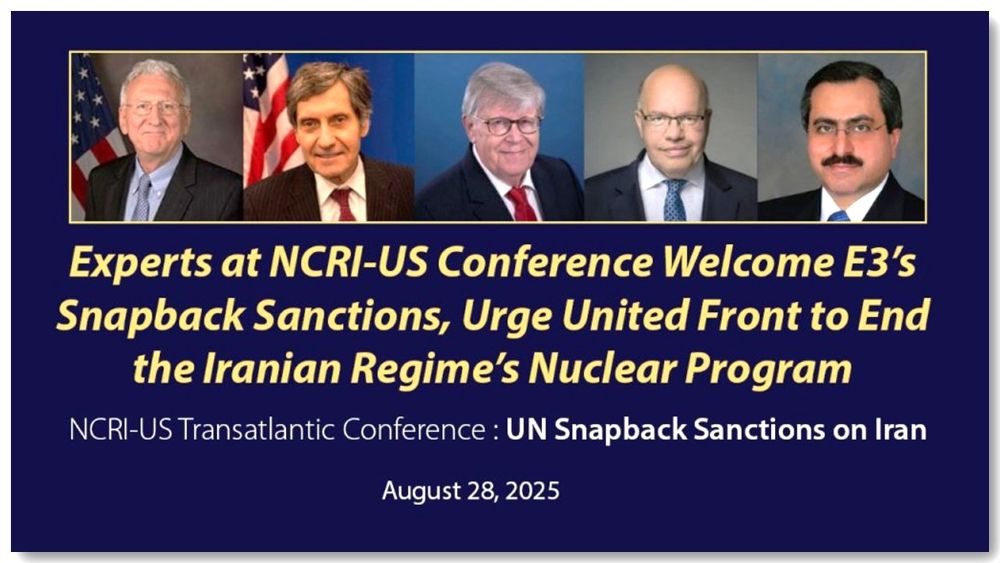
On August 28, 2025, the Washington Office of the National Council of Resistance of Iran (NCRI-US) convened a high-profile online policy conference to assess the implications of the European powers’ decision to reimpose United Nations sanctions on Tehran. The event, titled “UN Snapback Sanctions on Iran: Necessity, Effectiveness, and Consequences,” came just hours after France, Germany, and the United Kingdom (E3) announced they would activate the UN’s snapback mechanism in response to the Iranian regime’s nuclear violations.
Moderated by Alireza Jafarzadeh, Deputy Director of NCRI-US, the conference featured four leading international experts with direct experience in counter-proliferation and diplomacy: Ambassador Robert G. Joseph, former U.S. Undersecretary of State for Arms Control; Ambassador Joseph DeTrani, former Special Envoy for Six-Party Talks with North Korea; Peter Altmaier, former German Minister of Economic Affairs and longtime advisor to Chancellor Angela Merkel; and Dr. Olli Heinonen, former Deputy Director General of the International Atomic Energy Agency (IAEA).
Maryam Rajavi: “No to war, no to appeasement”
In a statement to the conference, Mrs. Maryam Rajavi, the NCRI’s President-elect, described the snapback decision as “belated but urgent and necessary.” She argued that the regime’s refusal to abandon its pursuit of nuclear weapons proves the futility of endless negotiations. Rajavi emphasized that the only lasting solution lies in democratic change led by the Iranian people and their organized resistance. Appeasement, she warned, has only emboldened Tehran and brought the world closer to conflict.
The mullahs’ regime will never abandon its pursuit of the nuclear bomb.
The activation of the snapback mechanism and the enforcement of the UN Security Council resolutions are long overdue, and their implementation has become more urgent than ever.
The failed talks in Geneva on… pic.twitter.com/0l1o4GIviX— Maryam Rajavi (@Maryam_Rajavi) August 28, 2025
Ambassador Robert Joseph: Negotiations have failed
Ambassador Robert Joseph applauded the E3’s move but stressed that sanctions alone are insufficient. He outlined four key conclusions: Iran has no right to enrich uranium; endless negotiations have failed; regime change by the Iranian people offers the only viable alternative; and time is running out as Tehran moves closer to weapons capability. He praised the NCRI and Maryam Rajavi’s Ten-Point Plan as a democratic vision for a secular, non-nuclear Iran.
Ambassador Joseph DeTrani: Iran nearing weapons capability
Joseph DeTrani warned that Iran’s 60% uranium enrichment, combined with its ballistic missile program and cooperation with North Korea, signals clear weapons intent. He underscored the global risk of a nuclear-armed Iran, predicting that regional states like Saudi Arabia, Egypt, and Turkey could follow suit. DeTrani endorsed the snapback sanctions as necessary and urged international unity to confront the threat.
Peter Altmaier: Western unity is restored
Speaking from Berlin, Peter Altmaier hailed the decision as a turning point for Europe’s role in global security. For the first time in years, he said, Europe and the United States are aligned on Iran policy. Altmaier called for greater support for the Iranian democratic opposition, stressing that while governments may hesitate to embrace regime change, civil society and parliamentarians can and should rally behind the NCRI and Maryam Rajavi’s platform.
Dr. Olli Heinonen: Iran must come clean
Dr. Olli Heinonen provided a technical perspective, pointing to Iran’s repeated violations of its safeguards commitments. He cautioned that unless Tehran allows intrusive inspections and dismantles its weapons-related infrastructure, the international community will face recurring crises. Heinonen warned against reviving the flawed JCPOA and urged a stronger verification regime, modeled after past disarmament cases in South Africa, Iraq, and Libya.
Alireza Jafarzadeh: Resistance is the decisive force
Closing the conference, Alireza Jafarzadeh highlighted the role of the Iranian Resistance in exposing Tehran’s clandestine nuclear and missile projects over the past three decades. He noted that resistance units inside Iran have carried out thousands of operations against the IRGC, and that this growing movement is the regime’s greatest fear. Jafarzadeh underscored that the NCRI’s democratic vision—embodied in Maryam Rajavi’s Ten-Point Plan—offers not just opposition to the current regime but a concrete alternative for the future of Iran.
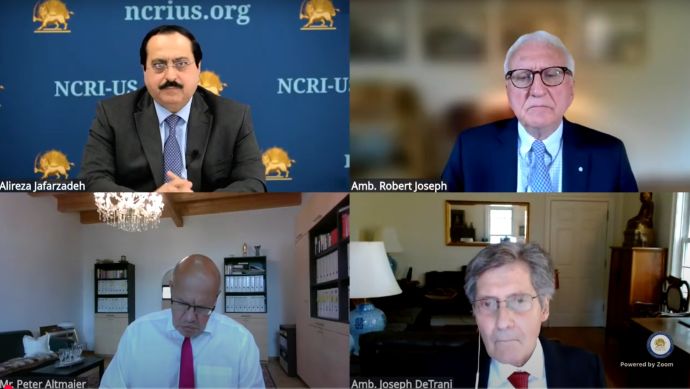
A consensus: Sanctions are not enough
Across the board, the panelists agreed that while the snapback decision marks a major step forward, sanctions alone cannot resolve the Iranian nuclear crisis. Only by empowering the Iranian people and their organized resistance, they argued, can the world prevent Tehran from acquiring nuclear weapons and ensure a peaceful, democratic future for Iran.
As Ambassador Robert Joseph put it, “The Iranian people want an end to the religious dictatorship. We must stand with them.”