



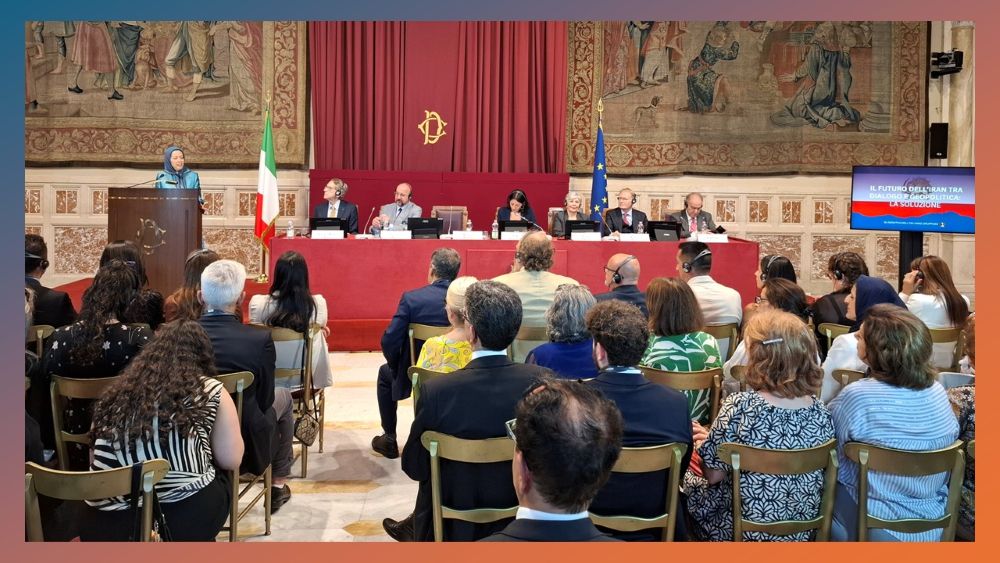
Maryam Rajavi Delivers Keynote Address, Backed by Cross-Party Italian and European Leaders
On Wednesday, July 30, 2025, the Italian Parliament hosted a high-profile conference titled “Iran Crisis: The Third Option for Change,” featuring a keynote speech by Mrs. Maryam Rajavi, President-elect of the National Council of Resistance of Iran (NCRI). The event brought together leading Italian lawmakers, senior European politicians, and international dignitaries in a strong show of support for the Iranian people’s struggle for freedom and democracy.

The conference marked a major step in European support for regime change by the Iranian people, as the majority of the Italian Senate declared its support for the “Free Iran 2025” Declaration, endorsing Mrs. Rajavi’s 10-point plan for a democratic Iran. Calls were also made for the designation of the Islamic Revolutionary Guard Corps (IRGC) as a terrorist organization, and for recognition of the resistance units’ struggle against the IRGC.
Key Speakers Included:
-
Charles Michel, President of the European Council (2019–2024), Prime Minister of Belgium (2014–2019)
-
Senator Giulio Terzi, Chair of the European Policies Committee in the Italian Senate, Foreign Minister (2013)
-
Senator Lucio Malan, Head of the Majority Coalition and Chair of the Brothers of Italy Parliamentary Group in the Senate
- Linda Chavez, Former Director of Public Liaison at the White House
- Naike Gruppioni, Member of Parliament, Member of the Foreign Affairs Committee
-
Lorenzo Cesa, Member of Parliament, Head of the Italian Delegation to NATO, President of the Union of the Centre
- Emanuele Pozzolo, Member of the Italian Parliament
Keynote Address by Maryam Rajavi
Speech at the Parliament of Italy
The Third Option: Change by the Iranian people and the Iranian Resistance
Today, I have come to the cradle of Italian democracy to present a comprehensive roadmap—a roadmap grounded in the strength, determination, and capabilities of a nation… pic.twitter.com/36uyd8L9on— Maryam Rajavi (@Maryam_Rajavi) July 30, 2025
The Third Option: Change by the Iranian people and the Iranian Resistance
Today, I have come to the cradle of Italian democracy to present a comprehensive roadmap—a roadmap grounded in the strength, determination, and capabilities of a nation that has risen up, and one that moves purposefully toward a momentous transformation: the overthrow of religious tyranny.
Just four days ago, the religious dictatorship in Iran committed yet another appalling crime: the execution of two members of the People’s Mojahedin Organization of Iran, Behrouz Ehsani and Mehdi Hassani; a crime against the youth of Iran, whose only offense was their desire for freedom.
Time and again, the regime’s executioners gave them a cruel ultimatum: to express remorse and save their lives—or to face death and embrace martyrdom. But their choice echoed the unwavering resolve of the 30,000 political prisoners massacred in 1988.Achieving change in Iran is based on the Third Option:
Not foreign military intervention.
Not religious dictatorship or appeasement of it.
But regime change by the Iranian people and their organized resistance.
The Iranian people and the Iranian Resistance are not asking for money or weapons to bring down this regime.
They are simply demanding that no one stand with the regime.The prevailing spirit among the people of Iran today is one of uprising and resistance. Even the prisons have become centers of defiance. In response, the regime’s strategy to prevent the next uprising is a brutal crackdown: a new wave of arrests, intensified pressure on political prisoners, and death sentences targeting opponents—particularly members of the PMOI.
Achieving change in Iran is based on the Third Option:
Not foreign military intervention.
Not religious dictatorship or appeasement of it.
But regime change by the Iranian people and their organized resistance.
The Iranian people and the Iranian Resistance are not asking for… pic.twitter.com/KVO9Ic4X95— Maryam Rajavi (@Maryam_Rajavi) July 30, 2025
The fundamental question now is this:
In the decisive battle between the Iranian people and the clerical regime, where does the international community stand?