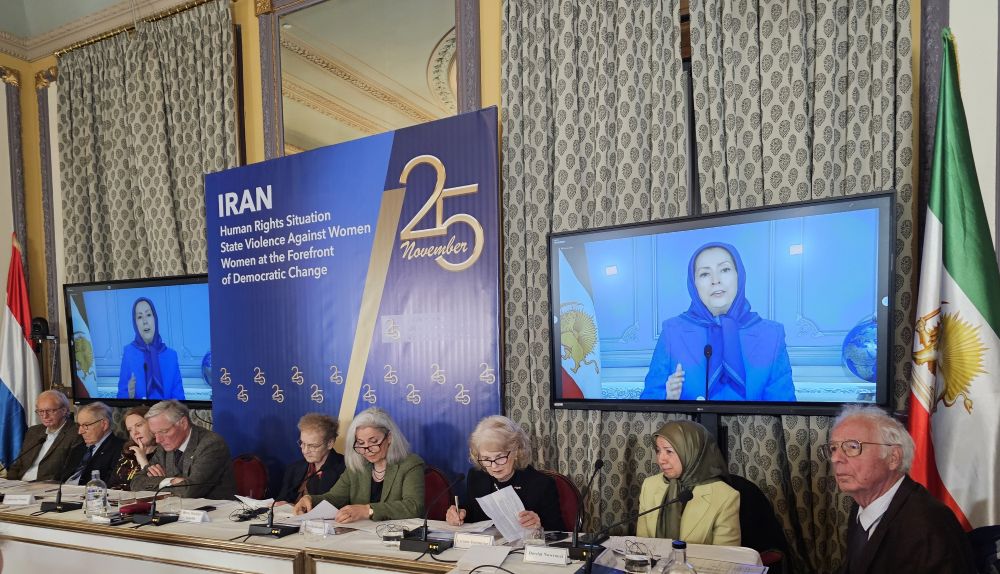
Institutionalized Violence and Suppression
Mrs. Rajavi highlighted that the theocratic establishment enforces forced religion, discrimination, and harsh punishments, especially against women. She pointed to the compulsory hijab as a primary tool of state violence, creating constant fear of arrest and exposing women to daily harassment.
According to Mrs. Rajavi, at least 53 women have been executed in Iran in 2025, reflecting a pervasive system of abuse. She stressed that political repression remains the most severe form of violence, referencing tens of thousands of female political prisoners who have suffered torture or execution, including victims of the 1988 massacre recently noted in a UN Third Committee resolution.
Criminalizing Womanhood
Mrs. Rajavi argued that in Iran, “being a woman” is treated as a crime when paired with refusal to submit or participation in resistance. Women are legally devalued—barred from the presidency and judgeships, and granted half the legal testimony value afforded to men.
She also condemned the neglect of imprisoned women, citing the recent death of political prisoner Somayyeh Rashidi due to withheld medical care and warning that Zahra Tabari now faces a death sentence.
The mullahs have institutionalized violence and repression against the people of Iran, especially women. They have taken away women’s rights and freedoms.
Nevertheless, the greatest violence against women is political repression. Under this regime, tens of thousands of female… pic.twitter.com/rN4i9FmadP— Maryam Rajavi (@Maryam_Rajavi) November 25, 2025
Women at the Heart of the Iranian Resistance
Mrs. Rajavi emphasized that violence and inequality lie at the core of the regime’s fundamentalist ideology. In contrast, the Iranian Resistance has made women’s liberation central to its democratic vision for Iran, rejecting both past and present dictatorships.
The movement’s platform includes secular governance, gender equality, the abolition of the death penalty, autonomy for Iranian Kurdistan, and a non-nuclear Iran. Mrs. Rajavi praised the role of women in leadership, noting that they form over half of the National Council of Resistance and hold key positions in the PMOI.
“Women are the force for change,” Mrs. Rajavi said, reaffirming that their leadership is indispensable to Iran’s democratic future.
Call for Dutch and International Action
Mrs. Rajavi urged Dutch parliamentarians to push their government toward a firmer policy on Iran. She called for conditioning diplomatic and trade relations on a halt to executions and for placing the Islamic Revolutionary Guard Corps (IRGC) on the terrorist list.
She concluded that toppling the clerical regime is not only vital for Iran but also a decisive global step toward ending violence against women.