


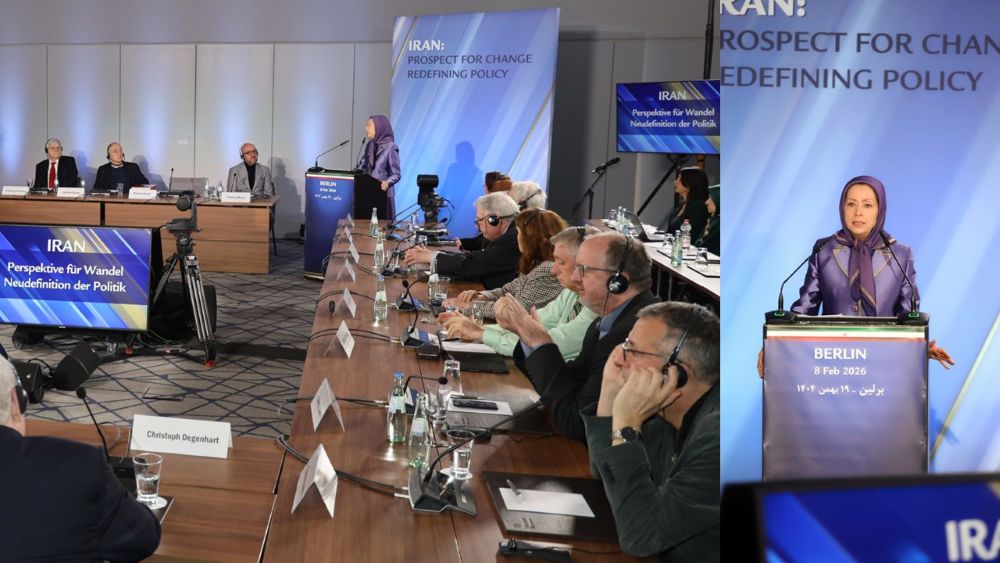
Berlin – On Sunday, February 8, 2026, Mrs. Maryam Rajavi, President-elect of the National Council of Resistance of Iran (NCRI), delivered a keynote speech at the Iran Conference: Prospect for Change in Berlin, attended by distinguished figures and members of the German Federal Parliament.
Mrs. Rajavi described the current situation in Iran as “the most critical and turbulent” in the country’s history. She highlighted the regime’s strategic failures, ongoing conflicts, and the January uprising, emphasizing the regime’s nationwide mass killings of civilians.
According to Mrs. Rajavi, the mass killings during the January uprising demonstrate that the regime’s downfall has entered an irreversible path. She stated that the regime carried out a “carefully designed and coordinated campaign of repression” to instill maximum fear among ordinary people.
In Iran’s case multiple factors exist that can guide the post-regime period toward an orderly and democratic path.
Foremost among them is the existence of a credible, long-standing democratic alternative: the National Council of Resistance of Iran.
This alternative is rooted in… pic.twitter.com/OAdW61MQ8l— Maryam Rajavi (@Maryam_Rajavi) February 8, 2026
Mrs. Rajavi underlined that multiple factors exist to guide a post-regime Iran toward democracy. Chief among these is the National Council of Resistance of Iran, which she described as a credible, long-standing democratic alternative with a nationwide network in cities across Iran. She said this alternative can serve as a unifying axis among diverse political forces, ethnicities, and religions, promoting the establishment of a democratic society.
Mrs. Rajavi also noted that the January uprising demonstrated how change in Iran can be achieved even under brutal repression, particularly when combined with organized forces, including the Resistance Units.
The conference highlighted the ongoing transformation in Iran and the Middle East, reflecting both the regime’s failures and the potential for organized democratic change as emphasized by Mrs. Rajavi.
The most decisive proof that the regime’s downfall has entered an irreversible path is the mass killing of people during the January uprising.
During this uprising, the regime implemented a carefully designed and coordinated campaign of repression, delivering a rapid and brutal… pic.twitter.com/wtbIgJiypX— Maryam Rajavi (@Maryam_Rajavi) February 8, 2026