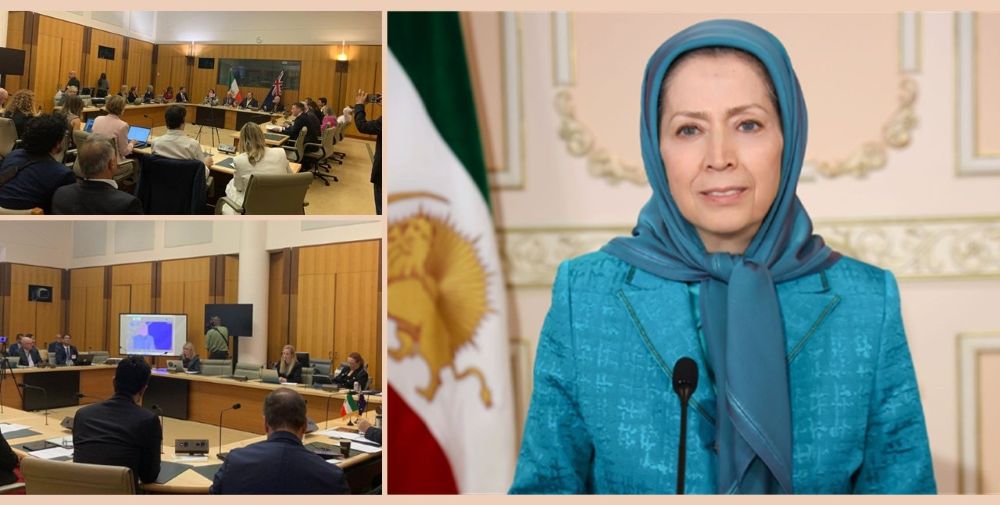
In a message to a conference attended by members of Australia’s Parliament and Senate, Mrs. Maryam Rajavi, President-elect of the National Council of Resistance of Iran (NCRI), outlined what she described as the only viable solution to Iran’s ongoing crisis: the overthrow of the ruling regime through a popular uprising and organized resistance.
Mrs. Rajavi emphasized that decades of repression, nuclear ambitions, and regional destabilization by Iran’s ruling clerics have brought the country and the region to a critical point. She criticized Western governments’ long-standing policy of appeasement, arguing that it has prolonged the regime’s survival.
Rejecting both foreign military intervention and passive diplomacy, Mrs. Rajavi presented the Iranian Resistance and its democratic platform as the alternative. She also called on Australia to take a leading role in shifting international policy by recognizing the NCRI’s provisional government and supporting the Iranian people’s struggle for democracy, gender equality, and a secular republic.
The regime ruling Iran, from the very beginning, knew that if it pursued a democratic path, it would swiftly lose its grip on power. It therefore adopted a sinister strategy built on the torture and execution of the Iranian people, the pursuit of nuclear weapons, and the export… pic.twitter.com/z7POC9xruy
— Maryam Rajavi (@Maryam_Rajavi) March 25, 2026
Full Message
Message to the Conference Featuring Members of the Australian Parliament and Senate
Maryam Rajavi: The Antidote to the Religious Fascism in Iran Is Overthrowing the Regime through the People’s Uprising and Organized Resistance
Honorable lawmakers of the Parliament, the Federal Senate, and the state assemblies of Australia,
I greet you and appreciate your attention to a sound and principled solution to the question of Iran.
At a time when Iran and the entire region are engulfed in a major conflict, in the name of peace and in the name of freedom, I call upon the world to recognize the only viable solution to Iran’s grave crisis. This solution is the overthrow of the regime by the Iranian Resistance, an organized uprising, and the Army of Freedom.
What Is the Solution?
The question is: how did the situation reach this critical point? And what solution can bring this crisis to an end?
The regime ruling Iran, from the very beginning, knew that if it pursued a democratic path, it would swiftly lose its grip on power. It therefore adopted a sinister strategy built on the torture and execution of the Iranian people, the pursuit of nuclear weapons, and the export of war and terrorism across the region.
From the outset, our Resistance has stood firm against this regime. The price has been immense: the sacrifice of one hundred thousand members of the Iranian Resistance.
At the same time, we have consistently warned of the dangers posed by this regime. For over four decades, we have repeatedly exposed its warmongering designs and terrorist activities. For three decades, we have brought its clandestine nuclear program to the world’s attention.
Yet instead of heeding these warnings, Western governments chose a policy of appeasement toward the ruling clerics. In doing so, they effectively contributed to the regime’s survival. At the core of this policy was the closing of pathways to change in Iran and, in practice, collaboration with the regime in suppressing the Resistance.
Over the past four decades, there have been critical junctures when the Resistance movement, relying on the support of the Iranian people, could have brought about profound change in Iran. Yet the policy of appeasement has been one of the principal factors in the regime’s survival.
Today, the solution remains the same.
As proven in 2025 and 2026, bombardment and foreign war are not the answer to the Iranian question. They do not bring stability or peace to the region, nor do they eliminate the threat this regime poses to global peace and security.
Every poison has its antidote; the antidote to the religious fascism ruling Iran is the overthrow of the regime by the people’s uprising and an organized resistance.
We have always declared—and we reiterate—that this Resistance seeks neither money nor weapons, nor does it require foreign boots on Iranian soil.
The Imperative for a Shift in Western Policy
The National Council of Resistance of Iran, established in Tehran in 1981, is a broad coalition encompassing diverse political and ideological currents.
It has announced a provisional government tasked with transferring sovereignty to the people of Iran and establishing a democratic republic. This interim government is founded on the Iranian Resistance’s Ten-Point Plan, which envisions a republic based on the separation of religion and state, one that upholds gender equality, recognizes the autonomy of ethnic nationalities, abolishes the death penalty, and is committed to a non-nuclear Iran living in peace and coexistence with the world.
Today, remnants of the deposed Shah’s dictatorship have been brought back onto the stage through the engineering of digital platforms and television programs. Their aim is to appropriate the popular uprisings and restore a monarchical system with the same repressive institutions of the past.
The people of Iran, however, have not endured nearly half a century of struggle against dictatorship only to return to another form of it. Iranian women, relegated to second-class status under the current regime, demand full equality. Oppressed nationalities, including Kurds, Baluchis, Arabs, and Turkmen, seek the restoration of their rights, not the imposition of a new form of authoritarianism of the kind pursued by those seeking to revive the monarchy.
We call upon the esteemed legislators of Australia to take the initiative in opening a new path in Western policy toward Iran. Over the past year, Australia has taken important steps: expelling the regime’s ambassador, suspending the operations of its embassy, and designating the Revolutionary Guard Corps (IRGC) as a terrorist organization.
These significant measures will achieve their full impact when they are complemented by the recognition of the provisional government announced by the National Council of Resistance of Iran that is tasked with transferring sovereignty to the people of Iran.