



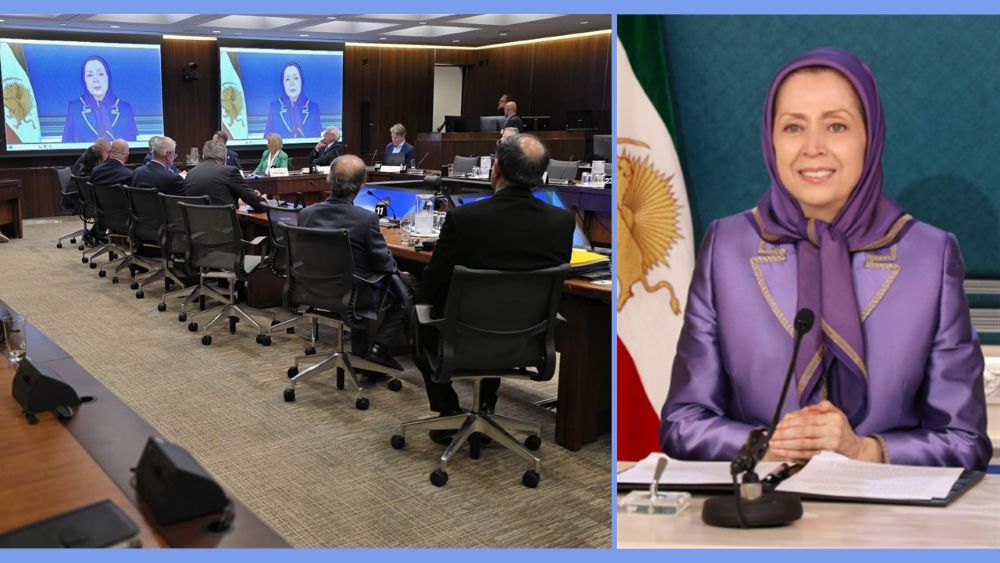
Mrs. Maryam Rajavi, President-elect of the National Council of Resistance of Iran (NCRI), delivered a video message to a parliamentary conference on Iran held at Canada’s Parliament Hill on May 27, 2026. Addressing Canadian lawmakers, international dignitaries, and policy experts, she argued that the Iranian people’s struggle for freedom is directly tied to global peace and security.
In her remarks, Mrs. Rajavi described the ruling clerical regime as the central source of terrorism, war, and instability in the region. She stressed that decades of appeasement have failed to moderate Tehran’s behavior and instead prolonged the survival of the dictatorship. Calling for a decisive shift in international policy, she urged democratic governments to support the organized Iranian Resistance and recognize the Iranian people’s right to overthrow the regime and establish a democratic republic based on the NCRI’s Ten-Point Plan.
Conference at the Parliament of Canada: Unprecedented rise in political executions in Iran, the role of the international community
The freedom of the Iranian people Is deeply connected to global peace#StopExecutionsInIranhttps://t.co/eiQKe5T3sK pic.twitter.com/z1HLielpxd— Maryam Rajavi (@Maryam_Rajavi) May 28, 2026
Freedom in Iran and Global Peace Are Interconnected
Mrs. Maryam Rajavi, President-elect of the National Council of Resistance of Iran, stated that the freedom of the Iranian people is inseparable from global peace and security. She said the world cannot eliminate the threat of religious extremism and regional warfare without confronting what she described as the ruling religious fascism in Iran.
According to Mrs. Rajavi, recent developments have once again demonstrated that the clerical establishment has neither the intention nor the capacity to reform its policies or behavior. She argued that the regime’s fundamental nature prevents meaningful change and has instead pushed Iran and the broader region deeper into instability.
Failed Appeasement Policies Strengthened the Regime
Mrs. Rajavi strongly criticized the long-standing Western policy of appeasement toward Tehran, arguing that it deprived the Iranian people and the international community of the principal force for democratic change inside Iran.
She said repeated concessions and negotiations allowed the regime to survive despite decades of domestic repression, terrorism, and regional intervention. Referring to the nationwide uprisings inside Iran, Mrs. Rajavi stated that the ruling establishment now faces an irreversible deadlock created by growing public anger and organized resistance.
She emphasized that military intervention or foreign war cannot resolve the Iranian crisis. Instead, she said the solution lies in supporting the Iranian people, the organized Resistance movement, and the Resistance Units operating inside the country against the Revolutionary Guards.
Support for Organized Resistance and Democratic Transition
Mrs. Rajavi presented the National Council of Resistance of Iran and its Ten-Point Plan as a democratic alternative capable of leading a peaceful political transition in Iran.
She explained that the NCRI’s vision includes a secular and democratic republic based on the separation of religion and state, gender equality, abolition of the death penalty, respect for ethnic nationalities, and a non-nuclear Iran living peacefully with the international community.
Mrs. Rajavi reiterated that the organized Resistance seeks neither foreign troops nor external military intervention, insisting that regime change must ultimately be achieved by the Iranian people themselves.
The major developments of the past year have proven important facts.
First, that the freedom of the Iranian people is deeply connected to global peace. Freeing the world from the threat of religious fascism, which is the main source of insecurity, terrorism, and war, is a single,… pic.twitter.com/kEwwrrniJ1— Maryam Rajavi (@Maryam_Rajavi) May 28, 2026
Rejection of Both Clerical Rule and Monarchy
A significant portion of Mrs. Rajavi’s message focused on rejecting any return to monarchy in Iran. She warned that remnants of the former Shah’s dictatorship are attempting to exploit current unrest in order to restore authoritarian rule.
Mrs. Rajavi criticized efforts to revive symbols associated with SAVAK, the Shah’s notorious secret police, arguing that such attempts undermine the democratic aspirations of the Iranian people and threaten to reproduce a past marked by torture and political repression.
She stressed that the Iranian people reject both religious dictatorship and hereditary monarchy, insisting that Iran’s future must be determined through democratic elections and popular sovereignty.
Call on Canada and the International Community
Concluding her message, Mrs. Rajavi called on Canada and democratic governments worldwide to adopt a policy of moral clarity toward Iran.
She urged governments to expel agents and lobbyists linked to the Iranian regime and formally recognize the legitimacy of the Iranian people’s struggle for freedom and democracy.
Mrs. Rajavi also called for international support for the NCRI’s Ten-Point Plan as a roadmap for establishing a democratic republic in Iran, arguing that such support would contribute not only to Iran’s freedom but also to lasting regional and global peace.