Maryam Rajavi: Regime Change in Iran Can Only Be Achieved Through Organized Resistance and Popular Uprising
At the Free Iran Summit 2026 in Paris, NCRI President-elect Maryam Rajavi rejected war, appeasement, and monarchy as solutions for Iran, arguing that democratic change can only emerge through the Iranian people’s organized resistance.
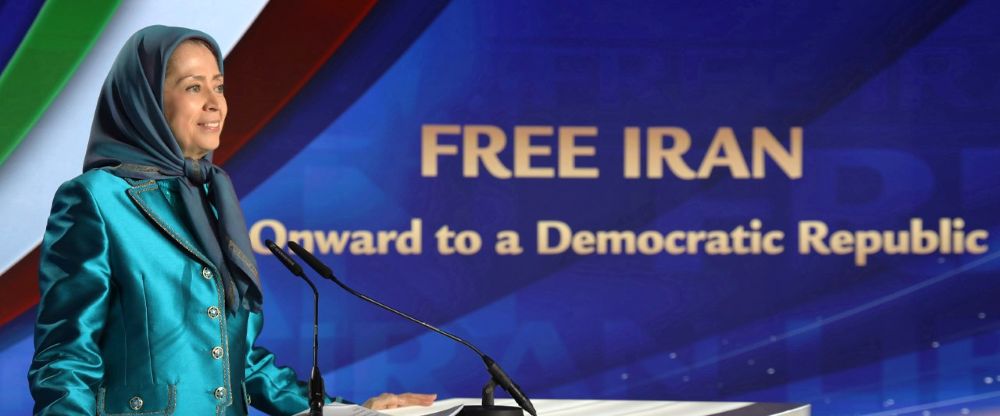
Paris, June 21, 2026 – Speaking on the second day of the Free Iran Summit 2026 in Paris, Mrs. Maryam Rajavi, President-elect of the National Council of Resistance of Iran (NCRI), declared that the only viable solution to Iran’s ongoing crisis is regime change through the organized resistance of the Iranian people.
Addressing an international audience of lawmakers, former officials, and supporters of the Iranian opposition, Mrs. Rajavi commemorated the 45th anniversary of the nationwide resistance that began on June 20, 1981, describing it as a historic turning point in Iran’s struggle against religious dictatorship.
She paid tribute to the thousands of members and supporters of the Iranian Resistance who have lost their lives over the past four decades, emphasizing that the movement remains committed to achieving a democratic republic in Iran.
Rejecting War and Appeasement
Mrs. Rajavi reiterated the Iranian Resistance’s long-standing position of opposing both military intervention and policies of appeasement toward Tehran.
Referring to restrictions imposed on an Iranian opposition gathering in Paris, she praised the thousands of Iranians who traveled to the French capital and said attempts to silence their voices had failed.
She highlighted support expressed by French lawmakers and international dignitaries during the summit, noting that many speakers had endorsed a “third option” for Iran—neither war nor accommodation with the ruling clerical establishment, but support for the Iranian people and their organized resistance.
According to Rajavi, decades of engagement with Tehran have demonstrated that expectations of reform or moderation within the current system are unrealistic.
“The Force for Change Exists”
A central theme of Rajavi’s address was that meaningful political transformation requires an organized force capable of confronting repression.
She pointed to the sacrifices made by the People’s Mojahedin Organization of Iran (PMOI/MEK), citing tens of thousands of members who were executed or killed during the movement’s struggle against the Iranian regime.
Mrs. Rajavi argued that the Resistance Units operating inside Iran have become a key organized force in anti-government protests and uprisings. She described them as networks of committed young activists who continue to challenge state repression despite severe risks.
“The force for change exists,” she asserted, arguing that organized resistance remains indispensable to any democratic transition.
Day 2: Free Iran Summit 2026 – Onward to a Democratic Republic
With a deep knowledge of the nature of the religious dictatorship, supporters of the Iranian Resistance have concluded that backing the democratic alternative is the key to change in Iran and to global peace and… pic.twitter.com/O5oTC0gf4m— Maryam Rajavi (@Maryam_Rajavi) June 21, 2026
Regime at a Political Dead End
Mrs. Rajavi portrayed the ruling establishment as increasingly fragile and isolated.
She argued that Iran’s leadership faces mounting political, economic, and social pressures while being unable to resolve internal crises. According to her assessment, the conditions that fueled previous nationwide protests have intensified, creating what she described as a growing potential for future uprisings.
Rajavi maintained that neither external military intervention nor attempts to manufacture political alternatives from outside Iran can provide a solution. Instead, she said, only the Iranian people and their organized resistance possess the legitimacy and capacity to bring about democratic change.
Highlighting the Resistance’s Role
The NCRI leader also pointed to the Iranian Resistance’s role in exposing Tehran’s nuclear activities, including revelations regarding the Natanz and Arak facilities.
She argued that disclosures made by the opposition over the years helped prevent the regime from advancing unchecked toward acquiring nuclear weapons and demonstrated the movement’s significance as a political force.
Rajavi further presented the resistance as a democratic alternative rooted in principles of religious tolerance, gender equality, and political pluralism.
Vision for a Democratic Republic
A major portion of Rajavi’s speech focused on the NCRI’s proposal for a transitional government following the fall of the current regime.
She said the Provisional Government announced by the NCRI would be tasked with transferring power directly to the Iranian people and organizing free elections for a constituent assembly within six months.
According to Rajavi, the assembly would then draft and adopt the constitution of a new democratic republic.
“We do not seek power for ourselves,” she said, stressing that the objective is to transfer sovereignty from dictatorship to the Iranian people.
Day 2: Free Iran Summit 2026 – Onward to a Democratic Republic
Today, at one of the most critical junctures in Iran's history, the decisive question is: What is the solution to the crisis? How can—and how must—this regime be brought down?For years, when the Iranian Resistance… pic.twitter.com/fjENXRyWfB
— Maryam Rajavi (@Maryam_Rajavi) June 21, 2026
Criticism of Monarchist Alternatives
Mrs. Rajavi also criticized supporters of restoring Iran’s former monarchy, arguing that they do not represent a democratic solution.
She accused monarchist groups of contributing to divisions within the opposition and rejected proposals that would rely on elements of Iran’s existing security and military apparatus to facilitate political change.
According to Rajavi, the Iranian people have already rejected both forms of dictatorship represented by the Shah and the ruling clerical establishment.
“There is no room for the Shah and the Sheikh,” she said, reiterating the NCRI’s commitment to a democratic republic.
“Peace and Freedom Will Prevail”
Concluding her speech, Mrs. Rajavi summarized the NCRI’s objectives as the establishment of peace, freedom, and popular sovereignty in Iran.
She reaffirmed the movement’s support for any genuine agreement that reduces tensions and alleviates the suffering of the Iranian people while insisting that the regime’s policies of regional intervention and pursuit of strategic power are inseparable from its survival strategy.
Mrs. Rajavi concluded by expressing confidence that Iran’s future would ultimately be determined by its people and organized resistance movement.
“Peace and freedom will prevail in Iran,” she declared.
As I have repeatedly said:
The overthrow of the religious dictatorship, and the achievement of freedom and a democratic republic, are the responsibility of ourselves, our people, and the National Liberation Army.
Peace and freedom will prevail in Iran.https://t.co/852TFGeelx— Maryam Rajavi (@Maryam_Rajavi) June 21, 2026