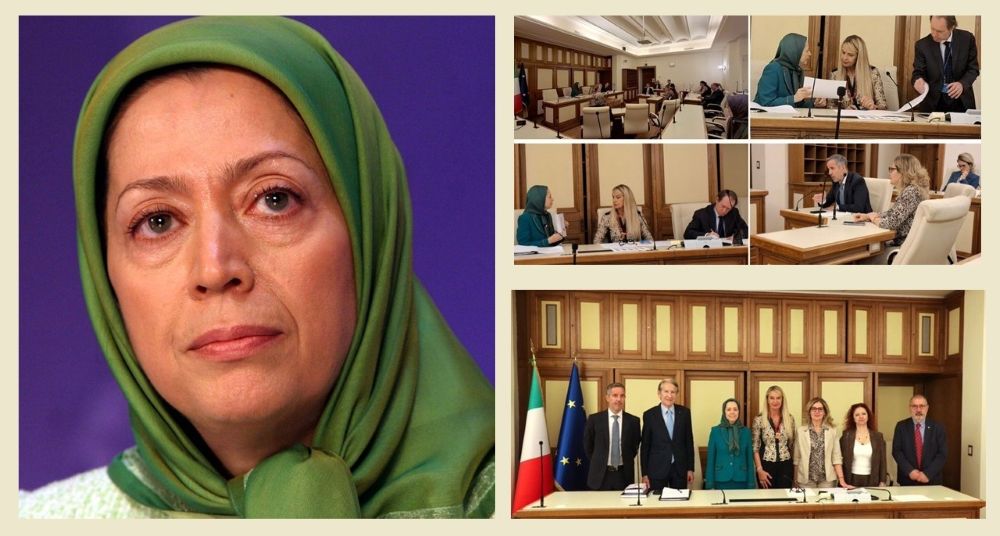
Mrs. Maryam Rajavi, President-elect of the National Council of Resistance of Iran (NCRI), addressed the Human Rights Commission of the Italian Senate, expressing her appreciation for the commission’s continued attention to the human rights crisis in Iran.
In her address, Maryam Rajavi stated that when she had previously appeared before the commission, she had described the scale of repression and the systematic dismantling of freedoms by Iran’s ruling religious dictatorship. She said that during the following year, the assault on the fundamental rights of the Iranian people had intensified.
She referred to executions, arrests of dissidents, and political repression, stating that the regime had used regional conflicts and crisis conditions to expand its crackdown against opponents and increase political executions.
Address to the #HumanRights Commission of the Italian Senate
The Iranian people and their Resistance look to Italy—historically a global pioneer in the movement to abolish the death penalty—to lead the way within the European Union in spearheading decisive measures against the… pic.twitter.com/BTzZMLN7IF
— Maryam Rajavi (@Maryam_Rajavi) July 16, 2026
Executions and Political Repression Against Dissidents
Maryam Rajavi stated that dozens of political prisoners, including members of the People’s Mojahedin Organization of Iran (PMOI/MEK) and other young activists, had been executed after being accused of participating in protests. She said that the authorities had refused to return the bodies of executed prisoners to their families, leaving relatives without information about their final resting places.
She also referred to the continued issuance of death sentences, including the case of Arghavan Fallahi, whom she described as having endured months of solitary confinement and torture while her father remained imprisoned.
According to Maryam Rajavi, executions are politically motivated and intended to create an atmosphere of fear to prevent renewed protests. She stated that the judicial process denies due process and violates international law.
Restrictions on Justice and Fair Trial Rights
Maryam Rajavi stated that the Iranian judiciary and security institutions have systematically undermined citizens’ access to justice. She referred to legal assessments concerning restrictions on lawyers, political prosecutions, interference by security bodies, and the weakening of independent legal representation.
She said that these measures had deprived Iranian citizens of the right to a fair trial and had created a system where judicial procedures were used as instruments of repression.
Internet Shutdowns, Crackdowns, and Suppression of Protests
In her remarks, Maryam Rajavi referred to missile and drone attacks against bases of Iranian Kurdish parties and described the nationwide internet shutdown imposed during protests as a major tool of censorship and control.
She stated that during the uprising, Ali Khamenei had ordered the suppression of protesters and that security forces, including the Islamic Revolutionary Guard Corps (IRGC), had killed protesters and carried out mass arrests.
She added that despite repression, families of victims and protesters had transformed mourning ceremonies into acts of resistance against the authorities.
International Silence and Accountability for Human Rights Violations
Maryam Rajavi criticized what she described as international silence regarding political executions in Iran. She referred to decades of impunity and highlighted the 1988 massacre of political prisoners as one of the most serious unresolved cases.
She cited a 2024 report by the UN Special Rapporteur on Iran, which addressed severe human rights violations and crimes committed against Iranian citizens.
She stated that Iranian authorities have not published a complete list of victims of the 1988 massacre or revealed burial locations, while the Iranian Resistance has documented names and information related to those killed.
“The Struggle for Liberty and Human Dignity Continues”
Maryam Rajavi highlighted the cases of political prisoners who were executed and stated that the charges brought against them reflected their opposition to what she described as religious tyranny and their defense of freedom and justice.
She mentioned Pouya Ghobadi and Vahid Bani-Amerian among those executed, describing their final statements as expressions of commitment to freedom and resistance.
She stated that executions and repression had failed to eliminate the resistance movement and that Resistance Units across Iran continued their activities.
Calls for Italy and the European Union to Take Action
Maryam Rajavi called on Italy, which she described as having a historic role in the movement to abolish the death penalty, to take a leading role within the European Union in responding to executions and human rights violations in Iran.
She called for:
- Conditioning diplomatic and trade relations with Iran on ending executions.
- Prosecuting those responsible for human rights violations under universal jurisdiction.
- Referring Iran’s human rights violations to the United Nations Security Council.
- Ensuring access for UN fact-finding missions and special rapporteurs to Iranian prisons and political prisoners.