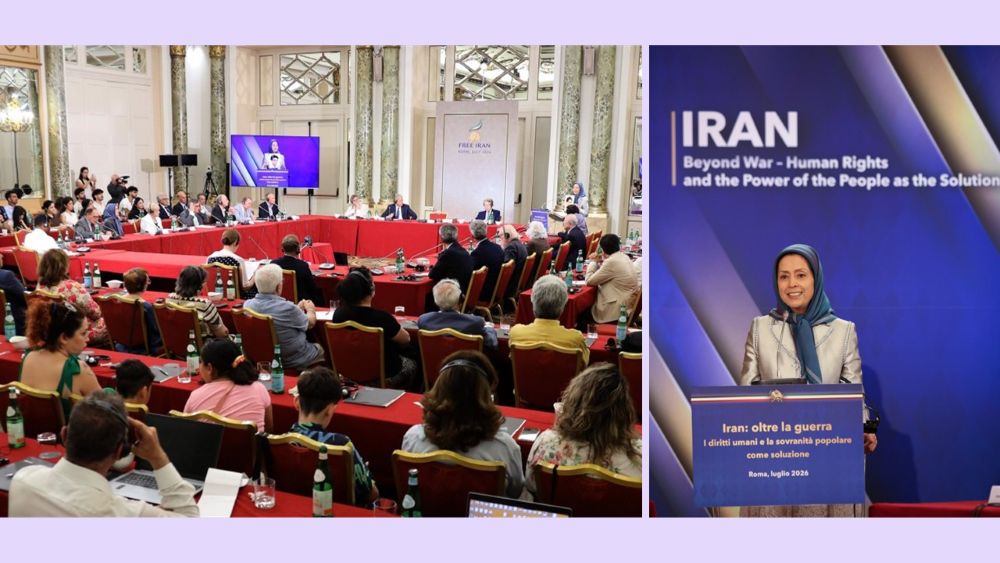
NCRI President-elect says neither preserving the current regime nor restoring the former monarchy can resolve Iran’s crisis
ROME, Italy — July 17, 2026 — Mrs. Maryam Rajavi, President-elect of the National Council of Resistance of Iran (NCRI), addressed the conference “Iran Beyond War, the Power of the People as the Solution” in Rome, presenting her assessment of Iran’s current crisis and outlining what she described as the path toward a democratic republic founded on popular sovereignty.
Mrs. Rajavi said that developments in Iran since the 1979 revolution have had profound regional and international consequences, citing the hostage-taking at the U.S. Embassy, the Iran-Iraq war, the rise of the nationwide resistance against clerical rule, the massacre and execution of political prisoners, the regime’s pursuit of nuclear weapons, its interventions across the Middle East, and acts of transnational terrorism, including the assassination of Mohammad Hossein Naqdi, the NCRI’s representative, in Rome.
Addressing the question of resolving Iran’s crisis, Mrs. Rajavi said the solution lies neither in preserving the current system nor in restoring the former monarchy, but in establishing a democratic republic. She stated that both the current and former dictatorships had reached historical and political dead ends, making their continuation impossible.
Address to the Conference: “Iran Beyond War, the Power of the People as the Solution”
What is the Solution to the Iranian Crisis?
Without a doubt, the solution lies neither in clinging to the present status quo by preserving this regime, nor in retreating to the past by reviving… pic.twitter.com/2tRWcHk2Qg— Maryam Rajavi (@Maryam_Rajavi) July 17, 2026
Mrs. Rajavi said the clerical regime survives by repressing its own people and engaging in foreign conflicts, while continuing its pursuit of nuclear weapons and missile programs. She stated that these policies are inseparable from the regime’s system of governance and said no viable solution can be envisioned short of its overthrow.
Mrs. Rajavi identified widening socioeconomic inequality, chronic poverty, unresolved economic, social and environmental crises, the erosion of the regime’s strategic foundations, intensifying internal divisions, and the existence of an organized nationwide resistance as factors that have created the conditions for change in Iran. She said these realities demonstrate that organized resistance and popular uprisings constitute the path toward political change.
Mrs. Rajavi said a viable alternative must possess three essential characteristics: the determination to confront the Islamic Revolutionary Guard Corps (IRGC), deep roots within Iranian society while remaining independent of foreign governments, and a highly organized structure composed of committed members prepared to make sacrifices in pursuit of change. She said the People’s Mojahedin Organization of Iran (PMOI/MEK) and its Resistance Units embody these characteristics.
Referring to recent activities, Mrs. Rajavi said the Resistance Units carried out 630 operations during the January 2026 uprising. She also said that on February 23, five days before the recent conflict, 250 members conducted an operation targeting Khamenei’s headquarters in Tehran. According to Mrs. Rajavi, the Resistance Units have evolved into units of a liberation army, and the regime regards the combination of organized resistance and public protests as its greatest challenge.
Mrs. Rajavi said the Iranian Resistance seeks to reclaim the people’s right to popular sovereignty without relying on foreign governments or external intervention. She said the provisional government announced by the NCRI exists to implement the Resistance’s Ten-Point Plan, which calls for a republic based on the separation of religion and state, gender equality, autonomy for oppressed nationalities, and a non-nuclear Iran.
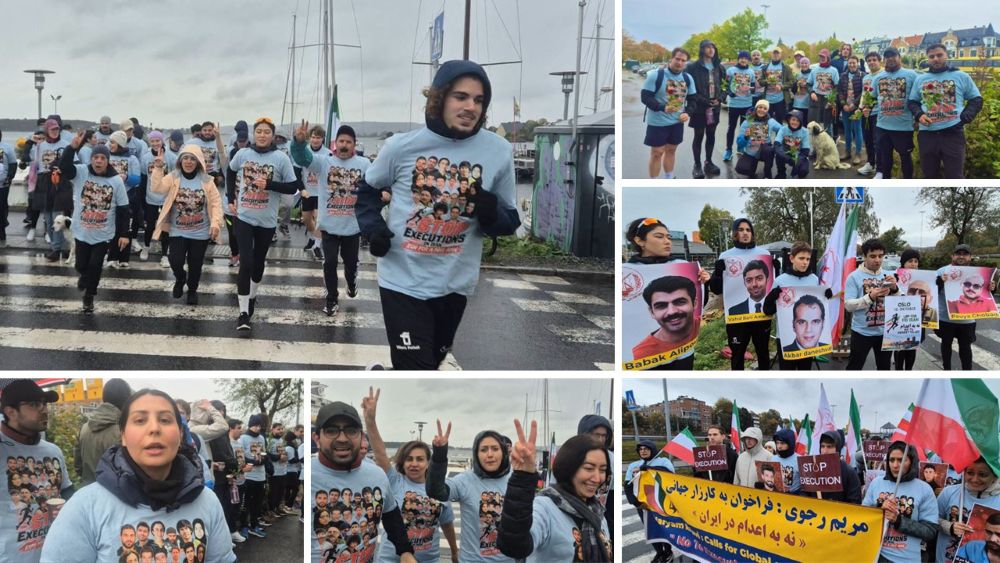
Mrs. Rajavi described the plan as the product of decades of sacrifice, referring to the deaths of 100,000 PMOI members and supporters. She also cited the case of 25-year-old Arghavan Fallahi, who she said endured months of solitary confinement and torture while her father remains imprisoned.
Marking the approaching 38th anniversary of the 1988 massacre of political prisoners, Mrs. Rajavi said more than 30,000 prisoners were executed under a decree issued by Ruhollah Khomeini, with more than 90 percent identified as PMOI members. She also referred to the execution of Babak Alipour in Ghezel Hesar Prison and quoted a message attributed to him stating that unconditional freedom, equality, justice, and the overthrow of the current regime are inseparable.
Mrs. Rajavi concluded by saying that the determination of successive generations of Iranians to pursue freedom would shape the country’s future. She also paid tribute to Maestro Reza Olia, a member of the National Council of Resistance of Iran and a supporter of the Iranian Resistance in Italy, following his recent death.
We have not sat in idle anticipation, waiting for foreign powers or external governments to bring change to Iran. Instead, we have risen to reclaim what is fundamentally ours: the right to popular sovereignty, and the right of our people to dignity and freedom.
This vision is… pic.twitter.com/u6EkNt4kRJ
— Maryam Rajavi (@Maryam_Rajavi) July 17, 2026