Maryam Rajavi addresses the 38th anniversary of Iran’s 1988 massacre and calls for international action on political executions.
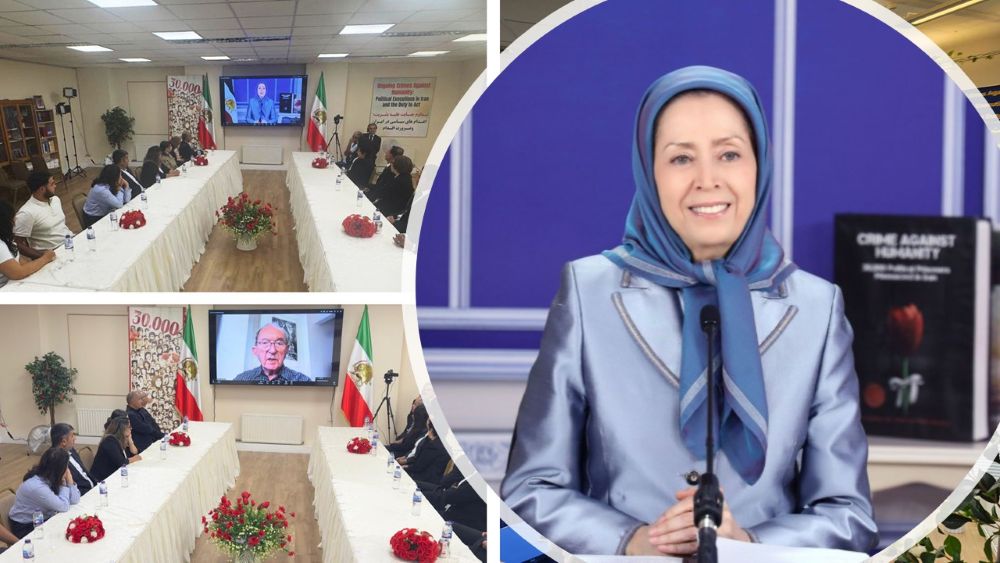
September 4, 2026 — Mrs. Maryam Rajavi, President-elect of the National Council of Resistance of Iran (NCRI), addressed the conference seeking justice for victims of the 1988 massacre in Iran in a message marking its 38th anniversary.
In her message, titled “The Movement for Justice is an Integral Part of the Struggle of the People of Iran to Overthrow the Clerical Regime,” Mrs. Rajavi addressed the 1988 executions, the current wave of political executions, and calls for justice and accountability.
The 1988 Massacre of Political Prisoners
Mrs. Rajavi said that the order issued by Ruhollah Khomeini called for the execution of PMOI prisoners who remained firm in their beliefs. She said the executions later included other political prisoners, while 90 percent of those executed were affiliated with the PMOI.
She recalled that in August 1988, Massoud Rajavi, the leader of the Iranian Resistance, wrote to the UN Secretary-General, citing information that Khomeini had issued a handwritten order for the execution of political prisoners who supported the PMOI.
Mrs. Rajavi also cited the late Baroness Boothroyd, who described the 1988 massacre as the largest massacre of political prisoners since the Second World War. She referred to Professor Javaid Rehman’s 2024 description of the massacre as a crime against humanity and genocide.
Mrs. Rajavi said that the world remained silent and failed to act, and that those who ordered and carried out the massacre have enjoyed impunity.
The Pattern of the 1988 Massacre Is Being Repeated
Mrs. Rajavi said that new human rights crimes are following the same pattern. She referred to the killing of protesters during the January 2026 uprising and said the regime subsequently used the conditions of war to begin a new wave of executions, amid concerns about another uprising.
She said that, as in 1988, the current situation involves the brutality of the regime and the resistance of political prisoners who remain firm in their beliefs.
Mrs. Rajavi referred to Vahid Bani Amerian, who was recently executed. She cited his statements from inside prison, including his declaration that more people would rise if he and others were executed and that his regime would not escape being overthrown.
She also cited Bani Amerian’s response when he was asked to express regret to avoid execution. He said he would not bargain over his life for the freedom of Iran.
Mrs. Rajavi also referred to Pouya Ghobadi, another political prisoner who was recently executed. She cited a letter he wrote from prison ten days after the January 2026 uprising began, in which he said he would have considered it his duty to fight alongside protesters if he had been outside prison.
Mrs. Rajavi said these were not isolated examples and represented Iran’s young generation. She stated that at least 40 political executions had taken place in recent months and that many more prisoners were awaiting execution.
Efforts to Terrorize the People
Mrs. Rajavi said the executions were being carried out in violation of international law and due process. She said their main reason was not the prisoners’ cases but the regime’s need to execute.
She said the remnants of the regime sought to frighten a generation that had entered the struggle to overthrow it.
Mrs. Rajavi stated that the movement for justice is part of the Iranian people’s movement to overthrow the regime and achieve a democratic revolution.
She also said that, as a result of efforts for justice, UN member states had, for the first time, officially recognized the unlawful and arbitrary executions of 1988 in the UN General Assembly’s annual resolution on Iran the previous year.
Mrs. Rajavi described this as an important first step and said that justice requires binding decisions and more serious action.
Justice in the Free Iran of Tomorrow
Mrs. Rajavi outlined commitments in the program of the National Council of Resistance of Iran, including the abolition of the death penalty.
She said the program also calls for an independent justice system and judiciary based on international standards, including the presumption of innocence, the right to public defense, and the independence of judges.
She added that the program calls for the abolition of the mullahs’ religious laws and the dissolution of the so-called Revolutionary Courts.
Mrs. Rajavi said that most of the perpetrators of the 1988 massacre who have been involved in crimes against humanity, genocide, and terrorism during the past four decades are still in positions of power.
Citing Professor Javaid Rehman’s July 2024 report, Mrs. Rajavi called on governments to create an international mechanism to bring those responsible for the 1988 massacre to justice and to use universal jurisdiction to prosecute those responsible.
She also called on governments to make trade and diplomatic relations with the regime dependent on an immediate end to executions and the release of all political prisoners.
Mrs. Rajavi said governments should ensure that every international agreement with the regime includes a binding and verifiable end to executions.
Remembering the Victims
Mrs. Rajavi recalled attending the Last Post ceremony at the Menin Gate in Ypres, Belgium, on December 12 of the previous year, where she laid flowers in memory of soldiers of European nations who have no known names or graves.
She said the ceremony brought to her mind the memory of the 30,000 political prisoners massacred in Iran whose burial places remain unknown.
Mrs. Rajavi said many grieving mothers died while still hoping to find the graves of their children.
Mrs. Rajavi concluded by saying that honoring the victims is also a tribute to the determination of a people who have experienced repeated bloodshed but have not given up their struggle for freedom.