



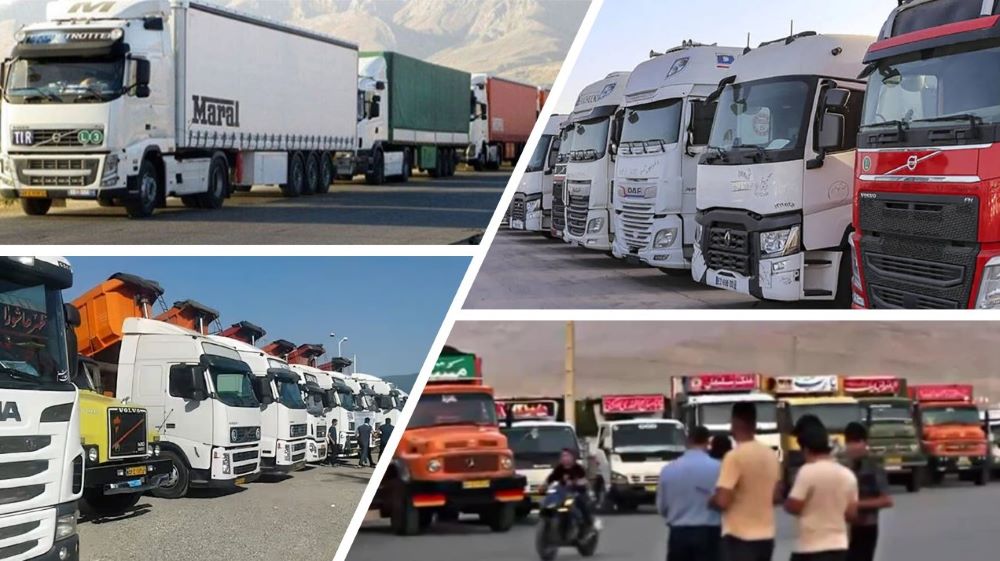
Iran’s Nationwide Truckers Strike Reaches Day 9 Amid Growing Unrest and Crackdown
As of May 30, 2025, the nationwide strike by Iranian truck drivers has entered its ninth consecutive day, marking a historic act of defiance against the clerical regime’s deep economic mismanagement and systemic corruption. Reports from across the country indicate that the strike, which began over a week ago, continues to gain traction, paralyzing key transit routes and exposing the regime’s growing vulnerability. The movement has now spread to more than 140 cities across Iran, underscoring its broad national scope and the depth of public discontent.

From Khorramabad and Dorud in Lorestan Province to Mashhad in the northeast, Shahabad near the Parvizkhan border in the west, and Kermanshah and Isfahan in central Iran, truck drivers are refusing to haul freight in protest of crippling economic pressures.
May 30—Kermanshah, western Iran
Truck drivers continue their strikes for ninth consecutive day as parking lots remain empty and drivers refuse to haul cargo.#IranProtests pic.twitter.com/cRpbl9a42Z— People's Mojahedin Organization of Iran (PMOI/MEK) (@Mojahedineng) May 30, 2025
In Baharestan district of Isfahan, the Malek Ashtar parking lot remains completely deserted—a clear sign of drivers’ commitment despite increasing regime threats.
May 30—Isfahan, central Iran
The Malek Ashtar parking lot in Baharestan district of Isfahan remains empty as truckers continue their strike for the ninth consecutive day.#IranProtestspic.twitter.com/KqjZqQKrNu— People's Mojahedin Organization of Iran (PMOI/MEK) (@Mojahedineng) May 30, 2025
Truckers have listed high insurance premiums, skyrocketing fuel and parts prices, and unrealistic freight rate adjustments as their primary grievances—demands that the regime has consistently ignored. Instead of responding with reforms, the authorities have doubled down on repression. Arrests have been reported in several provinces, and the Islamic Revolutionary Guard Corps (IRGC) has begun deploying its own fleet under the guise of “essential goods transport” to break the strike’s impact.
The regime’s attempts to divide and demoralize the strikers—including offering limited “incentive fuel” and spreading disinformation—have largely failed. Protesters across the country have stood firm, buoyed by growing public solidarity. On May 28, pickup drivers in Neyshabur joined the movement, and even rideshare drivers and other labor sectors have voiced support.
In a statement posted on X, Mrs. Maryam Rajavi, the President-elect of the National Council of Resistance of Iran (NCRI), underscored the broader political and social implications of this growing resistance:
“Today, May 25, 2025, the nationwide truck drivers’ strike entered its fourth day, expanding to at least 86 cities nationwide. At the same time, the voices of protest echoed from retirees in Ahvaz and Kermanshah, farmers in Khuzestan, and shoemakers in Tehran. The hardworking truck drivers declared, ‘We can no longer go on; we are crushed—but we will not stay silent.’ In Sanandaj, repressive security forces attacked the drivers with batons and pepper spray, arresting several of them. Just yesterday in Mashhad, bakers were also targeted with batons and tear gas. But these crackdowns cannot silence the growing wave of dissent—they only amplify it. Uprising and resistance remain the only path to liberation from poverty, discrimination, unemployment, and the regime’s entrenched corruption.”
Today, May 25, 2025, the nationwide truck drivers’ strike entered its fourth day, expanding to at least 86 cities nationwide. At the same time, the voices of protest echoed from retirees in Ahvaz and Kermanshah, farmers in Khuzestan, and shoemakers in Tehran. The hardworking… pic.twitter.com/JSY7pyMxY3
— Maryam Rajavi (@Maryam_Rajavi) May 25, 2025
Her remarks highlight that this movement is not just about freight rates or fuel prices—it is part of a rising tide of national defiance demanding dignity, justice, and democratic change.
This strike is not merely an industrial action—it is a reflection of a broader national crisis. With over 90% of Iran’s freight transport dependent on trucks, the continued paralysis of the transport sector sends shockwaves through the economy. As stated by a state-run publication, Donya-ye-Eqtesad, “If the wheels of transportation stop, the wheels of industry will also come to a halt.”
The government’s heavy-handed response—including arrests, threats of vehicle confiscation, and coercive fuel policies—has only deepened public resentment. Yet, far from silencing dissent, these measures have galvanized more workers and citizens to resist. Statements of support have poured in from teachers, retirees, oil workers, women’s rights groups, and more—underscoring the strike’s resonance as a symbol of national resistance.
On the ground, empty roads and parking lots speak louder than official propaganda. Whether in Mashhad, Isfahan, Kermanshah, or the border regions, the absence of trucks signals the presence of something far greater: a people demanding change.
Iran’s truck drivers have become the face of a broader struggle. As they enter their ninth day of strike action, their courage continues to inspire a population determined to reclaim its dignity, rights, and future from a regime that has long ignored their cries. What began as a strike for economic survival may well evolve into a transformative movement for national liberation.