


This report, originally published on the 1988 Massacre website, details a disturbing development regarding the destruction of graves belonging to executed political prisoners in Iran.
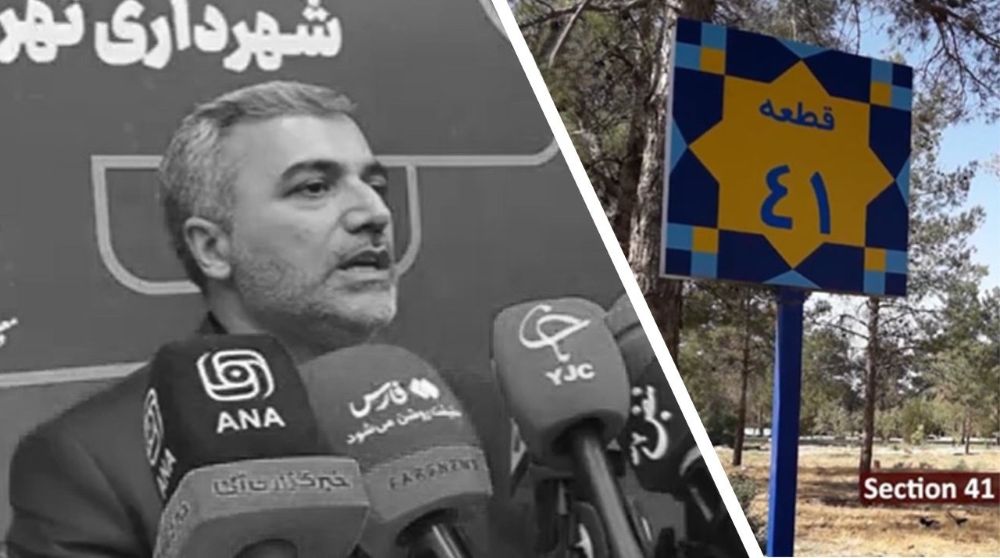
On 11 August 2025, Iranian authorities sent bulldozers and security forces to Section 41 of Tehran’s Behesht-e Zahra Cemetery—one of the most significant burial grounds for thousands of dissidents executed during the 1980s. On 19 August, Tehran’s Deputy Mayor Davoud Goudarzi publicly confirmed that the area had been converted into a car park. He explained that Section 41, where members of the People’s Mojahedin Organisation of Iran (PMOI/MEK) were buried in the early years following the revolution, was “abandoned,” and permission was granted to level the site and repurpose it for parking.
🚨 Tehran’s Deputy Mayor Davoud Goudarzi confirmed today that authorities have converted part of Iran’s largest cemetery—where thousands of executed political prisoners were buried—into a car park.
The regime seeks to erase evidence of its atrocity crimes.
CC: @drmaisato @WGEID pic.twitter.com/jEJHi7Q7hm
— M. Hanif Jazayeri (@HanifJazayeri) August 19, 2025
Similarly, on 16 August, Mohammad Javad Tajik, CEO of Behesht-e Zahra Cemetery, told the state-run Shargh Daily that Section 41—containing the remains of numerous executed PMOI members—had been flattened and turned into a parking lot. When questioned by the reporter, Tajik confirmed that the graves of those executed in the early 1980s were included in the demolition.
Human rights advocates argue this act is a deliberate attempt to erase physical evidence of atrocity crimes and to block efforts aimed at truth and accountability. Justice for the Victims of the 1988 Massacre in Iran (JVMI) has condemned the destruction, urging urgent international action to prevent further violations and safeguard the rights of victims’ families.
Section 41 holds thousands of individual graves, particularly from 1981—a year marked by mass arrests and executions of opposition members. Many buried there were affiliated with the PMOI and other dissident groups. The site is estimated to hold up to 9,500 graves and has long served as a critical place of remembrance for bereaved families. For decades, authorities have tightly controlled the area, restricting access, defacing gravestones, and harassing visitors.
Former UN Special Rapporteur on Iran, Professor Javaid Rehman, has repeatedly raised alarm about the systematic destruction of such sites. In his July 2024 report, he classified the 1988 mass executions as “ongoing crimes against humanity” and even “genocide,” urging universal jurisdiction to prosecute perpetrators. His findings documented similar destruction at both Section 41 and Khavaran Cemetery.
Landmark UN Report Condemns Iran’s 1988 Massacre as Crimes Against Humanity and Genocide
JVMI has called on the UN High Commissioner for Human Rights, Dr. Mai Sato (current UN Special Rapporteur on Iran), and the UN Fact-Finding Mission to independently investigate the demolition. They also urge UN member states to demand an immediate halt to the destruction of burial sites and guarantee unrestricted access for victims’ families.
The organization stresses that the Iranian government must be held accountable for attempting to erase evidence of mass executions. The international community, JVMI asserts, has both a moral and legal responsibility to preserve the memory of the victims and ensure justice is delivered.