




Iran’s Execution Crisis Escalates
|
Iran is experiencing a sharp and alarming surge in executions, particularly targeting political prisoners and individuals linked to the 2026 uprising. Executions in Iran are often carried out following charges such as “enmity against God” (moharebeh) or “corruption on earth,” which are broadly defined and frequently used against political dissidents and protesters. Recent reporting from the National Council of Resistance of Iran (NCRI) confirms that at least 10 political prisoners were executed between March 19 and April 4, including members of the PMOI/MEK and protest detainees. These cases often involve trials that fall short of international legal standards, with limited access to legal representation and reliance on confessions reportedly obtained under duress. In parallel, Iran Freedom reports a renewed wave of executions, warning that thousands arrested during the January uprising remain at risk, many subjected to torture and forced confessions. Human rights organizations have long documented patterns of incommunicado detention, coerced confessions broadcast on state media, and expedited judicial proceedings in politically sensitive cases. This pattern signals a systematic campaign of repression aimed at preventing another nationwide uprising, using capital punishment as a tool to deter dissent and maintain control over a restive population. |
Watch the LIVE broadcast for real-time updates, testimonies, and urgent briefings from the Iranian Resistance.
|
|
Take action now: Share this message, contact policymakers, and help amplify the call to stop these executions. The time to act is now. Silence enables executions. Visibility can save lives. |
The time to act is now. Silence enables executions. Visibility can save lives. |


Paris Rally – April 11
|
|
Join the “Peace and Freedom” rally in Paris, organized by Iranians and democracy advocates, supporting regime change and a secular democratic republic. This global movement shows: the executions will not be met with silence |
Latest Cases: A Pattern of Repression
|
|
Recent developments illustrate the scale and brutality of the crackdown: |
According to international reporting, over 145 executions have already been recorded in 2026, with many more feared unreported. |
A Systematic Strategy of Fear
|
|
This is not a series of isolated incidents—it is a coordinated state policy. |
Experts warn this trajectory mirrors past mass executions, raising fears of a new large-scale political purge. |


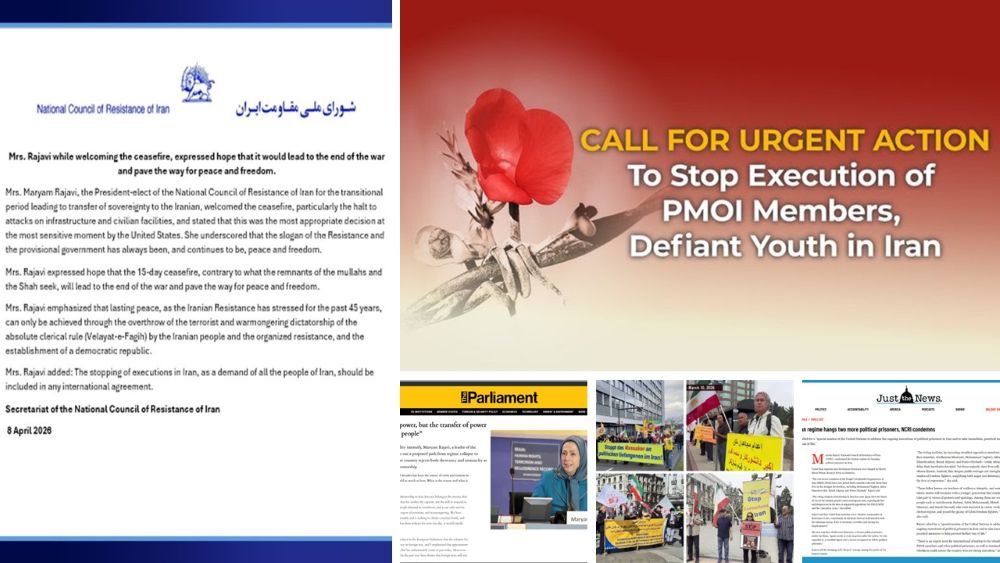
Global Rallies Across U.S., Canada, and Europe Condemn Execution of PMOI Political Prisoners |
|
Supporters of the Iranian Resistance held coordinated demonstrations in major cities across the United States, Canada, and Europe from March 30 to April 5, 2026, condemning the recent executions of six political prisoners affiliated with the People’s Mojahedin Organization of Iran (PMOI/MEK) as human‑rights violations and urging international governments to adopt firmer policies toward the Iranian regime and support the Iranian people’s pursuit of freedom and democracy. |


Maryam Rajavi Welcomes Ceasefire, Urges Path Toward Peace and Freedom |
|
Maryam Rajavi welcomes the ceasefire as a timely step to end the war and protect civilians, while emphasizing that lasting peace and freedom in Iran require the overthrow of the ruling clerical regime and the establishment of a democratic republic. |

.jpg)
Iranian Regime Hangs Two More Political Prisoners, NCRI Condemns |
|
The article reports that the Iranian regime executed two additional political prisoners affiliated with the PMOI/MEK in Ghezel Hesar Prison, and Maryam Rajavi, on behalf of the National Council of Resistance of Iran (NCRI), strongly condemned the hangings, calling for a special United Nations session to halt further executions and denounce the regime’s repression. |


“We Seek Not Power, but the Transfer of Power to the Iranian People” |
|
In this interview, Maryam Rajavi outlines a post-regime roadmap centered on overthrow by the Iranian people and resistance, followed by a short transitional government that organizes free elections within six months to establish a democratic republic rejecting both theocracy and monarchy. |

.png)
|
The situation in Iran demands urgent and decisive action. We call on:
Silence enables repression. Action saves lives. |
|
Thank you for standing with the Iranian people in their courageous struggle for freedom and democracy. Every voice, every action, and every share helps amplify their fight for justice. Stay informed, stay engaged, and continue supporting the movement for a free and democratic Iran. Share the Message Help amplify the voices of the Iranian people by sharing this update with your network. Together we build the future — a free and democratic Iran. Iran Freedom Network Advancing democracy, human rights, and freedom for Iran |